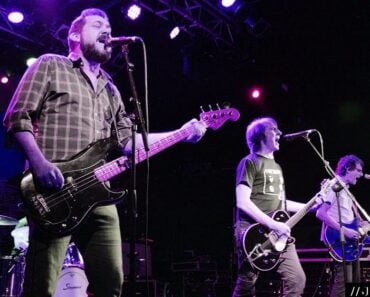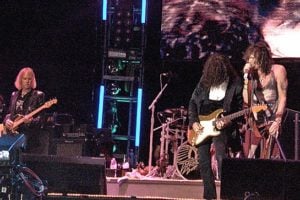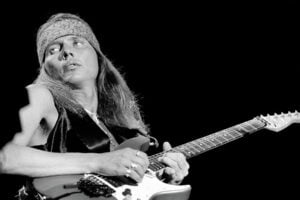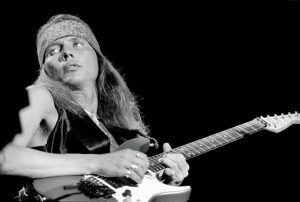
Feature Photo by David Ilzhoefe
Dawayne Bailey played with Bob Seger from 1983 to 1986 and was with Chicago for a decade after that, but he gives himself zero grace. “I’m very brutal about myself and my time with both bands,” he tells ClassicRockHistory.com.
“But at the end of the day, I was incredibly humbled and grateful to be given the chance to play with both,” he says. “As they say, ‘Ya live and ya learn.’ The good thing is that you can correct the mistakes you made years ago… and have fun doing it.”
It’s a good outlook to have, considering Bailey intends to keep at it. For that reason, he’s made peace with his regrets. “The good news with regrets is you can turn it around,” he says. “My goal is to write better songs, and just do what I’ve been good at since my teen years: play instrumental guitar music.”
How did you end up with Bob Seger’s Silver Bullet Band?
In 1982, I was also playing in a club band with my friend Janis Liebhart on vocals. Janis brought a friend of hers, an engineer named Hill Bren Swimmer, to one of our club gigs. As I was preparing to record my solo record, 45 Revenge of the Nerds, I brought in Janis to do lead vocals and hired Hill Bren Swimmer to engineer the record at Rumbo Recorders.
We finished that record, and I kept playing gigs with my club band, and out of the blue, I got a phone call from Hill Bren Swimmer asking if I wanted to make 40 bucks answering phones for Bob Seger, as they were all working on Seger’s new album at Rumbo Recorders for The Distance album.
So, I drove there on a Sunday afternoon and played secretary for Bob Seger. I answered calls from Don Henley and various other friends of Seger that day, and Jimmy Iovine sent me over to Ralph’s to get him some quarters so he could play the pinball machine in the studio lounge.
The following year, after I had been hired to play guitar with Seger, we were going on stage to a sold-out crowd at The Forum in LA. Jimmy Iovine was there, and I walked up to him before we went on stage and asked him if he wanted me to get him some quarters. [laughs] He looked at me really close and shouted, “Oh, hey, that was you at Rumbo!”
How did that lead to you actually joining Bob’s band?
After I answered phones for Seger on that Sunday, I got another call from Hill Bren Swimmer a couple of weeks later, and he asked if I wanted to audition for Seger on guitar. I was totally shocked; it was so surreal. I asked him when the audition was and if it was in a couple of days.
He said, “No. Probably a couple of months from now. But go buy all of his albums and learn all those songs…” I told him, “Bro… I can’t afford to buy all those albums. I’ve got two little kids here I gotta feed.” Then I said, “Besides, I’m sure Bob’s gonna hire some big-time guitar star by then. Why bother? I don’t stand a chance.”
But you did audition, right?
Around that same time, I had filmed a TV show for NBC called Fantasy, in which my band backed up actress Ann Jillian and singer Clint Holmes for an episode that would air a couple of months later. In late January of 1983, that TV show aired, and I was at home watching it.
It was the very first time I had ever appeared on national TV, and it was quite a moment for some hillbilly hick from the sticks. So, I watched it, saw my band with Ann and Clint, and thought, “Wow…how fun was that!”
Literally five minutes after that show was over, my phone rang, and it was Hill Bren Swimmer, asking if I had bought all those Seger albums he had told me about a couple of months before. He said, “You’d better know those songs because Seger’s office is gonna call you in five minutes, and I told them you know all his stuff…”
I told him, “I didn’t buy the albums, but I used to play along with ‘Ramblin’ Gamblin’ Man,’ when I was a kid, and I’ve heard all his hits on the radio over the years. So yeah, bro, I know that stuff.” And sure enough, Seger’s office called from Detroit, saying, “We’ve been told that you know all of Bob’s material. Can you fly out to Detroit tomorrow?”
What did you tell them?
Without blinking, I told them, “Yes, I know all his songs, and yes, I can fly out tomorrow.” I didn’t know all his songs. I had no cash. I had no luggage. I had no winter coats, and it was seriously freezing in Detroit. Plus, I had no road cases for my guitar—and I had no babysitter for my two kids, as I was their babysitter during the day. They were only two and four.
So, what did you do?
That night, I drove to my friend Janis’s house to tape some Seger albums onto cassettes to listen to on the plane to Detroit the next day, using a Walkman. Some way or the other, I pulled it all together enough to get on that plane with my ’58 Strat with a ’62 rosewood neck with no winter coat, and I crammed my homework into my ears for the entire plane ride.
I got off the plane in Detroit, and my cheesy homemade road case was destroyed, but the guitar made it in one piece. So, off I went to the hotel they had booked for me, and it was freezing ass cold outside. I stayed in all night working on Bob’s music.
How did the actual audition go?
The next day. I arrived at the Royal Oak Theater to meet Bob Seger & The Silver Bullet Band and their crew, including the guitar tech. Seger loved Boogie amps, so they plugged me into a small 1×12 Mesa/Boogie with my old, beat-up Fender Strat and no pedals.
It was straight into the amp, and I was straight from my little crib back home in L.A., standing there surrounded by all these millionaire rock legends. It was Seger and his band, along with Don Brewer and Craig Frost from Grand Funk Railroad.
And then there was me, with no winter coat, standing there with my Strat, knowing many.
of the songs, but not in much detail as far as the actual correct guitar parts to all those songs. I just knew basic chords and had basic overall memory of those monster Seger classics we all know and love.
But we played together, the band and me. We did “Hollywood Nights,” “Night Moves,” “Mainstreet,” Old Time Rock ‘N’ Roll,” “Her Strut, “The Fire Down Below,” and so on. I’ve always been deep into jazz-fusion, Zappa, Adrian Belew, Steve Vai, and prog, and here I was trying to keep everything as simple and solid as possible. [laughs]
Did Bob like your playing?
It seemed like Bob was okay with my playing. There was even a moment where, after I took a solo on “Mainstreet,” Bob and the entire band just stood there clapping over my solo. It felt amazing and was a much-needed boost in confidence.
So, the next song, I took a solo and really let it rip in my usual, fast, frantic fusion kind of way… and Bob stopped the band. He walked over to me and walked me out into the empty audience of the theater, stood there next to me, and said, “Bailey, ya know… you were doing so well up to that point. Just relax and keep it simple, and not so many notes.”
Were you able to recover?
In my head, I could tell I probably blew it, and he would send me back to L.A. We played a few more songs, and I did my best to stay slow and simple, sticking to the script. I was so green and had never played with such a famous band or played in such a pro situation. I was so out of my league here, but I struggled on through and did my best.
But Bob was also very interested in the fact that I played pedal steel after I told him I played in country bands back home in Kansas. They asked if I could stick around for a few days and hang back at the hotel. Bob said he would call me himself to let me know his decision on Thursday at 6 pm.
And sure enough, a man of his word, he did just that. Right on the dot at 6 pm, the phone rang in my hotel room, and it was Bob Seger on the phone. I answered and held my breath, and heard him say, “Bailey, you be the one!” At that exact moment, I heard the news that I was going to be Bob Seger’s new guitarist, direct from the man himself.
Considering your modest background, how did you take the news?
I was literally in shock. A few months before, when I was at a Gerard McMahon rehearsal, I had already heard about the Bob Seger audition. Knowing our drummer and bass player were both from Detroit, I asked them what kind of guy Bob was to work with and for.
The drummer laughed and said, “Why, dude? Are you gonna try to audition for Bob
Seger?” I said, “No. I just heard his song on the radio on the way here and wondered what kind of guy he was to play with…” The drummer said, “Well, don’t worry… Seger would never hire you. You’re way too jazz for him, and you wear your guitar way too high.
He said, “You are just not rock enough for Bob Seger.” And it was that drummer who was one of the very first people I called to let them know I would not be able to stay in Gerard’s band because I was the new guitar player for Bob Seger & The Silver Bullet Band.
How did your rig change once you got rolling with Bob?
Seger hired me in late January 1983. With gear, I was incredibly naive and green and not very up to date on great gear, how to use it, or how it all worked, even though I had been playing guitar and in bands since I was a kid. But I had my Fender Strat, and I also used an early ‘70s Gibson L5-S with low impedance pickups.
And then, I had an early ‘70s Fender Twin Reverb amp, a Ross Distortion pedal, and a Morley wah. That was it. I had never played through Hiwatts, Marshalls, or Mesa/Boogies. I simply had that little Fender Twin Reverb and a couple of pedals.
But as soon as Bob hired me, he let me know he did not like my old Strat. He also asked me to use a Mesa/Boogie 1×12 combo amp. I also bought a new Mesa/Boogie 4×12 cab as an extension speaker. I didn’t really know what in the hell I was doing, but one thing is
for sure… that amp with that 4×12 was loud as a mother fucker. [laughs]
What did you get to replace your Strat?
I had a blue Performance Strat that Bob called “Ole Blue.” It was made by Performance Guitars in Hollywood. I also had my handmade Gordon Van Ekstrom Strat. And we went to the Gibson factory in Nashville, and they gave me an amazing flame top Les Paul.
Really beautiful and mine weighed about 100 freakin’ pounds! It was outrageously heavy. [laughs] I put some Seymour Duncan JB humbuckers in there, and Bob did not like my tone at all. So, when we played in St Louis, I called up Silver Strings vintage guitar shop.
They brought down a bunch of gear to our soundcheck the next day. I played a bunch of guitars until Bob let me know he loved a beautiful red 1961 Gibson ES-345. I played that for the rest of the tour, and those super-sweet vintage PAF humbuckers sounded so tasty.
What was it like recording the Like a Rock album?
Bob has a studio in a house behind his main home. Bob would fly us to Detroit to start work on those Like a Rock songs, and during the early stages, I would play the gear Bob had there in his home studio. He had a sunburst Les Paul Custom that he asked me to play through a Mesa/Boogie.
And I brought in my vintage Guild D-40C acoustic to use on the song “Like A Rock.” We worked on at least a dozen songs in his home studio, and after we recorded them, he would give us copies to take home to prepare for the actual sessions at Criteria Studios in Miami the following year.
As for guitar solos, I never reached that stage with Bob. That would have been overdubs, and I only played on basic tracks with Bob. Bob almost always uses different players in the studio, completely different bands. Then, when it’s time to choose which recordings will be used, he’d choose his favorites, and all the other recordings never see the light of day.
How much of your playing actually made it onto Like a Rock?
So, after all the recording we did, he only released one song that I played on, and that was the title track, “Like A Rock.” Rick Vito overdubbed the slide guitar solo on that song at Rumbo Recorders in Canoga Park, CA.
I only play acoustic on “Like A Rock.” When I got to the studio that day, Bob handed me a really beautiful vintage sunburst Gibson J-200. He said it was a gift from Don Henley… you can see Bob playing that same J-200 in his “Night Moves” video.
But actually, there was a second song along with the title track that I’m on, which was a cover of “Fortunate Son,” but it only appears on the CD version of the album as a bonus track.
Why did you leave Bob’s band to join Chicago?
Bob hired me in February 1983. I stayed until February 1986, so it was only a three-year run. Bob replaced Mark Chatfield and me with Rick Vito and Fred Tackett. As much as I loved playing with Bob and his band, I don’t think I was a great fit. I was just so green with gear, and with knowing what Bob loved with great guitar parts and overall attitude.
Bob has such an amazing choice of players to choose from, and deserved the perfect fit for his music and tours. I was a bit of an oddball and just too inexperienced, but I truly appreciated him giving me a chance. That was my very first taste of “the big time,” and boy… that’s a helluva way to hit the big time.
What made you a better fit with Chicago?
So, when Chicago hired me, I knew I had to deliver the guitar tones used on their albums, but I had my work cut out for me on many levels. Not only their amazing chops and parts, but they were all using Bob Bradshaw racks full of incredibly expensive parts.
rack gear at that time.
Not only did I not own any of that kind of stuff, but I also didn’t know how in the hell to program it or how it all worked. I was totally in the dark and totally out of my league… just like with Bob Seger. I was struggling to fit in and be “one of the L.A. session gang.” I was so out of the loop and the L.A. studio clique.
Were you able to catch up?
I slowly got used to all that stuff and eventually tweaked it to my liking, and I finally gained a bit of confidence and experience. It was a slow process, but I had to move fast and learn on the job. I was amazed they gave me that time to experiment and stumble along the way.
As for me fitting in with Chicago… boy, that’s a joke. [laughs] Chicago is the kind of band with serious hardcore fans of its former members. I could write a book on that topic alone. The fans are brutal when it comes to their love and devotion to such a monster legend talent as Terry Kath.
But when I joined the band, I was totally blind and stupid about what the hell I was getting myself into. I was expected to stand over in Terry Kath’s spot on stage and in the studio. What the fuck was I thinking? [laughs] And those fans will not let you live it down either. [laughs]
There does seem to be a legion of fans who felt you were not a good fit for Chicago.
One of the biggest regrets I’ve had of all time was not focusing on sticking to the Terry Kath method of staying true to his guitar parts, solos, and tone. I spent too much time focused on ‘80s shred guitar when I didn’t even possess the true chops to pull that stuff off.
My tapping skills were nonexistent. I was sloppy, off time, lame, and just downright.
half-assed and weak. I cringe when I watch those videos of me struggling to play that style of shred guitar. You either have it or you don’t, and I did not.
And to make it worse, I neglected to stick to the Terry Kath script. So, I’m sorry, but I agree with many of those fans who always preach that I was a horrible fit for Chicago. If I had it all to do all over again, I would have seriously stayed true to Terry Kath’s style, attitude, and tone.
I would have stayed authentic to the music of Chicago instead of playing the selfish card and trying to inject too much of my own personality and style… and too much ‘80s shred crapola. I feel like I wasted everybody’s time, and my own life and career. I’m sorry to be so harsh and brutal. After all these years, this is how I feel about my decade with Chicago.
Is that essentially why you left Chicago?
Oh, let us count the reasons why we parted ways. There were some very personal reasons I don’t care to discuss in the media. Best to remain private and personal, but as for other reasons, I have to say I was shocked and extremely pissed off that they refused to release our Stone of Sisyphus project and do a big band album instead of World War II cover tunes.
What are you getting into these days?
I’m just trying to be myself and follow my dreams, my heart, and visions of what I do best and what makes me happy. Much of that is writing a lot of solo guitar music that’s similar to the solo guitar piece I used to play in Chicago concerts called “Darian.”
As for what’s next, I’ll be playing more live gigs and not isolating and woodshedding so
much. I want to be true to myself, stay authentic, give people the best I can, and have fun doing it. The rest will take care of itself.
Check out similar articles on ClassicRockHistory.com Just click on any of the links below……
An Interview With Chris Pinnick, Formerly Of Chicago
Tony Obrohta of Chicago: 10 Albums That Changed My Life
Read More: Artists’ Interviews Directory At ClassicRockHistory.com
Read More: Classic Rock Bands List And Directory
Read More: 100 Essential Albums From The 1960s That Everyone Should Own
Dawayne Bailey, formerly of Bob Seger’s Silver Bullet Band and Chicago, article published on ClassicRockHistory.com© 2026
Classicrockhistory.com claims ownership of all its original content and Intellectual property under United States Copyright laws and those of all other foreign countries. No one person, business, or organization is allowed to republish any of our original content anywhere on the web or in print without our permission. All photos used are either public domain Creative Commons photos or licensed officially from Shutterstock under license with ClassicRockHistory.com. All photo credits have been placed at the end of the article. Album Cover Photos are affiliate links and the property of Amazon and are stored on the Amazon server. Any theft of our content will be met with swift legal action against the infringing websites.