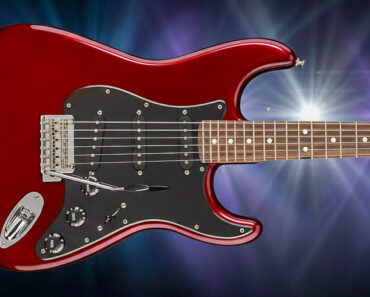
Feature Photo: irish10567 from Little Falls, NJ, USA, CC BY 2.0 <https://creativecommons.org/licenses/by/2.0>, via Wikimedia Commons
The Fender Stratocaster is not merely an electric guitar; it is a foundational element of modern music, an icon of industrial design, and a cultural touchstone that has transcended its original purpose. From its introduction in the early 1950s, the Stratocaster has provided a revolutionary combination of form, function, and versatility that has been embraced, adapted, and popularized by a staggering range of artists. Its history is a story of groundbreaking innovation, a difficult period of corporate transition, and a strategic rebirth that cemented its status as one of the most recognizable electric guitars in the world.
The Originals: Inventing a New Standard
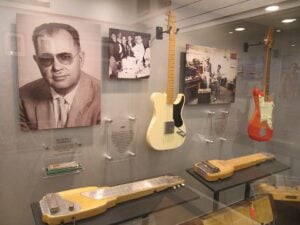
The Stratocaster was born from the imagination of Leo Fender. A relentless inventor rather than a performing musician, Fender had already revolutionized the music world with the Telecaster, originally called the Broadcaster, and the Precision Bass. These were practical, solid-body instruments designed for reliable mass production. By late 1952, Fender and his team were already developing a more advanced guitar that would incorporate feedback from musicians who found the Telecaster’s squared body edges uncomfortable during long performances.
Feature Photo: Mr. Littlehand, CC BY 2.0 <https://creativecommons.org/licenses/by/2.0>, via Wikimedia Commons
Working with a team that included George Fullerton, Freddie Tavares, Bill Carson, Don Randall, and several musicians who tested prototypes, Leo Fender set out to create a guitar that represented a major step forward. Tavares helped shape the instrument’s flowing double-cutaway outline, while guitarist Rex Gallion is often credited with encouraging the body contours that made the guitar more comfortable to play.
The result was introduced in 1954. Its deeply contoured body included a beveled area for the player’s forearm and a cut on the back that allowed the instrument to fit more naturally against the body. The Stratocaster also featured three single-coil pickups with staggered pole pieces, offering a wider tonal range than the Telecaster’s two-pickup configuration. The original three-way selector switch allowed players to choose the bridge, middle, or neck pickup individually. Musicians soon discovered that they could balance the switch between positions to combine two pickups, producing the distinctive in-between tones that later became a defining part of the Stratocaster sound.
The guitar’s most technically ambitious feature was Fender’s Synchronized Tremolo system. Although Fender used the word tremolo, the mechanism actually created vibrato by raising or lowering pitch. Its integrated bridge and tailpiece moved with the strings and used springs mounted inside a cavity in the back of the guitar. The design allowed players to alter the pitch of all six strings simultaneously while maintaining far greater stability than many earlier systems.
The Stratocaster was introduced during the spring of 1954, with full-scale production beginning in October. Despite its futuristic appearance and versatility, the instrument was not an immediate runaway success. Many professional guitarists still favored hollow-body electrics, while saxophone and piano remained dominant lead instruments in early rock and roll.
The Stratocaster’s first major rock and roll ambassador was Buddy Holly. When the Crickets appeared on The Ed Sullivan Show on December 1, 1957, Holly performed with his sunburst Stratocaster in front of a national television audience. In the United Kingdom, Hank Marvin of the Shadows used a Fiesta Red Stratocaster to develop a clean, echo-drenched sound that inspired generations of British guitarists.
The CBS Era And Cultural Explosion
The Stratocaster’s cultural ascent continued during the 1960s. It became a favorite in the surf rock scene, most notably through Dick Dale, whose powerful playing pushed Fender guitars and amplifiers to new limits. The instrument then moved into the center of several moments that changed the direction of popular music.
In 1965, Bob Dylan appeared at the Newport Folk Festival with a sunburst Stratocaster and an electric backing band. The performance divided portions of the folk audience but became one of the defining moments in the rise of folk rock.
A year later, Jimi Hendrix arrived in London and transformed what audiences believed an electric guitar could do. Playing right-handed Stratocasters upside down and restrung for a left-handed player, Hendrix used feedback, extreme pitch bends, effects, and controlled noise as compositional tools. His performance at the 1967 Monterey Pop Festival, which ended with him setting a hand-painted Stratocaster on fire, became one of rock music’s most unforgettable images.
Hendrix, Eric Clapton, David Gilmour, Jeff Beck, Ritchie Blackmore, Rory Gallagher, and many other major guitarists helped make the Stratocaster central to blues rock, psychedelic rock, progressive rock, and hard rock. The same instrument could produce glassy rhythm parts, singing lead tones, aggressive distortion, and experimental effects without losing its recognizable character.
Behind the scenes, Fender underwent a monumental corporate change. Leo Fender and Don Randall sold the company to CBS in January 1965. The transition did not immediately transform the instruments because existing parts, tools, and production methods continued to be used. Over time, however, CBS introduced highly visible changes, including the larger headstock, the three-bolt neck plate with Micro-Tilt adjustment, bullet-style truss rods, and polyester finishes.
Many excellent Stratocasters were built during the CBS years, and musicians including Ritchie Blackmore, David Gilmour, Nile Rodgers, and the Edge created landmark recordings with instruments from that period. Nevertheless, the company developed a reputation for inconsistent quality control as production increased during the 1970s. Weight, neck fit, finishing, and assembly could vary considerably from one guitar to another.
Rebirth And The Modern Era
By the early 1980s, Fender faced serious financial and reputational problems. CBS sold the company in March 1985 to a group of investors led by Bill Schultz. The new Fender Musical Instruments Corporation acquired the name, distribution network, remaining inventory, machinery, and intellectual property, but not the main Fullerton factory.
For a short period, American production slowed dramatically while Japanese-built Fender and Squier instruments helped keep the company active. Schultz and his team established new headquarters in Brea, California, and acquired a smaller factory in Corona in October 1985. Their central mission was to restore Fender’s reputation by emphasizing quality rather than production volume.
Fender launched the American Standard Series in 1987. The American Standard Stratocaster blended the original design with modern, player-focused changes, including 22 frets, a 9.5-inch fingerboard radius, updated electronics, and a two-point synchronized tremolo. The line became Fender’s principal American production series for nearly three decades.
That same year, Fender established the Custom Shop in Corona. The operation became known as the Dream Factory, creating high-end instruments, historically detailed recreations, artist models, and one-of-a-kind guitars built by specialist craftspeople.
This renewed focus on quality arrived as another generation of guitar heroes was demonstrating the Stratocaster’s continuing relevance. Stevie Ray Vaughan revitalized blues rock with the battered 1963 instrument known as Number One. Yngwie Malmsteen used scalloped-fingerboard Stratocasters to help define neoclassical metal, while Mark Knopfler demonstrated the guitar’s clean, crystalline character through his distinctive fingerstyle playing.
Fender also embraced artist-driven instruments. The Eric Clapton Stratocaster appeared in 1988 as one of the company’s earliest major Signature Series models. Its active mid-boost circuit and Lace Sensor pickups gave Clapton a thicker tone while retaining the familiar Stratocaster design. Signature instruments for Jeff Beck, Stevie Ray Vaughan, Yngwie Malmsteen, Buddy Guy, Robert Cray, Eric Johnson, and many others followed.
The Stratocaster In The 21st Century
The Fender Stratocaster remains a major presence in blues, rock, indie music, funk, country, R&B, jazz, and pop. The following guitarists are notable examples of musicians who have prominently used Stratocasters or closely related Strat-style instruments during the 21st century.
John Mayer became one of the defining modern Stratocaster players during the 2000s. His Fender instruments included sunburst, Olympic White, and Custom Shop models, most famously the black Stratocaster known as the Black One. Fender also produced a John Mayer signature Stratocaster with a thick C-shaped neck and Big Dipper pickups designed with a scooped midrange.
Joe Bonamassa is most closely associated with Gibson guitars, but Stratocasters have also remained an important part of his extensive vintage collection. He began attracting attention as a child while playing a 1972 Fender Stratocaster and has continued using vintage Strats for selected songs and performances.
Kenny Wayne Shepherd represents the generation of blues guitarists who followed Stevie Ray Vaughan. A 1961 sunburst Stratocaster became one of his most important instruments, and Fender later developed a Kenny Wayne Shepherd signature model.
Albert Hammond Jr. of the Strokes helped return the Stratocaster to the center of indie rock at the beginning of the 2000s. His tightly controlled rhythm playing and interlocking guitar parts became essential to the sound of albums including Is This It and Room on Fire.
Alex Turner rose to prominence with Arctic Monkeys while frequently playing an Arctic White Stratocaster. The instrument helped shape the clipped punk rhythms, surf-influenced lines, and sharp riffs heard during the band’s earliest period.
Courtney Barnett has used left-handed Stratocasters to create a sound that moves easily between melodic indie rock, noisy distortion, and loose, conversational guitar parts. Her black and white Strats have become closely associated with her live performances.
Jawny has represented a younger generation of alternative-pop Stratocaster players. He has toured with a brightly painted custom Strat-style guitar that complements the colorful visual presentation of his music.
Cory Wong has built a distinctive modern funk style around the Stratocaster’s bright attack and clean in-between pickup tones. His longtime Sapphire Blue Highway One Stratocaster inspired an official Fender signature model designed for his precise rhythm playing.
H.E.R. brought the Stratocaster into contemporary R&B, soul, pop, and hip hop performances. Fender created a Chrome Glow H.E.R. signature Stratocaster equipped with Vintage Noiseless pickups.
Tom Misch uses Stratocasters to blend neo-soul, jazz, funk, electronic music, and understated pop songwriting. His clean tone and fluid chord voicings helped make the instrument central to his recordings and performances.
Jason Isbell has used vintage Stratocasters throughout his solo career and his work with the 400 Unit. His prized 1960 Stratocaster has appeared frequently in concerts, supporting a style that combines Southern rock, country, blues, and highly detailed songwriting.
Billie Joe Armstrong has used Fender Stratocasters at various points in Green Day’s career. His famous guitar Blue, however, is a Fernandes Strat-style instrument rather than a Fender, heavily modified with stickers and a powerful bridge pickup.
Tom DeLonge used Squier and Fender Stratocasters during the early years of Blink-182. His heavily modified instruments typically used a single bridge humbucker, and Fender later produced a Tom DeLonge signature Stratocaster built around that stripped-down configuration.
John Frusciante of the Red Hot Chili Peppers has long been associated with vintage Stratocasters. His worn 1962 sunburst Stratocaster became his principal instrument, shaping the clean funk rhythms, melodic chord voicings, and expressive lead tones heard throughout his work with the band.
Billy Corgan of the Smashing Pumpkins has used numerous Stratocasters since the band’s earliest years. His instruments helped produce the layered distorted guitars of the group’s classic albums, and Fender later issued a Billy Corgan signature Stratocaster.
David Gilmour remains one of the musicians most closely identified with the Stratocaster. Although his famous Black Strat was sold at auction in 2019, Gilmour has continued using Stratocasters and custom Strat-style instruments in the studio and onstage.
Check out similar articles on ClassicRockHistory.com Just click on any of the links below……
Read More: Artists’ Interviews Directory At ClassicRockHistory.com
Read More: Classic Rock Bands List And Directory
Updated August 1, 2026.
Exploring The History Of The Fender Stratocaster article published on ClassicRockHistory.com © 2026
Classicrockhistory.com claims ownership of all its original content and intellectual property under United States copyright laws and those of all other foreign countries. No person, business, or organization is allowed to republish any of our original content anywhere on the web or in print without our permission. All photos used are either public domain Creative Commons photos or licensed officially from Shutterstock under license with ClassicRockHistory.com. All photo credits have been placed at the end of the article. Album cover photos are affiliate links and the property of Amazon and are stored on the Amazon server. Any theft of our content will be met with swift legal action against the infringing websites.