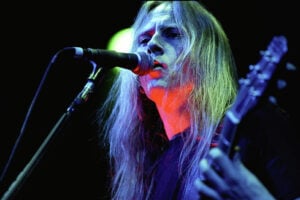
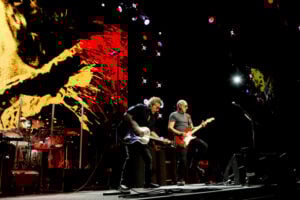
Photo courtesy of Chipster PR.
Where was Ten Years After at by the time the Ssssh record came about?
Two tours of America, and that was the third record, where we were constantly touring. It came out shortly after Woodstock, though we’d recorded it in June 1969, before we went on our tour of the States in July. So, things were rolling!
How impactful was Woodstock on Ten Years After?
When it happened, it was just another festival. We were six weeks into an American tour, we’d done the Newport Jazz Festival, the Atlanta Pop Festival, and the Texas Blues Festival. And others I can’t even remember, so as far as we knew, and we weren’t watching television or listening to the radio, it was just another festival until we actually got there and realized how many people were there. [laughs]
So, we did the festival, left, finished the tour, and went home. It wasn’t until we came back on the next tour, which was quite soon afterwards, that people started asking us about it, what it was like, how we felt about it being in Life Magazine, and all of those things. And then, of course, 12 months later, when the movie came out, that’s when the impact started to happen.
Up until that time, we were playing all the major venues, headlining our own shows to thousands of people, but there were obviously more people when we were playing a festival or something. So, we’d been doing a steady climb, and then when the Woodstock movie came out, it just took one giant leap.
Circling back to the Ssssh record, what was the creative process like?
Well, we were basically a jam band. [laughs] We’d come off tour, and the manager said, “We’ve booked some studio time. Have you got any material?” And Alvin always preferred… well, what can I say? He preferred to be the songwriter for whatever reason. [laughs] And so, he’d be trying to write the songs coming into the studio because, you know, the poor guy didn’t have time.
He was so busy. He’d just come off a 17-week tour, and 10 days off, and you’re off on another one. It was tough times, so a lot of the time we’d go in with some lyrics and a rough idea of what to do. And I wrote, but it was very difficult… I was able to get a few riffs into the creative process. [laughs]
What songs came about first?
You know, I don’t think it was even that… I think it was, “Oh my God, we’ve got to go in and make a record, we’d better get some songs.” [laughs] It wasn’t like we had these songs lying around for months and months. It was like, “Okay, now I’ve gotta write.” But I mean, I watched a documentary on [Bruce] Springsteen, where he had 40 songs when he went in to do this particular record.
His guys were going, “That’s great. I really like that one. No, no, I don’t want that…” But we didn’t have that. We were trying to get the batch of songs together, like “Good Morning Little Schoolgirl,” for example. I’d heard a version of that, and I started messing around with the riff, where I twisted the riff around and made it into a different riff.
I started playing that when we were on tour in the dressing room, and we were jamming on it, so that was one song that came together. And “I Woke Up This Morning” is a blues song… that’s how we worked. Alvin did little home demos; I did home demos; he would play them, and then we’d work out an arrangement for the song. Then we’d jam it until we felt it was good, then put it down. Two weeks in the studio was generally the most time we spent.
What was the key to your bass tone back then?
It was the usual thing: two 100-watt Marshall amps and 4×12 cabs. And I would keep changing out the resistors to get a little bit more treble, bottom end, and middle. But my influence was really from upright bass players; I wanted my bass to sound like Bill Black, Elvis’s bass player. So, it was a rockabilly style of bass playing, and then I started listening to Duke Ellington and Count Basie, and became a big fan of Ray Brown and jazz bass playing.
As Alvin was the principal songwriter, did he have input into your bass licks?
Um, no, not really. I fed him the bass licks! Everybody did what they wanted, you know, that’s how it worked. We played what we wanted to play, or what fit around the music. And in those days, the bass was slightly different than what it is now, where it’s subservient to the drums. But if you listen to old rock and jazz records, back then, the drummer accompanied the bass, so the bass was not behind the drums in the mix. So, you might say that I had a pretty free hand.
Were you happy with Ssssh the first time you listened to it back?
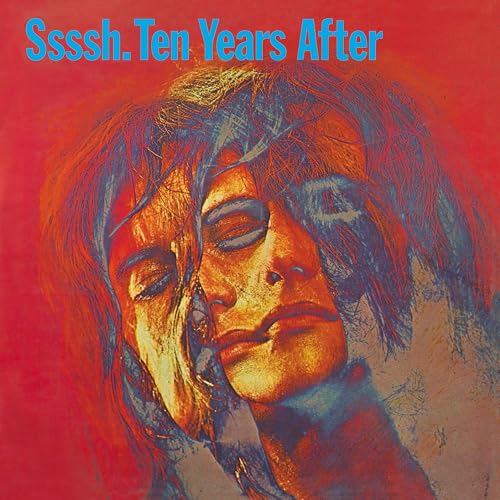
It’s the first album that we did in an eight-track studio, as the first three, one of which was live, we did in independent studios that we were in for Decca. They were very classical-based studios, and the routine was very different. But for Ssssh, we were paying for it ourselves, so we started later and recorded all night. The experience was very different.
The record has more space and more room, which was a dramatic change for it. And so, at the time, I thought, “This is the best one that we’ve done…” That’s what I thought, and over the years, I must say, though I don’t listen to anything I’ve worked on, this record has always stuck in my mind. I’ve always thought, “This is one of the best that we made,” and we’ve made a number of records, but I always thought that one was good.
How do you look back on the impact of Ten Years After on the psych-meets-blues-rock scene?
Everybody is different, but I didn’t feel intimidated by anybody. But I didn’t really think about that… what you do at a young age at that stage is you record, go on stage, and play your heart out. You hope that you get a reaction from the audience, but as far as making records, heck,—– I don’t know.
Do I think we were as good as The Beatles? No! They wrote better songs. They spent more time in the studio. But that’s different because, as I say, we were a boogie rock ‘n’ roll band, you know, we were a psychedelic-jam band. [laughs] It’s difficult… you don’t think about things like that, you know? You don’t read reviews, you just go out there. You’re moving every day.
Check out similar articles on ClassicRockHistory.com Just click on any of the links below……
Complete List Of Ten Years After Songs From A to Z
Read More: Artists’ Interviews Directory At ClassicRockHistory.com
Read More: Classic Rock Bands List And Directory
Leo Lyons of Ten Years After: The ClassicRockHistory.com Interview article published on ClassicRockHistory.com© 2025
Classicrockhistory.com claims ownership of all its original content and Intellectual property under United States Copyright laws and those of all other foreign countries. No one person, business, or organization is allowed to re-publish any of our original content anywhere on the web or in print without our permission. All photos used are either public domain Creative Commons photos or licensed officially from Shutterstock under license with ClassicRockHistory.com. All photo credits have been placed at the end of the article. Album Cover Photos are affiliate links and the property of Amazon and are stored on the Amazon server. Any theft of our content will be met with swift legal action against the infringing websites.