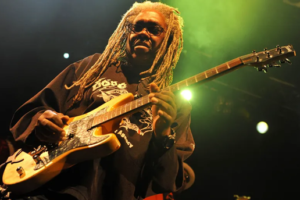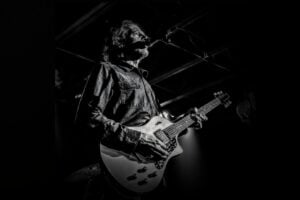
Feature Photo by Eric Stormer
It’s unfair to boil Marc Ford’s career down to just The Black Crowes. Sure, The Southern Harmony and Musical Companion (1992), Amorica (1994), and Three Snakes and One Charm (1996) are, as Ford puts it, “Good records. Period.”
But there’s far more to Ford’s catalog. One could look toward 1990s Burning Tree, his work with Ben Harper in the 2000s, his three records with The Magpie Salute—where he teamed up with former Black Crowes bandmate, Rich Robinson—or his production work, a crown jewel of which is Ryan Bingham’s Mescalito (2007).
But Ford’s fans will know that it’s his solo work where he really shines, showcasing his old-school guitar hero chops and combining them with a diversified songwriting palette. Dig into albums like 2003’s It’s About Time, 2007’s Weary and Wired, 2014’s Holy Ghost, or 2023’s Neil Songs to catch the vibe.
Lately, Ford has been touring with Lucida Williams, adding another notch to an already impressive guitar-playing belt. As Ford puts it, “I go where I’m needed.”
As for what keeps him inspired to create new music, which he still does often, Ford tells ClassicRockHistory.com, “It’s what I do. Painters paint whether they are selling the pictures or not. Songwriters write; musicians make music. I was following my interests. Playing with different people.”
What are your earliest memories of music in your life, and what specifically drew you to the guitar?
The radio was always on in my grandmother’s car. I used to love hearing her sing along. I saw an old man selling second-hand acoustics at a swap meet, and the joy on the old man’s face while he played made me decide I wanted some of that.
How did the scene you grew up in affect you as a player?
Well, if it’s about influence, then there wasn’t a lot of culture in the suburbs I grew up in. So, you really had to seek out any information you could get your hands on. We used to ride our bikes for miles to go see someone with a guitar, a distortion pedal, or anything related.
Tell us about one of your earliest gigs, which was a band called Citadel, and how that led to Burning Tree?
That was basically a band made from high school friends. We’d play local gigs and parties. Anywhere they’d let us. Burning Tree is what was left without the singer. So, I sang. I would watch a couple of VHS tapes I had over and over again. Jimi Hendrix and The Who’s “The Kids Are Alright” became the bar to strive for.
What gear did you use on the Burning Tree record, and what sort of exposure did it grant you as a guitar player?
I had a couple of brand-new Fender Strats that I bought with the record advance, along with a Marshall small-box 50-watt amp and a matching 8×12 cabinet. I think I had a wah [pedal] and a Dunlop Fuzz Face. We rented a 100-watt [Marshall] Super Lead, an old Vox AC30, and a Les Paul from Guitars R Us, which was the LA vintage shop at the time. It introduced me to a world stage, and I had a lot of noise to make.
Why do you think Burning Tree didn’t hit commercially, and where were you at artistically after the band folded?
For all the reasons that most albums don’t have commercial success. I wasn’t sure what to do next.
The story goes that you befriended Chris Robinson and ended up joining The Black Crowes, even turning down a spot in Guns N’ Roses. Why were the Crowes the right band for you at that time?
I connected to the Crowes’ music much more than Guns. Don’t get me wrong, I was at those early shows, and they Guns N’ Roses were incredible, but I saw the job with the Crowes as a better opportunity to express myself as a guitar player.
How would you say up most impacted the Crowes from a guitar perspective? And of the three albums you worked on with the Crowes, which one are you most proud of?
Oh, I don’t know. Listen and tell me. I can’t say I am more proud of any one record over another, they each have their own value. Those records were good. Period. And the band put on one hell of a show. Also, there wasn’t much else going on in rock ‘n’ roll. I don’t consider grunge music rock ‘n’ roll.
You became a guitar hero of sorts then. What was that like for you, and did that sort of praise sit well with you?
The only time I ever felt like a hero was when I was gifted a cape. [laughs] Kidding aside, of course, it felt good to be recognized for what you’re doing, but I was on a rocket ship playing at the extent of my abilities for tens of thousands of people.
Not to mention with people we’d learned from, like the Brothers, the Stones, Neil Young, Page and Plant. I was sure I was gonna get found out at any moment. Eventually, I realized I was developing a style of my own through a mix of my influences. Like many others, I didn’t have many formal lessons; I learned by mimicking.
After the Black Crowes, you worked extensively with Ben Harper. What led to that, and how did your rig change compared to your ‘90s gigs?
Ben heard me playing with Chris Stills and introduced himself. The spot opened, and I played for three years. Not much changed equipment-wise. Not as much muscle was needed. I had a [Fender] Super Reverb and a 100-watt Roccaforte half-stack that I would switch between, along with a few different guitars. I think I got a tremolo pedal after I met Bill Asher.
You reunited with the Crowes in 2005-2006. What did it mean to you to have closure with the band?
It felt redemptive. Things didn’t end well in the ‘90s. I was glad to have an opportunity to set the record straight.
You also reunited with your Burning Tree bandmates in the 2000s. What led to that, and are you open to more?
I got asked, simple as that. I’m open to just about anything as long as it’s moving forward.
From 2016 to 2019, you were with The Magpie Salute, teaming up with Rich Robinson again. What can you say about the chemistry you share?
We have a thing. We played a lot of gigs together.
Tell us about your series of signature guitars with Asher, along with the amps and pedals that accent your notable tone.
Bill and I got into a conversation about what I would want from a guitar if I could start from scratch. Using the design shapes he already had, he built a guitar that had the appointments we talked about.
We refined it to what it is now. He’s incredible at what he does. Same with the other guys, like Scott at BMF or Adam at Satellite, they are local to me, and things were born out of a relationship.
A lot of people feel that when you’re onstage or in the studio on a project, your presence is immediately felt. Can you put your finger on that?
Is that good or bad? [laughs] I don’t know… it’s a language, and I just try and add something to the conversation.
Catch us up on what you’re doing now and what’s next for you?
These days, I’m pretty busy with Lucinda Williams. I do some producing of other artists, and some session work. I’ve got a record finished that my son Elijah produced, but I don’t have the time to promote it. I go where I’m needed.
Check out similar articles on ClassicRockHistory.com Just click on any of the links below……
Read More: Marc Ford: 10 Albums That Changed My Life
Read More: Artists’ Interviews Directory At ClassicRockHistory.com
Read More: Classic Rock Bands List And Directory
Marc Ford: The ClassicRockHistory.com Interview article published on ClassicRockHistory.com© 2026
Classicrockhistory.com claims ownership of all its original content and Intellectual property under United States Copyright laws and those of all other foreign countries. No one person, business, or organization is allowed to re-publish any of our original content anywhere on the web or in print without our permission. All photos used are either public domain Creative Commons photos or licensed officially from Shutterstock under license with ClassicRockHistory.com. All photo credits have been placed at the end of the article. Album Cover Photos are affiliate links and the property of Amazon and are stored on the Amazon server. Any theft of our content will be met with swift legal action against the infringing websites.