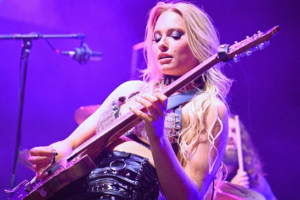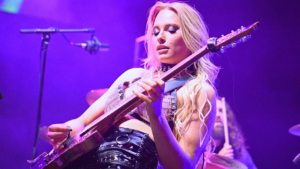
Feature Photo by Gus Stewart
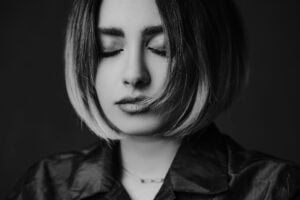
Sophie Lloyd is a powerhouse on guitar. Her rise via social media opened doors for a new age of players, and her induction into Machine Kelly’s band amplified that.
But Lloyd’s journey didn’t start like the players she grew up idolizing, like Joe Satriani or Steve Vai’s. Embarrassingly, it was SpongeBob SquarePants,” she laughs. “There’s an episode where he plays a version of ‘I Wanna Rock’ by Twisted Sister, and he’s flying through the air with a V-shaped guitar. I remember watching that and thinking, ‘That’s exactly what I want to do.’”
Humorous as that is, we all have to start somewhere, and Lloyd was serious about guitar. “That moment stuck with me,” she tells ClassicRockHistory.com. “I didn’t just want to play guitar; I wanted that larger-than-life, rock and roll feeling. That’s really what shaped the kind of player I wanted to become.”
As Lloyd grew older, she discovered YouTube. This was before it was the sort of thing that creators, let alone guitar players, monetized to grow their career. She was just having fun, but soon, Lloyd found herself with millions of followers across YouTube, Instagram, TikTok, Facebook, and Twitch.
This led to none other than Machine Gun Kelly direct messaging her, asking her to join his band, which she did. Further exposure, and an unfortunate bout of imposter syndrome—followed. Soon after that, Lloyd released her first solo album.
“Seeing artists like Slash collaborate with different musicians also inspired me to create something similar and collaborate with vocalists,” she says. “So, I created my own version of that, which became Imposter Syndrome.”

Lloyd continues to tour with Machine Gun Kelly, while cultivating a blossoming solo career. She’s also still on social media, though it’s a tough space. “The biggest downside is how easy it is to tie your self-worth to engagement,” she says.
Adding, “You can create something you genuinely love, but if it doesn’t perform well, it can make you question everything, and that’s not how art should work.”
According to Lloyd, the key is to be yourself and stay grounded. “It can also push you into chasing trends rather than creating what you actually enjoy, which can lead to burnout,” Lloyd says. “But I wouldn’t change much about my journey on social media.”
“I guess the only thing is that I do wish I’d started streaming earlier, especially during lockdown when it really took off,” she admits. “It’s very easy to tie your worth to numbers, likes, views, and comments, and that’s something I’m still learning to manage. But overall, I’m incredibly grateful for what it’s given me.”
What are the earliest memories of music in your life?
Music was always part of my world growing up. My mum was an aerobics instructor, so there was always music blasting in the car. My dad would collect vinyl records and was always playing artists like Rory Gallagher and Santana, so I was surrounded by those sounds from a very young age.
My uncle also played guitar, and I remember he gave me a Marshall amp when I was a kid. I didn’t really understand what it was at the time, but I knew it looked cool. It just sat in my room like this mysterious, exciting object. Little did I know what it would lead to!
What things did you struggle with as you were learning, and when did you feel like you got to a point where you were ready to take your career to another level?
I still feel like I’m learning constantly, but early on, I really struggled with improvisation. I’ve always had quite a logical mindset, so I preferred the structure of knowing exactly what I was playing and when. Letting go and just feeling it didn’t come naturally at first.
On top of that, I dealt with a lot of performance anxiety and imposter syndrome, which made things harder. But saying “yes” to bigger opportunities, like playing with Machine Gun Kelly, pushed me out of my comfort zone and helped me to develop both technically and mentally.
How did you end up on social media doing covers and play-throughs, and when did you realize you were on to something?
I started on YouTube before it was what it is today; there was no monetization or strategy behind it, it was really just a video diary for myself. I also grew up in a small town without many musicians around, so it became a way to connect with like-minded people.
One of my first covers was “Surfing with the Alien” by Joe Satriani, and when that hit 30,000 views, I couldn’t believe it. That was the moment I realized that people are actually watching this. And it made me want to keep going.
Did your growth on social media impact your gear choices? If so, how?
At first, my gear choices were shaped by the people around me. My first proper amp was a Diezel VH4, which was what was in the studio when I recorded Delusions.
As I got more involved in the online space, I started using Neural DSP, which a lot of my peers recommended. It made everything so much easier, especially for creating content. Being able to plug straight into Logic and have consistent tones without setting up loads of gear was a game-changer. Also, living in a London flat and a 100-watt amp don’t really mix. [laughs]
Even discovering Kiesel guitars came through connections online, as they are not sold in stores over here. They were recommended to me by Rob Caggiano from Volbeat, then I just sent them an email with links to my social media pages, and they accepted me as an artist! So, social media definitely helped open those doors.
As your social media star grew, how did that impact you? It must have been a huge amount of pressure and exposure to grapple with.
It’s been a bit of a double-edged sword. On one hand, it’s given me incredible opportunities. On the other, it created this immense pressure to be perfect.
When you’re posting online, you can retake things endlessly until they’re flawless, and that can definitely set an unrealistic standard for yourself. That’s why my imposter syndrome got quite bad, especially when it came to playing live.
Twitch helped me a lot with that. It bridged the gap between online polished content and real live performance; people could see the mistakes as well as the good moments. People didn’t mind the mess-ups; people actually liked them, which reminded me that music is about connection rather than perfection.
How did you end up with Machine Gun Kelly, and why do you think he picked you for his touring band?
MGK actually reached out to me via Instagram after his drummer, Rook, showed him some of my videos. They were looking for another guitarist, and I guess they thought I was a good fit. I’m very grateful they took a chance on me, as they’d only really seen my online content, and I didn’t have much experience as a touring musician.
I think part of why they chose me was also about representation. MGK has a big audience of young girls, and having a female guitarist on stage sends a powerful message about what’s possible.
What’s MGK like as a bandleader? What does he expect from you, and how have you impacted his music?
He’s incredibly driven and creative; he’s always pushing boundaries and trying to evolve his music and the show. He really encourages us to contribute ideas and have our own moments on stage.
I think I’ve brought more of a rock and shred element into the live show with some big solos and more guitar-forward moments. And being the only female in the band adds a different dynamic both musically and visually, which I think is really important.
How have you grown as a player since joining MGK, and how has your gear changed?
My confidence has grown massively. Playing in front of big crowds regularly forces you to step up in a way nothing else really can. Also working with musicians like Justin Lyons [Guitar Slayer] has also pushed me; his approach is very different, more rooted in gospel, and that’s opened my perspective a lot.
Gear-wise, I switched to using a Kemper for MGK touring. It’s very practical, being able to switch tones quickly and stay consistent is essential on tour. The techs do most of the dialing in, so I haven’t had a chance to really delve into it myself.
I do miss the sound and feel of real amps, though. And I love the Neural DSP for my own stuff, and it’s the software I know the best.
You’ve begun to grow your solo career, too. What’s inspired you there?
I’ve always loved instrumental music. Players like Joe Satriani and Steve Vai have always been huge influences on me, so building my own identity within that space is something I’m really passionate about. My first EP was fully instrumental, and I love creating my shred versions for YouTube, allowing the guitar to tell the story and carry the song.
Has there ever been a time when you felt like you failed? If so, how did you manage that?
Definitely, and I think that’s just part of the process. One that stands out is my first solo show with a band just before lockdown. I wasn’t fully prepared, and my performance anxiety got the better of me. Some of those performances ended up online and were heavily scrutinized, which was tough.
It definitely made my imposter syndrome worse for a while. But instead of hiding from it, I became more open about how I was feeling and started streaming on Twitch. That helped me learn that mistakes are okay, and when you take that pressure off, you actually perform better and enjoy it more.
Do you have any signature gear in the works, or any updates on that front?
Yes! I have a signature Kiesel guitar, the SL6 and SL6X. They’re incredibly versatile and so easy to play, and I use them for pretty much everything. There’s a hardtail version and one with a tremolo and sustain pickup, which is essential for all the weird sounds I love making.
We also recently released a limited ‘Americana’ edition with a red, white, and blue denim fade, to tie in with the MGK Lost Americana tour, which was really special.
Where do you see your career going?
I’d love to focus more on my solo career, that’s where my biggest passion lies. I’m excited to get back into writing, collaborating, and hopefully performing more as a solo artist, especially at big mainstream events.
I recently did the Rugby World Cup Final at Twickenham. I’d love to do more of that and keep pushing into new spaces. I’m also really interested in composing for film and video games. That’s something I’d love to explore, but I’m still figuring out how to break into that world.
Check out similar articles on ClassicRockHistory.com Just click on any of the links below……
Read More: Artists’ Interviews Directory At ClassicRockHistory.com
Read More: Classic Rock Bands List And Directory
Read More: 100 Essential Albums From The 1960s That Everyone Should Own
Sophie Lloyd Interview article published on ClassicRockHistory.com© 2026
Classicrockhistory.com claims ownership of all its original content and Intellectual property under United States Copyright laws and those of all other foreign countries. No one person, business, or organization is allowed to republish any of our original content anywhere on the web or in print without our permission. All photos used are either public domain Creative Commons photos or licensed officially from Shutterstock under license with ClassicRockHistory.com. All photo credits have been placed at the end of the article. Album Cover Photos are affiliate links and the property of Amazon and are stored on the Amazon server. Any theft of our content will be met with swift legal action against the infringing websites.