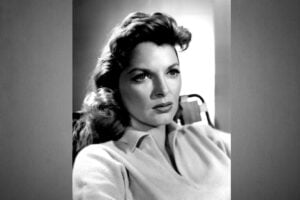
Feature Photo: CBS Television, Public domain, via Wikimedia Commons
Julie London was one of the most recognizable female vocalists of the 1950s and 1960s, celebrated for her smoky, intimate singing style and her ability to bring extraordinary emotion to even the simplest melodies. Born Julie Peck on September 26, 1926, in Santa Rosa, California, London began her entertainment career as an actress before becoming a successful recording artist. Her understated vocal approach set her apart from many of the more powerful singers of her generation.
London’s recording career took off in 1955 with her unforgettable version of “Cry Me a River,” written by Arthur Hamilton. The single reached number nine on the Billboard pop chart and became her signature recording. Her debut album, Julie Is Her Name, climbed to number two on the Billboard album chart, establishing her as a major recording star. She went on to release nearly thirty studio albums, interpreting jazz standards, romantic ballads, and popular songs with a style that was distinctly her own.
Beyond her recording success, Julie London enjoyed a lengthy acting career that included appearances in films such as The Girl Can’t Help It (1956) and Man of the West (1958). She later became familiar to television audiences through her portrayal of nurse Dixie McCall on the popular series Emergency!, earning a Golden Globe nomination in 1974. London passed away in 2000, but her recordings have continued to attract new generations of listeners. Our Top 10 Julie London Songs list celebrates some of the finest performances from her remarkable musical career.
# 10 – Desafinado (Slightly Out of Tune)
Julie London released “Desafinado,” also known as “Slightly Out of Tune,” as a single in 1962. The song was written by Antônio Carlos Jobim and Newton Mendonça, with English lyrics credited to Jon Hendricks and Jessie Cavanaugh. London’s recording reached number 110 on Billboard’s Bubbling Under the Hot 100 chart. The song also appeared on her 1963 album The End of the World.
# 9 – Black Coffee
Julie London recorded “Black Coffee” for her 1960 album Around Midnight, released by Liberty Records. The song was written by Sonny Burke and Paul Francis Webster and had previously become a jazz standard through recordings by other performers. London’s version was not a nationally charting single, but it became one of the memorable performances from her jazz-oriented recordings of the early 1960s.
# 8 – Blue Moon
Julie London released her recording of “Blue Moon” on the 1958 album Julie Is Her Name, Volume Two. Written by Richard Rodgers and Lorenz Hart in 1934, the song was also issued as a single by London in September 1958 on Liberty Records. Her version did not reach the national Billboard pop singles charts, although the song itself had already become a widely recorded American standard.
# 7 – The End of the World
While Skeeter Davis did the definitive version of this wonderful song, I have always loved Julie London’s sultry version. She really makes it sound like it’s the end of the world, and the wasy she sings it makes you hope it doesn’t really end. Julie London recorded “The End of the World” for her 1963 album of the same name. The song was written by Arthur Kent and Sylvia Dee. London’s recording did not chart separately as a major pop single, but her album The End of the World reached number 127 on the Billboard album chart.
# 6 – Misty
I don’t know about you but whenever I hear this song I can’t help but think about that Clint Eastwood movie Play Misty For Me. It wasn’t the greatest movie, but this song is the center point of the film. Julie London’s version of “Misty” appeared on her 1960 album Around Midnight. The music was composed by jazz pianist Erroll Garner in 1954, with lyrics added by Johnny Burke. Although London’s recording did not become a nationally charting single, the song had already enjoyed considerable commercial success through Johnny Mathis, whose 1959 recording reached number 12 on the Billboard pop chart.
# 5 – I’m Glad There Is You
Julie London included “I’m Glad There Is You” on her debut album Julie Is Her Name, released in December 1955. The song was written by Jimmy Dorsey and Paul Madeira Mertz and originally published in 1941. London’s recording was not a separate chart hit, but the album became a major success, reaching number two on Billboard’s album chart.
# 4 – I’m in the Mood for Love
Julie London recorded “I’m in the Mood for Love” for her 1955 debut album Julie Is Her Name. The song was written by Jimmy McHugh and Dorothy Fields in 1935 and had already become an established popular standard. London’s version did not chart independently as a single, but it benefited from the success of Julie Is Her Name, which peaked at number two on Billboard’s album chart.
# 3 – Sway
Julie London released her version of “Sway” on the 1963 album Latin in a Satin Mood. The song originated as the Mexican composition “¿Quién Será?” by Luis Demetrio and Pablo Beltrán Ruiz, with English lyrics written by Norman Gimbel. London’s recording did not become a Billboard singles-chart hit, but her interpretation has remained one of the most recognizable performances from her Latin-influenced recordings.
# 2 – Fly Me to the Moon
Julie London recorded “Fly Me to the Moon” for her 1963 album The End of the World. The song was written by Bart Howard in 1954 and was originally published under the title “In Other Words.” London’s recording did not reach the national Billboard singles chart, although the album peaked at number 127. Her interpretation became one of the better-known recordings in her catalog.
# 1 – Cry Me a River
Julie London’s signature recording of “Cry Me a River” was released as a single in 1955 and appeared on her debut album Julie Is Her Name. Written by Arthur Hamilton, the song became London’s biggest commercial hit, reaching number nine on the United States Billboard pop chart. It also reached number 22 on the United Kingdom Singles Chart in 1957. The recording sold more than one million copies and established London as one of the most recognizable vocalists of the era.