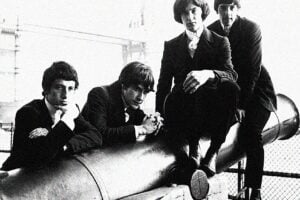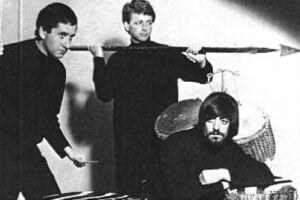
Feature Photo: Sheressesuzspen11, CC BY-SA 3.0 <https://creativecommons.org/licenses/by-sa/3.0>, via Wikimedia Commons
The Strangeloves formed in 1964 by the songwriting and production team of Bob Feldman, Jerry Goldstein, and Richard Gottehrer. Before forming the group, Feldman and Goldstein had already been working together as songwriters since 1959, and the two had recorded non-charting singles as Bob & Jerry in 1961 and 1962. They later joined forces with Gottehrer in 1962, formed FGG Productions, and scored a major hit with “My Boyfriend’s Back” by the Angels in 1963. As British Invasion-style beat groups became more dominant, they decided to form their own beat group, and because they felt they could not convincingly pass as British, they adopted an Australian identity instead.
That invented image became a central part of the band’s early presentation. Publicity materials described the members as three Australian brothers named Giles, Miles, and Niles Strange, who were supposedly raised on a sheep farm and made wealthy through a sheep-breeding venture. The fiction was colorful, but the music carried the weight. Their first single, released as the Strange Loves, was “Love, Love (That’s All I Want from You),” which reached number 122 on the Billboard Hot 100. A much bigger breakthrough followed in 1965 when “I Want Candy,” written and produced with Bert Berns at Bang Records, became a hit and pushed the group into a level of visibility that required live performance, something its creators had not originally planned to do themselves.
Once “I Want Candy” took off, The Strangeloves had to adapt quickly. Their road work was first handled by a backing band of session musicians, including John Shine, Jack Raczka, Tom Kobus, and Richie Lauro. In early 1966, that lineup shifted to a trio of FGG studio musicians, Ken Jones, Jack Raczka, and Joe Piazza, who more closely fit the Strange brothers’ concept. Greg Roman later joined as a bassist in 1968. Even with those touring lineups, the studio recordings continued to be handled by Feldman, Goldstein, and Gottehrer, with session musicians added when needed. That arrangement kept the creative control in the hands of the men who had built the project from the start.
Their recorded output was concise but commercially visible. The Strangeloves released one studio album, I Want Candy, in 1965. Their biggest hit singles were “I Want Candy,” which reached number 11 on the US Billboard Hot 100 and number 7 in Canada, “Night Time,” which climbed to number 30 in the United States, and “Cara-Lin,” which reached number 39 on the Billboard Hot 100 and number 100 in Canada. Other charting singles by the trio appeared under related names, including the Beach-Nuts, the Sheep, and Rome & Paris, but the Strangeloves’ name remained the one most closely associated with their mid-1960s success. In Australia, the country they had falsely claimed as home, their own chart impact was modest, though Johnny Young & Kompany later had an Australian hit with a cover of “Cara-Lin,” retitled “Cara-Lyn.”
What gave the group lasting value was not a long discography, but the durability of the songs and the reach of the people behind them. Their material has been recorded by David Bowie, Bauhaus, the J. Geils Band, the Fleshtones, Aaron Carter, George Thorogood, and Bow Wow Wow. Gottehrer went on to become a highly influential producer for acts associated with the early CBGB scene, including Richard Hell and the Voidoids, the Fleshtones, and Blondie. He also co-founded Sire Records with Seymour Stein, worked with Robert Gordon, produced Marshall Crenshaw’s first album, and later founded the Orchard. Goldstein remained active as a producer and manager, helping connect Nightshift with Eric Burdon, a move that led to the formation of War, and working with the Circle Jerks through his management and label operations. Those later careers explain why The Strangeloves continue to be respected, because the group’s legacy stretches into songwriting, production, label building, and the broader business of rock music.
The band’s history also includes a late return that underscored the affection still attached to the name. In December 2018, after more than 50 years, The Strangeloves reunited for a one off performance at the Bowery Ballroom in New York City, backed by Yo La Tengo. All three members also appeared in the documentary film BANG! The Bert Berns Story. Bob Feldman died on August 23, 2023, nine days after his 83rd birthday. The Strangeloves never had a massive catalog, nor did they leave behind a long list of major awards, but their place in rock history remains secure through one memorable album, a group of successful singles, and the enduring influence of the men who created them.
# 10 – Love, Love (That’s All I Want from You)
The band’s first single was released in 1964. At the time, the group was credited as the Strang Loves, which was later shortened to the one-word name The Strangeloves. The song peaked at number 122 on the US Billboard Hot 100.
# 9 – Out In The Sun
When this song was first released, it was issued under the band name The Beach-Nuts, which was a group that combined The Strangeloves and The Angels. The song was released in 1965. It peaked at number 106 on the Billboard Hot 100.
# 8 – Hide And Seek
Released in 1966 and peaking at number 85 on the Billboard Hot 100, the song was issued under the band name The Sheep rather than The Strangeloves. It’s amusing how they would release songs under different band names.
# 7 – Because of You
This was only two-thirds of the Strangloves, Bob Feldman and Jerry Goldstein, who were behind this one, as they called themselves Rome and Paris. This one was released in 1966. I hear a little Frank Zappa-style vocal in the background, although I’m pretty sure that wasnt Frank Zappa.
# 6 – I Feel Good
The guys returned as The Sheep once again, with their single “I Feel Good,” released in 1966. The song hit number 130 on the Billboard Hot 100.
# 5 – Sendin’ My Love
This one has that “I Want Candy” feel written all over it. The song was released in 1965 on their album I Want Candy.
# 4 – Hang On Sloppy
We all know the McCoy’s version, which became a big hit. However, the band discovered Rick Derringer at a club, brought him into the studio, replaced the original vocals on this song with Rick Derringer’s, and released it as The McCoys. Below is the original without Derringer.
# 3 – Cara-Lin
The next three songs became the band’s biggest hits as The Strangloves. Once again, we’re not really talking about a band; we’re talking about three songwriters, but these three songs were the songs under the name of Strangeloves that achieved the highest chart position on the Billboard Hot 100. “Cara-Lin” peaked at number 39 on the Billboard Hot 100.
# 2 – Night Time
There are so many great versions of this song recorded by various bands over time. I’ve always loved George Thorogood and the Destroyers version. This was the second-biggest hit in the Strangeloves’ musical output under their name. The song peaked at number 30 on the Billboard Hot 100.
# 1 – I Want Candy
Everyone knows this one. A lot of people first heard this song in the ’80s, when MTV heavily pushed the band Bow Wow Wow and their tantalizing video of the song’s recording. The original Strangeloves version became the biggest hit of their career under The Strangloves name, peaking at number 11 on the Billboard Hot 100.
Check out similar articles on ClassicRockHistory.com Just click on any of the links below……
Read More: Artists’ Interviews Directory At ClassicRockHistory.com
Read More: Classic Rock Bands List And Directory
Read More: 100 Essential Albums From The 1960s That Everyone Should Own
Top 10 Songs By The Strangeloves article published on ClassicRockHistory.com© 2026
Classicrockhistory.com claims ownership of all its original content and Intellectual property under United States Copyright laws and those of all other foreign countries. No one person, business, or organization is allowed to republish any of our original content anywhere on the web or in print without our permission. All photos used are either public domain Creative Commons photos or licensed officially from Shutterstock under license with ClassicRockHistory.com. All photo credits have been placed at the end of the article. Album Cover Photos are affiliate links and the property of Amazon and are stored on the Amazon server. Any theft of our content will be met with swift legal action against the infringing websites.