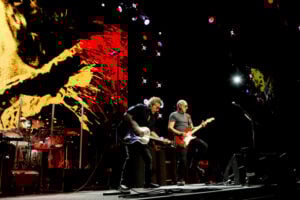
Photo: Ted Van Pelt from Mechanicsburg, PA, USA / CC BY 2.0 (https://creativecommons.org/licenses/by/2.0)
Our Top 10 Songs From The Cult list looks at one of the most distinctive British rock bands to emerge during the 1980s. Singer Ian Astbury and guitarist Billy Duffy first worked together under the name Death Cult before shortening it to the Cult in 1984. Their debut album, Dreamtime, arrived that same year and established a sound built from post-punk atmosphere, psychedelic imagery, and Duffy’s commanding guitar work.
The band’s commercial breakthrough came with Love in 1985. Songs such as “She Sells Sanctuary” and “Rain” expanded the Cult’s audience without sacrificing the mystery and drama of the earlier material. Two years later, producer Rick Rubin helped strip the group’s sound down to hard-rock essentials on Electric.
The Cult reached an even larger international audience with Sonic Temple in 1989. Produced by Bob Rock, the album reached the Top 10 of the Billboard 200 and number three on the United Kingdom albums chart. “Fire Woman” became the band’s biggest worldwide single, while “Edie (Ciao Baby),” “Sun King,” and “Sweet Soul Sister” reinforced the album’s status as a hard-rock classic.
After releasing Ceremony in 1991 and the self-titled The Cult in 1994, the band separated in 1995. Astbury and Duffy reunited the Cult in 1999 and released Beyond Good and Evil in 2001. That album featured former Guns N’ Roses drummer Matt Sorum.
The Cult continued with Born into This, Choice of Weapon, and Hidden City. Bassist Chris Wyse, who had also worked with Ozzy Osbourne, and drummer John Tempesta became important members of the group’s twenty-first-century lineup. The band’s eleventh studio album, Under the Midnight Sun, arrived in 2022.
Many musicians have passed through the Cult, but Astbury and Duffy have remained its creative center. These ten selections offer a starting point for listeners exploring the band’s combination of gothic atmosphere, psychedelic rock, blues, post-punk, and arena-sized hard rock.
# 10 – Dirty Little Rockstar
We open our Top 10 Songs From The Cult list with “Dirty Little Rockstar,” one of the hardest-driving tracks from the 2007 album Born into This.
The bass and guitar lock into a dirty, swaggering riff while Ian Astbury delivers a lyric aimed at manufactured celebrity and empty rock-star behavior. The song’s title is mocking rather than admiring, and the performance carries the attitude of a band that had already survived several generations of music-industry fashion.
“Dirty Little Rockstar” combines the Cult’s familiar hard-rock power with a tight twenty-first-century production. It served as the first single from Born into This and demonstrated that the band could still create direct, riff-centered rock without merely copying its 1980s records.
# 9 – Edie (Ciao Baby)
“Edie (Ciao Baby)” appeared on Sonic Temple in 1989. The song was inspired by Edie Sedgwick, the actress, model, and Andy Warhol associate whose brief life became one of the most enduring stories connected to the 1960s art world.
Rather than building the track around a crushing riff, the Cult uses acoustic textures, strings, and a restrained rhythm to create one of the album’s most emotional moments. Astbury’s vocal moves between admiration, sadness, and fascination with Sedgwick’s beauty and tragic history.
The song reached number thirty-two on the United Kingdom singles chart. Its cinematic arrangement proves that Sonic Temple offered more than arena-rock force.
# 8 – Rise
“Rise” was released on the Cult’s 2001 reunion album, Beyond Good and Evil. The track announced the band’s return with a massive guitar sound and one of Billy Duffy’s most aggressive riffs.
The verses create tension through heavy, controlled rhythms before the chorus opens into the kind of uplifting declaration that Ian Astbury delivers so effectively. The production is darker and denser than the Cult’s 1980s work, but the central chemistry between voice and guitar remains immediately recognizable.
“Rise” became the album’s lead single and remains one of the strongest songs from the band’s post-reunion period.
# 7 – Love Removal Machine
The Cult’s third studio album, Electric, contains enough memorable riffs to fill an entire ranking. “Love Removal Machine” stands among the record’s most exciting tracks.
Producer Rick Rubin encouraged the band to abandon the layered sound of its initial recording sessions and rebuild the songs around drums, bass, and Duffy’s guitar. The resulting performance has the directness of classic hard rock while retaining Astbury’s unmistakable personality.
“Love Removal Machine” reached number eighteen on the United Kingdom singles chart. Its opening guitar figure, driving beat, and explosive chorus made it a natural concert favorite and one of the recordings that defined the Cult’s transformation into a major hard-rock band.
# 6 – New York City
“New York City” is the second selection on this list from Sonic Temple. The track is one of the album’s rawest and most aggressive performances.
Billy Duffy builds the song around a blunt guitar attack, while Astbury treats New York as a place of danger, temptation, noise, and constant motion. Iggy Pop contributes backing vocals, adding another layer of street-level intensity to the recording.
The song helps balance the polished scale of Sonic Temple. While tracks such as “Edie (Ciao Baby)” reach for cinematic beauty, “New York City” brings the album back to sweat, distortion, and attitude.
# 5 – Resurrection Joe
“Resurrection Joe” was released as a non-album single in 1984, during the period between Dreamtime and Love. The song was later collected on several compilation and archival releases.
The recording captures the Cult while its sound was rapidly changing. The rhythm carries traces of the band’s post-punk beginnings, but Duffy’s guitar and Astbury’s vocal already point toward the larger, more muscular approach that would define the next several albums.
“Resurrection Joe” reached number seventy-four on the United Kingdom singles chart. Its tense opening and propulsive groove make it one of the most rewarding early recordings in the Cult’s catalog.
# 4 – Rain
“Rain” appeared on the 1985 album Love. The song’s enormous opening riff and ritualistic vocal make it one of the clearest examples of the Cult’s ability to combine post-punk atmosphere with direct rock power.
The arrangement is simple but highly effective. Duffy’s guitar establishes the song’s identity immediately, while the rhythm section leaves enough space for Astbury’s voice to sound both intimate and commanding.
“Rain” reached number seventeen on the United Kingdom singles chart. It remains a fan favorite and an essential part of the band’s live repertoire.
# 3 – She Sells Sanctuary
“She Sells Sanctuary” was released in 1985 and became the first single from Love. The recording introduced a much wider audience to the Cult and remains one of the most recognizable songs of the decade.
Billy Duffy’s effects-covered guitar creates a shimmering opening before the rhythm section enters. The contrast between that luminous texture and Astbury’s forceful vocal gives the song its unique emotional lift.
“She Sells Sanctuary” reached number fifteen on the United Kingdom singles chart and remained on the chart for twenty-three weeks across its original run. The song helped transform the Cult from a respected underground band into an international rock attraction.
# 2 – Lil’ Devil
“Lil’ Devil” appeared on the Cult’s 1987 album Electric. Ian Astbury, Billy Duffy, Jamie Stewart, and drummer Les Warner deliver a compact performance filled with blues-rock swagger and punk energy.
The song reflects Rick Rubin’s stripped-down production philosophy. Every instrument serves the groove, and Duffy’s riff leaves no unnecessary space between the opening beat and the chorus.
“Lil’ Devil” reached number eleven on the United Kingdom singles chart. Its combination of simplicity, attitude, and momentum makes it one of the finest pure rock-and-roll songs the Cult ever recorded.
# 1 – Fire Woman
We close our Top 10 Songs From The Cult list with “Fire Woman,” the opening single from Sonic Temple.
Producer Bob Rock helped the band create a layered guitar sound that was heavier and more polished than Electric without losing Duffy’s distinctive style. The opening guitar pattern builds anticipation before the full band enters, and Astbury delivers one of the most powerful vocals of his career.
“Fire Woman” reached number one in New Zealand, number fifteen in the United Kingdom, number forty-six on the Billboard Hot 100, and number two on Billboard’s Modern Rock Tracks chart. It became the Cult’s largest worldwide single and helped carry Sonic Temple to platinum status in the United States.
The song remains the most complete expression of the band’s arena-rock power, which earns it the number-one position on this list.
More Classic Rock Articles
Explore more stories, lists, and features on ClassicRockHistory.com.
Read More: Artists’ Interviews Directory at ClassicRockHistory.com
Read More: Classic Rock Bands List and Directory
Read More: Top 200 Songs About Food
Read More: 25 Best Classic Rock Live Albums of All Time
The Cult Studio Albums
Dreamtime (1984)
Love (1985)
Electric (1987)
Sonic Temple (1989)
Ceremony (1991)
The Cult (1994)
Beyond Good and Evil (2001)
Born into This (2007)
Choice of Weapon (2012)
Hidden City (2016)
Under the Midnight Sun (2022)
Updated August 3, 2026.
Top 10 Songs From The Cult article published on ClassicRockHistory.com © 2026
ClassicRockHistory.com claims ownership of all its original content and intellectual property under United States copyright laws and those of all other countries. No person, business, or organization is allowed to republish any of our original content anywhere on the web or in print without our permission. All photos used are either supplied by the artists, public-domain Creative Commons images, or photographs officially licensed from Shutterstock for ClassicRockHistory.com. Photo credits appear with their respective images.