

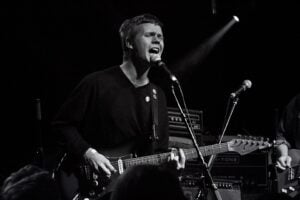
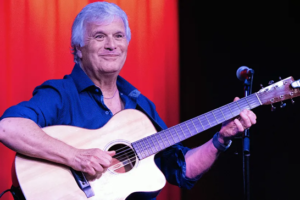
Photo: David Gans (Flickr user dgans, http://www.dgans.com/), CC BY 2.0 <https://creativecommons.org/licenses/by/2.0>, via Wikimedia Commons
Steve Goodman’s career stayed rooted in Chicago even as his songs traveled far beyond the city, moving through folk clubs, country radio, and baseball stadium speakers. A singer, songwriter, and guitarist active from 1968 to 1984, he built his reputation as a writer with a sharp ear for everyday language and a gift for choruses that other artists wanted to carry into their own catalogs. His best-known composition, “City of New Orleans,” became a modern standard through recordings by Arlo Guthrie, John Denver, Willie Nelson, and Judy Collins, and it ultimately brought Goodman a major songwriting honor. He also co-wrote “You Never Even Called Me by My Name,” which became David Allan Coe’s best-selling song, and he wrote the Chicago Cubs anthem “Go, Cubs, Go,” a piece of local identity that later took on a life of its own.
His early development followed a classic Chicago arc of schools, neighborhoods, and club stages, and then a quick leap into the wider folk circuit. Goodman was born on Chicago’s North Side and started writing and performing as a teenager. After graduating from Maine East High School in 1965, he attended the University of Illinois, pledged Sigma Alpha Mu, and then formed a cover band called the Juicy Fruits with Ron Banyon, Steve Hartmann, and Elliot Englehardt. In early 1967, he headed to New York City for a month, staying near Cafe Wha? in Greenwich Village and performing regularly, then returned to Chicago and began working key rooms such as the Earl of Old Town and The Dangling Conversation, building a devoted local following that positioned him as a serious new writer on the scene.
By the late 1960s, Goodman was already treating music as both craft and livelihood. While attending Lake Forest College, he supported himself by singing advertising jingles, and during that same period, he learned that the persistent fatigue he felt was leukemia. The diagnosis did not slow his output and added urgency to his approach to work, pushing him toward a full-time path as a performer and writer. In his personal life, he married Nancy Pruter in 1970, and the two remained closely connected to the Chicago world he came up in, even as his songs began circulating nationally.
The turning point came through a series of live-performance relationships that defined his rise. In 1971, while opening for Kris Kristofferson at the Quiet Knight in Chicago, he made an impression that led Kristofferson to introduce him to Paul Anka, and the demo sessions that followed helped Goodman land a contract with Buddah Records. Around the same time, he placed songs on Gathering at the Earl of Old Town, and he stayed deeply tied to Chicago’s Old Town School of Folk Music, where his friendship with John Prine became part of the larger story of that scene. Goodman also became a repeat performer at the Philadelphia Folk Festival, appearing six times between 1970 and 1978, and those festival years helped cement his name among audiences who cared as much about songwriting as stage presence.
“City of New Orleans” is the record industry moment that turned Goodman from a respected club writer into a songwriter with national leverage. He played the song for Arlo Guthrie at the Quiet Knight, Guthrie recorded it, and Guthrie’s version reached the top twenty in 1972, giving Goodman the financial footing to commit fully to music. Willie Nelson’s later recording earned Goodman a posthumous Grammy for Best Country Song in 1985, a recognition often described as a Grammy songwriter award for the same category. Goodman’s catalog kept crossing genre lines, too, including the country spoof brilliance of “You Never Even Called Me by My Name,” credited to Goodman and Prine in its writing history, and carried into the mainstream through Coe’s hit recording, complete with Goodman being named in the spoken epilogue.
As a recording artist, Goodman released a long run of albums that reflect both his studio work and the demand for his live performances. His discography lists eighteen albums, spanning early Buddah titles such as Steve Goodman and Somebody Else’s Troubles, the Asylum stretch that included Jessie’s Jig and Other Favorites, Words We Can Dance To, Say It in Private, High and Outside, and Hot Spot, and later releases on Red Pajamas. That later period included live titles such as Artistic Hair, archival and radio-based releases such as The Easter Tapes, and posthumous projects including Santa Ana Winds and Unfinished Business, with the latter noted for its Grammy-award connection in its release notes. Another major performance milestone came when Goodman reached broader audiences as the opening act for Steve Martin during Martin’s peak stand-up years, and when he became a regular Easter Sunday guest on Vin Scelsa’s New York radio show, from which recordings eventually fed into The Easter Tapes.
Beyond conventional album and touring narratives, Goodman left tangible civic and cultural footprints, with names, places, and institutions attached to them. His ties to the Chicago Cubs ran deep enough that he wrote “Go, Cubs, Go,” and in 2007, the Cubs began playing the song after each home win, which renewed public attention around his work. Illinois Lieutenant Governor Pat Quinn declared October 5, 2007, “Steve Goodman Day” in the state, and in 2010, Representative Mike Quigley introduced legislation to rename the Lakeview post office on Irving Park Road in Goodman’s honor, a bill that was signed into law by President Barack Obama on August 3, 2010. After Goodman’s death from leukemia on September 20, 1984, his connection to Cubs culture remained visible, including Jimmy Buffett dedicating “The Star Spangled Banner” to him on October 2, 1984, and the later scattering of some of Goodman’s ashes at Wrigley Field in 1988, echoing the theme of his song “A Dying Cub Fan’s Last Request.”
# 10 – Go Cubs Go
Steve Goodman was a Chicago native and huge Cubs fan, even though he lived at a time when the team was the laughingstock of baseball. Steve Goodman was commissioned by WGN, the network that showed Cubs games (and is even mentioned in the song.) If Chicago Cubs fans couldn’t root for a winning team, they could at least have a good song. This became played at every home Cubs game when they won from 1984 – 1987, although it enjoyed a resurgence in 2008. Originally released only as a single, it didn’t appear on an album until 1994’s No Big Surprise: Anthology, a compilation commemorating the tenth anniversary of Steve Goodman’s death.
# 9 – You Better Get It While You Can (The Ballad of Carl Martin)
This finger-snapping tune is a tribute to bluesman Carl Martin, whom Steve Goodman considered the greatest musician he ever played with. This is mostly a rap (unusual for 1984) with a sung chorus. Since Carl Martin preferred playing the mandolin, a mandolin is featured in the arrangement. Considering that Steve Goodman was battling what would be a losing battle with leukemia at the time, the lyrics are especially poignant: “From the cradle to the crypt is a mighty short trip, so you better get it while you can.” This originally appeared on the 1984 album Santa Anna Winds, which came out after he had died.
# 8 – The 20th Century is Almost Over
You can’t get more folk than writing a song with John Prine. Both of these legends put their heads together to pen this delightfully weird look at life in the late 1970s, such as linoleum floors and learning about the Great Depression from reading the magazine True Confessions. Time seemed to be going faster than in the 1800s. During live performances, Steve Goodman would say this song was inspired by his car insurance calendar, when car insurance companies used to give you annual trinkets for being a customer. Johnny Cash would do a notable cover version of this. It first appeared as the final track on Steve Goodman’s 1977 album Say It In Private.
# 7 – You Never Even Call Me By My Name
John Prine and Steve Goodman often performed together, so they wrote songs together. This time around, they decided to parody just about every country song they ever heard. And succeeded. Steve Goodman does a good Hank Williams impersonation here, especially on the word “crying.” Features gems of lyrics like, “You’re the one who always tried to change me. And that is why I’ll always stay the same.” Also features Steve Goodman singing instrumental parts, which must be heard to be believed. Manages to work trains, mothers, and jail in a particularly original way. This originally appeared on Artistic Hair in 1983, but was re-released in 2019.
# 6 – My Old Man
Many artists have written songs about their fathers, but few show both the good and the bad sides of their dads. It’s an achingly beautiful song, but not too sentimental. “And, oh, the fights we had,” he tenderly sings, but then makes us miss his old man just as much as he misses him. Somehow, his old man is also your old man. When he sings, “And I’d give everything I own just to hear what he said when I wasn’t listening”, you do, too. It originally appeared on Steve Goodman’s 1977 album Say It In Private. John Prine would go on to perform this many times, even though he wrote a song for his father, “Paradise.” When it was time for Steve Goodman’s daughter to put out a tribute album in 2006, she called it My Old Man.
# 5 – Talk Backwards
This is a goofy, jazz-flavored song that does just what the title says: talks backwards. But only at certain times. Much of it is talking forwards, in a scat-like rap. It’s an imaginative song that emphasizes just what a unique songwriter Steve Goodman was. This is yet another gem from the 1984 album Affordable Art. Unlike most other Steve Goodman songs, the guitar is not prominently featured, but it does have a big band.
# 4 – Banana Republics
Jimmy Buffett recorded a few of Steve Goodman’s songs, but this arguably is the best one. It’s smooth yet danceable, with touches of tequila and tourism. Goodman takes a look at Americans in Latin America, those running from the IRS and those buying “secondhand American dreams.” The poetry is exquisite, accompanied by fine harmonies and a flute-heavy accompaniment. Steve Goodman’s version originally appeared on his 1976 album Words We Can Dance To. Jimmy Buffett’s version would appear a year later.
# 3 – A Dying Cub Fan’s Last Request
This is a funny song about baseball that’s even funny to people who can’t stand baseball. It’s too bad that Steve Goodman never lived long enough to see the Chicago Cubs do the seemingly impossible by winning the World Series in 2016. It only took 108 years. In that time, there have been many perpetually disappointed yet fanatically devoted Chicago Cubs fans. Steve Goodman was one. After his death, some of his ashes were thrown on Wrigley Field. In some ways, this was a more affectionate tribute to being a Cubs fan and the Cubs than “Go Cubs Go.” Although performed live since 1981, a studio version did not appear until the final album released while he was still alive, 1984’s Affordable Art. The album was reissued in 2019 with a new disc of extras.
# 2 – City of New Orleans
This Steve Goodman composition has been covered so many times that you have to wonder which artists haven’t covered it. Arlo Guthrie’s 1972 version is best known. There’s something about train songs that appeals to even people not all that fond of trains. This one is particularly picturesque, pairing visions of nostalgia with borderline ugly banality. Steve Goodman reportedly got the idea for his best-known song while (surprise, surprise) riding on a real train called City of New Orleans. Steve Goodman’s first version appeared on his 1971 debut album, simply titled Steve Goodman.
# 1 -Vegamatic
Once upon a time, there were very few television programs late at night. There were, however, many ads. Steve Goodman takes the notion of subliminal messages in advertisements to a new level here, singing as a man who sleep-shops. Those readers of a certain age can easily remember what a Veg-O-Matic was, as well as Ginsu knives, telephones with wires, and those K-Tel record compilations. This is one of those songs you hear and remember years later. That’s why it tops our list of 10 best Steve Goodman songs. It originally appeared as a live track on Affordable Art.
Check out similar articles on ClassicRockHistory.com Just click on any of the links below……
Read More: Artists’ Interviews Directory At ClassicRockHistory.com
Read More: Classic Rock Bands List And Directory
Read More: 100 Essential Albums From The 1960s That Everyone Should Own
Updated February 11, 2026
Top 10 Steve Goodman Songs article published on ClassicRockHistory.com© 2026
Classicrockhistory.com claims ownership of all its original content and Intellectual property under United States Copyright laws and those of all other foreign countries. No one person, business, or organization is allowed to re-publish any of our original content anywhere on the web or in print without our permission. All photos used are either public domain Creative Commons photos or licensed officially from Shutterstock under license with ClassicRockHistory.com. All photo credits have been placed at the end of the article. Album Cover Photos are affiliate links and the property of Amazon and are stored on the Amazon server. Any theft of our content will be met with swift legal action against the infringing websites.












if you are not familiar with Steve Goodman you should listen to Six hours ahead of the sun and The loving of the game for starters. They are better than most of the songs on this list
Well, that’s your opinion, and one you are most certainly entitled to.
Steve Goodman should be revered like Georges Brassens is in France. More young artists should sing his repertoire. he was such a musical genius with such witty lyrics.