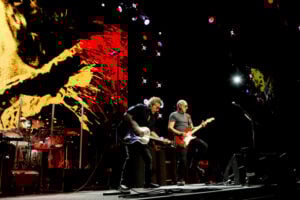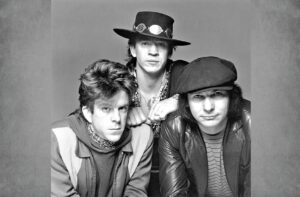
Feature Photo: Photo: By Don Hunstein (MTV) [Public domain], via Wikimedia Commons
Stevie played with unmatched intensity, weaving conviction, intricacy, complexity, delicacy, and explosive power into his performances, making it seem almost otherworldly that this human being walked among us. Like his idol Jimi Hendrix, Stevie had a presence that set him apart from mortals. Yet, while Hendrix’s style had a raw, unpolished grit, Stevie added a refined ruggedness that was uniquely his own.
Stevie’s musical journey began at a young age when he was inspired by his older brother, Jimmie Vaughan. He taught himself guitar by playing along to records by many of his influences, including Albert King, B.B. King, Freddie King, Muddy Waters, Albert Collins, Johnny “Guitar” Watson, Wes Montgomery, Django Reinhardt, Chuck Berry, and Lonnie Mack.
At seventeen, Vaughan left high school and moved to Austin to pursue music full time. He played in several bands before the Triple Threat Revue evolved into Double Trouble, a name taken from the Otis Rush song. Drummer Chris Layton joined in 1978, and Tommy Shannon later became the band’s bassist. After years of building a reputation in the Texas club scene, Vaughan and Double Trouble landed a spot at the 1982 Montreux Jazz Festival, where they caught the attention of Jackson Browne and David Bowie. Browne offered the band the use of his Los Angeles studio, while Bowie recruited Vaughan for Let’s Dance. The rest was certainly history in the making.
Vaughan’s career continued to soar even as alcoholism and cocaine addiction were taking a devastating toll. During a European tour in 1986, he collapsed and finally sought treatment, beginning the sobriety that would transform the final years of his life and career. Live Alive, released in 1986, had been assembled from performances recorded before and around that turning point. After getting clean, Vaughan returned to extensive touring, including dates opening for Robert Plant, festival appearances, and European shows, before recording his fourth studio album with Double Trouble, In Step, in 1989. In 1990, he recorded Family Style with his brother Jimmie. On August 26, 1990, Vaughan performed at Alpine Valley Music Theatre in East Troy, Wisconsin, where the evening ended with a famous encore jam involving Eric Clapton, Buddy Guy, Jimmie Vaughan, and Robert Cray . After the concert, Vaughan boarded a helicopter that crashed shortly after takeoff, killing him at the age of 35.
Much like with all of the other greats who have died young, there’s no telling how far his talents could have soared. But we only have his indelible work to marvel over for many years. So here’s to one of the best blues guitarists of his time and one of the greatest to ever walk the Earth: Stevie Ray Vaughan!
# 10 – The House Is Rockin’ – In Step (1989)

Now this is what you call a party song! “The House Is Rockin'” kicks off In Step, Stevie Ray Vaughan and Double Trouble’s final studio album released during Vaughan’s lifetime. Written by Vaughan and Doyle Bramhall, the track was recorded on February 10, 1989, during the In Step sessions and produced by Jim Gaines with Vaughan and Double Trouble. Stevie is joined by Tommy Shannon on bass, Chris Layton on drums and percussion, and Reese Wynans on keyboards. The song is short, loud, loose, and completely infectious—the perfect way to open an album that found Vaughan sounding renewed and fully alive.
# 9 – Couldn’t Stand the Weather – Couldn’t Stand the Weather (1984)

“Couldn’t Stand the Weather,” the title track from Stevie Ray Vaughan and Double Trouble’s second studio album, captures Vaughan at full force. Recorded at the Power Station in New York on January 18, 1984, the song was written by Stevie Ray Vaughan and features Tommy Shannon on bass, Chris Layton on drums, and Jimmie Vaughan joining his younger brother on guitar. The stop-start riff, shifting dynamics, and fiery guitar exchanges turn the track into one of the most distinctive original compositions of Vaughan’s career.
# 8 – Rude Mood – Texas Flood (1983)
![Stevie Ray Vaughan/Stevie Ray Vaughan & Double Trouble - Texas Flood [Legacy Edition] [Digipak]](https://m.media-amazon.com/images/I/51vIFTZ7V+L._SL500_.jpg)
“Rude Mood,” the instrumental from Stevie Ray Vaughan and Double Trouble’s debut album Texas Flood, is a tour de force that captures the speed, swing, and ferocious attack of Vaughan’s early playing. Recorded during the remarkably fast Texas Flood sessions at Jackson Browne’s Down Town Studio in Los Angeles, the song draws from the Texas blues-shuffle tradition and shows just how much rhythmic work Vaughan could make one guitar do at once. “Rude Mood” earned Vaughan a 1984 Grammy nomination for Best Rock Instrumental Performance, a remarkable achievement for a debut-album instrumental that still sounds like somebody lit a match under the blues.
# 7 – Little Wing – The Sky Is Crying (1991)

Stevie Ray Vaughan’s instrumental rendition of Jimi Hendrix’s “Little Wing,” released posthumously on The Sky Is Crying in 1991, stands as one of the most beautiful tributes he ever recorded to his idol. Vaughan cut the track at the Power Station in New York during the 1984 Couldn’t Stand the Weather sessions, with Tommy Shannon on bass and Chris Layton on drums, but it was left off that album and did not receive its major official release until after Stevie’s death. Rather than imitate Hendrix, Vaughan stretches the composition into his own language, moving between delicacy and enormous emotional power without ever needing a vocal.
# 6 – Life Without You – Soul to Soul (1985)

“Life Without You,” the closing track from Stevie Ray Vaughan and Double Trouble’s 1985 album Soul to Soul, is one of the most heartfelt songs Vaughan ever wrote. Recorded during sessions at Dallas Sound Lab in Irving and Riverside Sound in Austin, the track places his guitar and vocal at the center of a slow, emotional performance that feels almost like a farewell even though it was recorded years before his death. Vaughan later used extended live performances of “Life Without You” to speak directly to audiences about life, loss, and eventually the dangers of drugs and alcohol, giving the song an emotional weight that continued to grow beyond the studio recording.
# 5 – Voodoo Child (Slight Return) – Live Alive (1986)
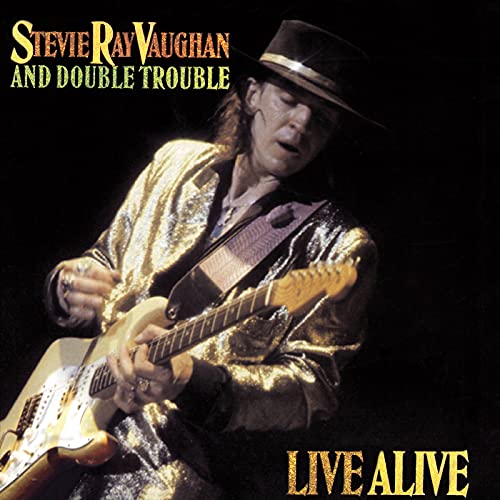
“Voodoo Child (Slight Return)” is a song Stevie Ray Vaughan made unmistakably his own even though it was written and first recorded by Jimi Hendrix. Our pick here comes from the 1986 live album Live Alive, which was assembled from performances recorded at the Montreux Jazz Festival, Austin Opera House, and Dallas Starfest during 1985 and 1986. Vaughan’s version keeps the wah-wah fire and psychedelic spirit of Hendrix’s original while pushing it through his own Texas blues attack, resulting in an extended guitar showcase that became one of the essential highlights of his live repertoire.
# 4 – Tin Pan Alley – Couldn’t Stand the Weather (1984)
This nine-minute performance from Couldn’t Stand the Weather is nothing short of dulcet magnitude. “Tin Pan Alley (aka Roughest Place in Town),” written by Robert Geddins, surrounds the listener with the atmosphere of a dark, smoke-filled bar straight out of Raymond Chandler noir. Vaughan never needs to become grandiose; he lets the song unfold slowly, using space, tone, and restraint as powerfully as speed. Recorded at the Power Station in New York during the 1984 album sessions, it remains one of the greatest examples of how devastating Stevie Ray Vaughan could be when he slowed everything down.
# 3 – Riviera Paradise – In Step (1989)
Stevie was a true master at his craft, a champion of every style of blues imaginable, and “Riviera Paradise” showed how far beyond traditional blues language he could travel. The closing instrumental on In Step, written by Vaughan, blends blues with jazz in a slow, spacious performance built around his guitar and Reese Wynans’ keyboards, with Tommy Shannon and Chris Layton supplying the subtle foundation underneath them. Coming from the album that followed Vaughan’s recovery and sobriety, the track feels calm, reflective, and almost transcendent—a glimpse of musical directions he might have explored much further had he lived.
# 2 – Crossfire – In Step (1989)
“Crossfire” captures the triumphant comeback at the heart of In Step. Written by Bill Carter, Ruth Ellsworth, Chris Layton, Tommy Shannon, and Reese Wynans, the track locks into one of the toughest grooves Double Trouble ever recorded, with Vaughan’s vocal and guitar riding over Shannon’s bass line, Layton’s drums, Wynans’ keyboards, and the Texacali Horns. Released in 1989, “Crossfire” became Vaughan’s only number-one hit on Billboard’s Album Rock Tracks chart and showed that the newly sober guitarist had lost none of his fire—in fact, he sounded more focused than ever.
Read More: Stevie Ray Vaughan David Bowie Tour: Why It Never Happened.
# 1 – Pride and Joy – Texas Flood (1983)
When Texas Flood arrived in 1983, it hit blues-rock like a bolt of lightning, and “Pride and Joy” became the song that introduced countless listeners to Stevie Ray Vaughan and Double Trouble. Written by Vaughan and recorded during the remarkably fast sessions at Jackson Browne’s Down Town Studio in Los Angeles, the song combines a traditional Texas shuffle with the kind of guitar playing that made it sound as if rhythm and lead were happening at the same time. “Pride and Joy” reached number 20 on Billboard’s Mainstream Rock chart and became Vaughan’s signature song, a perfect gateway into the power, precision, soul, and sheer joy that defined his playing.
Read More: Complete List Of Stevie Ray Vaughan Albums And Discography
Check out similar articles on ClassicRockHistory.com Just click on any of the links below……
Read More: Complete List Of Stevie Ray Vaughan & Double Trouble Band Members
Read More: Complete List Of Stevie Ray Vaughan Songs From A to Z
Read More: Artists’ Interviews Directory At ClassicRockHistory.com
Read More: Classic Rock Bands List And Directory
Updated September 4, 2026.
Top 10 Stevie Ray Vaughan Songs article published on ClassicRockHistory.com © 2026