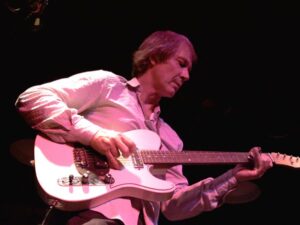
Feature Photo courtesy of Jim Weider
Seeing as Jim Weider grew up in Woodstock, New York, and knew most of The Band’s original members, when Levon Helm, Garth Hudson, and Richard Manuel first reformed The Band back up in the ‘80s, he made for a perfect replacement for guitarist Robbie Robertson, who wasn’t interested in a reunion.
In Weider, The Band found a kindred spirit who understood its mission statement: creating and playing music for the people and places they grew up around. But it wasn’t easy, and Manuel committed suicide in 1986.
Hard as that was to manage, The Band soldiered on, reeling off three latter-day albums in 1993’s Jericho, 1996’s High on the Hog, and a final record, 1998’s Jubilation, before Garth Hudson’s death in 1999 sidelined The Band for good.
Since then, Weider has continued to champion The Band’s music, forming The Weight Band in 2013 and releasing two studio records, 2018’s World Gone Mad, and 2022’s Shines Like Gold, and two live records, 2019’s Acoustic Live, and 2020’s Live Is a Carnival.
This is especially important as Levon Helm died in 2012, and Robbie Robertson, whom Weider never met or spoke with, died in 2023, making the 74-year-old Weider the keeper of the proverbial Band-related flame. This is fine by Weider, who hopes to release more music in the future.
As for how he hopes he and his music will be remembered, he tells ClassicRockHistory.com, “I hope the fans feel the music I write and make them remember something, like their home, their parents, and friends. And I hope it brings them a little closer together in these divided times.”
What are the earliest memories of music in your life, and what inspired you to pick up the guitar?
I would say Elvis, Chuck Berry, and The Ventures. And then, of course, the British Invasion bands, like The Beatles, The Rolling Stones, and The Yardbirds. And with the guitar, my father played a little guitar, but Elvis and Scotty Moore’s playing, James Burton on the Ricky Nelson show, and Steve Cropper.
How did the scene you grew up in affect you as a player, and overall, as a young musician, and what was it like coming up in the wild ‘60s and ‘70s?
Well, I grew up in Woodstock, NY. You had amazing guitar players like John Hall, Buzzy Feiten, who was in the Paul Butterfield Band, Robbie Robertson, Dave Sanborn, and many more! Music was developing, taking chances, and the blues, folk, rock, and jazz were cross-pollinating.
How did you first meet the guys in The Band and end up joining them as a replacement for Robbie Robertson in the ’80s?
I met Levon [Helm], Garth [Hudson], and Rick [Danko] when they were living here. They came into a high-end stereo music store that I worked at. In the early ‘80s, I started working with Levon’s All Stars, then Rick moved back to Woodstock.
I worked some shows with Levon and Rick. Then, when Garth and Richard Manuel moved back to town, Levon asked me to tour with The Band in 1985 with Crosby, Stills & Nash tour, and I stayed with them for 15 years and a lot of road miles.
What appealed to you about The Band musically? Did you have an idea that the new version of The Band would be different and could have an impact?
The Band’s music was really about American stories, about the working man, and the mountains in Woodstock. It was a Woodstock sound, combining blues, folk, and rock. We had the original lineup of five members and recorded some songs. The first year I joined, I was very excited.
What can you say about the evening that Richard Manuel, unfortunately, committed suicide? Was the writing on the wall that he was in a bad place?
It was a rough time. He was fighting demons. I felt bad for him, and we all had his back. It was a very hard, terrible time when that happened. After losing Richard, we toured on, and we formed a ’90s group with two new members. We made some great records.
How did things change, leading to the recording of the now-classic albums Jericho, High on the Hog, and Jubilation?
Well, we toured on, and then, as I stated above, we added Richard Bell on keyboards and Randy Ciarlante as an extra drummer and vocalist to play with Levon. But The Band’s music ended when Rick died in December of 1999.
You helped create the AnalogMan King of Tone pedal, a beloved overdrive pedal used around the world. How did that happen, and did its success take you by surprise?
Well, I had used an [Ibanez] Tube Screamer [overdrive] for years, but never liked the loss of bottom and change of natural tone [mid hump]. So, we modelled the King of Tone after my modified ‘65 [Fender] Deluxe Reverb amp to get that natural breakup and tone. I’m glad that people like the pedal so much. It was great to work with Mike Piera of AnalogMan, and we’re still close friends.
Are you still friends with any of your remaining former bandmates, and would you reunite with them as The Band if the option were on the table?
All my former bandmates are dead except for Randy Ciarlante, and he’s not touring anymore. I started The Weight Band in 2013 after Levon died in 2012. We’ve been touring since, and we put out two studio albums, World Gone Mad and Shines Like Gold, and a live-in-Japan album, also playing classic Band songs and continuing the Band’s sound and legacy.
How were your relations and communications with Robbie over the years? It’s been said that he had a lot of issues with his former bandmates. Did he treat you nicely?
He was the only one that I have never met or spoken with.
What’s next for you, and do you have any regrets?
I’m wanting to write some music that’s healing and combine it with film to perform live. I don’t have many regrets musically. I set out to play music and stuck to it through all the hard times because of a passion that drove me. And if you have that, and stay with it, that’s the big reward.
Check out similar articles on ClassicRockHistory.com Just click on any of the links below……
Read More: Artists’ Interviews Directory At ClassicRockHistory.com
Read More: Classic Rock Bands List And Directory
An Interview With Jim Weider Of The Band article published on ClassicRockHistory.com© 2026
Classicrockhistory.com claims ownership of all its original content and Intellectual property under United States Copyright laws and those of all other foreign countries. No one person, business, or organization is allowed to re-publish any of our original content anywhere on the web or in print without our permission. All photos used are either public domain Creative Commons photos or licensed officially from Shutterstock under license with ClassicRockHistory.com. All photo credits have been placed at the end of the article. Album Cover Photos are affiliate links and the property of Amazon and are stored on the Amazon server. Any theft of our content will be met with swift legal action against the infringing websites.