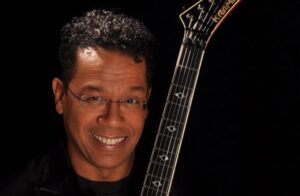
Feature Photo courtesy of Carlos Alomar
Before joining David Bowie’s band in the ‘70s, Bronx-native Carlos Alomar had performed with Chuck Berry and James Brown and was getting steady with the Main Ingredient and RCA Records. Life was good.
On the surface, it seemed like Alomar and Bowie didn’t need each other, but as they soon found out, the pairing was a match made in heaven. After hooking up with Bowie and forming a backing band called The D.A.M. Trio, which would come to define Bowie’s work in the ‘80s.
Alomar helped the halcyon glam rocker reel off iconic albums in 1975’s Young Americans, 1976’s Station to Station, 1977’s Low, 1979’s Lodger, and 1980’s Scary Monsters. During this time, Alomar was Bowie’s trusted friend and bandleader as well.
Even though Bowie moved away from The D.A.M. Trio in the ‘80s, Alomar kept working with Bowie on 1985’s Tonight, 1987’s Never Let Me Down, 1995’s Outside, 2002’s Heathen, and finally, 2003’s Reality, before the two parted ways professionally.
Even though they weren’t recording together anymore, Alomar remained friends with Bowie through the end of his life, which is why he’s celebrating his old pal’s music now. The timing is perfect, as retrospect has led to love and praise being showered on The D.A.M. Trio’s era.
Also perfect is Alomar’s refined approach to playing. “I have amassed a huge arsenal of music in my life,” he tells ClassicRockHistory.com. “I now listen more, and by playing less, I can say more. It’s all in the pocket, and in the groove. Technique fades… intent sharpens. I’m no longer trying to prove anything. I’m trying to tell the truth in fewer notes.”
Outside of Bowie, Alomar has appeared on records by The Pretenders, Paul McCartney, Cyndi Lauper, the Bee Gees, Mark Ronson, and more. But at this point, his focus is honed on celebrating his time with Bowie. “It’s about completing my history, but not my story,” he says.
“I’d like to leave a map—not instructions—a map, for younger musicians to understand that collaboration, curiosity, and integrity are eternal,” he explains. “You don’t chase relevance. You chase truth. Your truth… and if you’re lucky, relevance follows.”
What inspired you to pick up the guitar—and what keeps you inspired to pick it up today?
I didn’t choose the guitar… it chose me. I was only 10 years old when I saw the glistening glow of the tuning pegs of a guitar in my older brother’s room. That was it… as a Pentecostal minister’s son, music was alive in church.
I grew up surrounded by rhythm, not theory, not lessons, life rhythm. The guitar became my translator. It let me say things I didn’t yet have language for. At first, it was survival. Later, it became purpose.
What keeps me picking it up today is the same thing: curiosity. If I ever feel like I “know” the instrument, that’s the day I should put it down. The guitar still asks questions. I still chase answers.
What sort of scene did you grow up in, and how did that shape you?
I was born in Ponce, Puerto Rico, but I grew up in New York – the Bronx, Harlem, and Manhattan at a time when music wasn’t boxed in. Jazz musicians were playing with R&B players. Latin rhythms lived next door to gospel. Soul, funk, rock — it was all one conversation. That taught me something early: music is not a genre — it’s an intention. That idea stayed with me my entire life.
Tell us about playing with Chuck Berry. What was that like?
Chuck Berry was the source code. Playing with him wasn’t about interpretation. It was pure Rock and Roll. He set me straight with one response: “Boy! You don’t rehearse rock ‘n’ roll.” It was about respecting the engine. His music was direct, unapologetic, and physical. No frills. No excuses. You didn’t “add” to Chuck Berry, you locked in. It taught me restraint. And restraint is power.
And how about James Brown?
James Brown was discipline disguised as chaos. Find that groove. James taught me that rhythm guitar is not accompaniment, it’s command. There were three guitarists… find your place. People think funk is loose, but it’s not. It’s military precision with soul. Lock it down…
Every stroke mattered. Every accent had a purpose. Find that special lick for the “Bridge.” If Chuck Berry gave us the blueprint, James Brown taught us how to operate the machine when he said, “Hit Me!”
How did you join David Bowie’s band?
David was ending one life and beginning another. Ziggy was gone. He was searching — and I was searching too. I was touring with The Main Ingredient after their hit song, “Everybody Plays the Fool,” as well as working as a session musician at RCA studios.
I was called to do a session for Lulu, and David Bowie was the producer. I was bold enough to walk up to David and comment that he was way too thin, and that he should come to my house for a meal… which he accepted.
When we met, it wasn’t about guitar parts. It was about trust. He didn’t hire a guitarist — he invited a collaborator. We met, became friends, recorded an album, got a number one hit song with John Lennon… that was it. That distinction matters.
Were you influenced by guitarists who were in David’s band before you?
Absolutely not! I was not interested in lead guitar. Lead guitar is found within rhythm guitar… they are one, to me. Mick Ronson brought drama and orchestration. I brought architecture and rhythm. I wasn’t there to replace anyone. I was there to reframe the role of guitar inside David’s evolving identity.
What’s it like working with David? How do you form songs together?
David worked from concept. I worked from feel. We met in the middle: author and composer. I’d build a rhythmic spine — something that could breathe, bend, and survive transformation. He’d paint characters, worlds, and emotional geometry over it. That’s how songs were born: structure meets imagination.
What’s a nuance in David’s music most people don’t pick up on?
Space. David understood negative space the way painters do. He knew when not to sing. When not to fill. When to offset his vocals, to make the listener take note of his lyrics. That silence? That’s where the tension lives.
What is the definitive Bowie record from your era?
There isn’t one — and that’s the point. Each record was a chapter, not a destination. If you freeze one moment, you miss the journey. But… Scary Monsters truly defined who the D.A.M. trio [drummer Dennis Davis, guitarist Carlos Alomar, and bassist George Murray] was, and their departure from the Bowie world left a definitive mark on his sound.
In the ’80s, you worked with Paul McCartney and The Pretenders. What was that like?
Paul is melody incarnate. Effortless, generous, deeply musical. And a true family man… the kind of guy that is always welcomed by his mates at the local pub. Pressed to Play was just a fun album and a delightful way of being introduced to the English countryside as well.
The Pretenders were raw truth — attitude with intelligence. I was called in by Jimmi Iovine to help them with their Get Close album. The outcome was a song called “Light of the Moon.” As always, Chrissie Hynde delivered a masterful performance. No safety net. Just commitment. Both experiences reminded me that great music is about presence, not reputation.
More recently, you played a role in Mark Ronson and Bruno Mars’ “Uptown Funk” but weren’t properly credited. What happened?
History isn’t always tidy. My rhythmic DNA is in that track — that’s undeniable. Credit systems don’t always reflect lineage. But here’s the thing: influence doesn’t disappear because it’s uncredited. It travels. It mutates. It survives. But if you need a definitive answer… ask the producer.
What gear are you using these days?
I love efficiency, so less is more. Instrument-tone-effects. That’s it! I choose tools the way architects choose materials. How does it respond? Does it translate touch? Does it stay out of the way, or does it lead me to more choices?
Gear should serve the idea, not announce itself. So… I always (and still) use my Alembic guitar “Maverick” for songwriting. And I have a Brian Moore synthesizer guitar in stereo for any instrument imaginable, a Boss GT 1000 core for any amplifier and/or distortion effects, and finally, a TonePrint Plethora X3 for special effects
What are your short- and long-term goals? How will you achieve them?
Short-term: to tell the story accurately, musically, historically, and emotionally. That’s why I launched Carlos Alomar presents the D.A.M. Trilogy Tour Back to Berlin. The tour was a declaration of the D.A.M. Trio’s (Davis, Alomar, Murray) influence.
And also their influence on David Bowie’s music during one of his most expressive eras: Station to Station, the Berlin Trilogy, and Scary Monsters. As for the long-term, to complete the Bowie “Triology-B2B” tour in America and then launch The Soulfulness of David Bowie tour.
Check out similar articles on ClassicRockHistory.com Just click on any of the links below……
Complete List Of David Bowie Songs From A to Z
Read More: Artists’ Interviews Directory At ClassicRockHistory.com
Read More: Classic Rock Bands List And Directory
An Interview With Former David Bowie Guitarist Carlos Alomar article published on ClassicRockHistory.com© 2026
Classicrockhistory.com claims ownership of all its original content and Intellectual property under United States Copyright laws and those of all other foreign countries. No one person, business, or organization is allowed to re-publish any of our original content anywhere on the web or in print without our permission. All photos used are either public domain Creative Commons photos or licensed officially from Shutterstock under license with ClassicRockHistory.com. All photo credits have been placed at the end of the article. Album Cover Photos are affiliate links and the property of Amazon and are stored on the Amazon server. Any theft of our content will be met with swift legal action against the infringing websites.