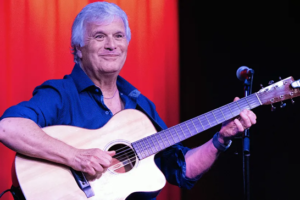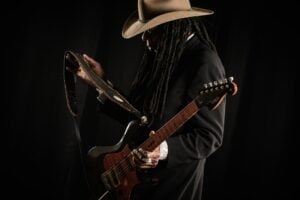
Feature Photo by John Francis
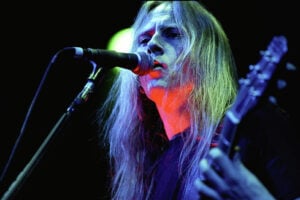
Larry Mitchell has toured with Billy Squier, played on Rick Ocasek’s records, and is great friends with, and has shared the stage with, Steve Stevens, Nile Rodgers, and Steve Vai. He’s a player’s player; a session legend, and always in demand.
These days, Mitchell is focused on his production work, new music, and boatloads of touring for 2026. The plan is to trek overseas, as he loves to do, hit the festival circuit, and do what he does best: rip it up on guitar and deliver groovy music for concert-loving fans.
Mitchell’s outlook is always sunny, and his vibe is always cool as the other side of the pillow. “Regrets are a hard thing,” he tells ClassicRockHistory.com. “Everything in the past has led right up to this very moment I’m in right now. So, changing anything would lead to a completely different outcome. So, it’s all good.”
What are your first memories of music in your life?
Strumming a broom to Elvis songs on the radio and TV, Junior high school Battle of the Bands competition, and getting my first electric guitar from Sears or JCPenney. Not sure where, but that’s the kind of store it was.
What drew you to the guitar, and when did you decide the sort of player you wanted to be?
I don’t really know what drew me to it, as far as I can remember, the guitar and drums were always a thing. Once, my mother threw my drums out the back window on the third floor because I was playing while she was trying to watch TV. That pretty much sealed the guitar decision for me.
How did the scene you grew up in impact you as a player?
In junior high and high school in Far Rockaway, Queens, I hung out with a group of friends who were into Funk and R&B, and then I played in a rock band with friends from school. They took me to see my first rock concert, Van Halen 1979. Life-changing it was.
The local guitar hero in Far Rockaway was Steve Stevens (Billy Idol). He and my friend Jeff Thall (Bryan Ferry) were big Sonic influencers. After high school, there was always a group of guitarists that hung out swapping guitar licks and thoughts.
My friend Jon Levin lived in the neighborhood. I spent many evenings at Jon’s house, and we used to see Long Island guitarists play. Jon is the guitarist in the band Dokken now. After High School, I was in a Rush tribute band. We played all over Long Island and Queens.
Tell us about your early gigs and how you got into session work.
After I started going into Manhattan almost every day in the mid-1980s, I joined a band called the Rhythm Team, led by drummer and singer Steve Missal. He owned a rehearsal and small recording studio called Shelter Studios in the Music Building on 8th Avenue and 38th Street in Manhattan.
People would see me play live gigs with different bands and then ask me to record on their songs in the studio. A lot of that was at Shelter studios at first, then to bigger studios. Toward the late 80’s, I did some Ghost playing. Mostly young up-and-coming rock bands that had the look but not quite the chops. That was a big unspoken thing back in the late ‘80s and early ‘90s.
Your career really took off after working with Ric Ocasek on Fireball Zone. Tell us about that. Were you a fan of Ric and Elliot Easton’s work in The Cars, and did that style factor into what you were doing?
I was taken by surprise by playing on the Fireball Zone record. I ran into Nile Rodgers one night at the China Club, and he said, “Hey, what are you doing tomorrow?” I said, “Whatever you want me to do.” He had a song that needed a guitar solo on Ric’s record. I went in and played the solo, which was an amazing experience.
I grew up a fan of Nile and The Cars, but really only knew Elliot Easton. I was guitar-focused; Elliot played some great, memorable solos and parts on The Cars’ records. Afterward, Ric invited me to his place to hear more of the songs, and the next thing I knew, a week later, I was back in the studio with him and Nile playing on a lot more songs.
Not long after, you worked with Tracy Chapman. How did that come about, and what was that like?
Ric and Tracy had the same management for a little bit, and I guess my name came up when Tracy was looking for a guitar player. Vernon Reid had played guitar on the single, “Bang Bang Bang,” I believe, so they had a bit of a rock player in mind.
That was a wonderful time and tour playing with Tracy. Absolutely one of the most impressive, consistent acoustic guitarists I have met. Everything was the same. Perfect. Everything she played. Dynamics, tone, everything played exactly the same, every time.
What led you to play with Steve Vai? What was he like? And what did that experience teach you?
I was very aware of Vai in my Long Island days. I think I saw the David Lee Roth tour like seven times. [laughs] Then in 1988, I became an Ibanez Guitars artist. I finally got to meet Steve then. I was fortunate enough to play some of the big Ibanez NAMM show jams and showcases, and so got to know Steve a bit more. He was a big influence on why I wanted to play Ibanez Guitars back then. I was an Ibanez artist for 26 years.
In 2008, I believe, Ibanez asked me to be a part of their 100th celebration. It was Andy Timmons, Paul Gilbert, Steve Vai, Marty Friedman, and me, along with Simon Phillips, Pat Torpey, and Jeff Bowers. That was the first time just sitting and talking with Steve, and just hanging out. I had just won my Grammy Award, which might have helped me elevate my status a little.
We spoke a lot about warming up before a show and then on to life things. We all jammed for the final song. I was lined up after Steve and before Andy, and I was like, “Wait a minute. Who set this order up?” Steve was amazingly supportive. Even shouting supportive, encouraging things right next to me while I was doing my solos, and that, my friend, is unnerving as can be.
Cool, but you realize that Steve Vai is yelling supportive things at you after he just played some amazing, crazy, cool stuff, and then you realize in a few measures Andy Timmons will be taking over. It was interesting! We stayed in touch, and a few years later, he was touring through Alabama.
I texted him that I was coming, and he invited me to sit in and play with them—so much fun. Usually, when we jam, he just looks at me and says, “Start something groovy,” and we get funky. At one of his shows and a very funky jam, Steve asked me if I would be interested in teaching at a Vai Academy. I have been doing it since then, and they are a blast.
I was fortunate enough to open shows for Steve on his last solo tour in 2023 and a couple in 2024, I believe. All on the East Coast. Playing with Steve has taught me to embrace the freedom and the spiritual side of guitar playing. Embrace the flow from one note to the next, and of course, to have fun on stage and in the music.
You also worked with Billy Squier. Tell us about that.
Playing with Billy was wild. It was 1991, and it was my first proper Rock tour! Billy is a great guitar player! I think it is very underrated. His timing and rhythm playing is spot on and in the groove. He also has some great phrasing for solos. I wish I had been into vintage guitars back in 1991.
Billy has a 1958 sunburst Les Paul, two 1957 Gold Top Les Pauls, one with P90s, the other with humbuckers, a 1959 Les Paul Jr with P90’s, and a [Fender] Nocaster on the road. A 100 Plexi for Clean and a 50 Watt JCM800 for Leads, with an AB box and a Wah.
I have a Bradshaw rig with four different preamps and a lot of Ibanez guitars. We were so opposite. I only wish I had gotten into vintage guitars then, when the prices were somewhat reasonable. We had nice moments on stage.
What’s been the key to your guitar rig, and where does it stand today?
Delay has always been the staple. Back when I got my first big tour, Miguel Bose in Spain and Italy. I spent $2,800 on a TC Electronic 2290. Before that, I never had a whole rig that added up to that much money. But I love delays. I had a Deluxe Memory Man and a Boss DE-200 Half Rack delay, etc. That was the crazy Big Heavy 16 space Rack Days. Then, in the mid-90s, I went back to a small pedalboard and two small 15-watt tweed-covered Fender Pro Juniors—still some of my favorite amps.
I got into amp modeling in 2007/2008 with Fractal Audio. Had the Ultra, then the Axe Fx 2, AX8, and now the FM3 and new AM4. I love that I can get on a plane with my whole rig as carry-on, and it is way more versatile than all of my past rigs combined. The flexibility of routing and instant changes, and it just gets better and better all the time. It’s like you are limited by your own mind. Dream up tones and textures, and then figure out how to do it.
You’re friendly with Steve Stevens, who helped you get your signature guitar off the floor, right?
Steve has been great! I love guitars and guitar factories, etc. I used to go to Maryland for about a month every year and teach a workshop. Produce a record for Native American Artist Dawn Avery, who ran the music department there. I had just been invited to the Gibson Custom Shop in Nashville, and that was fun, so I wanted to see PRS. But that was not possible at the time.
Since I was going to be in Maryland for a month, I remembered that Steve was working with a new company, Knaggs Guitars. So, I contacted Steve and asked if he could check and see if I could just come by and see where they made them. He wrote Joe Knaggs and Peter Wolf one of the nicest letters, and Joe said, “Come on by!”
I was not looking for an endorsement. After 26 years with Ibanez, things had kind of changed a bit. I had just let the artist relations/marketing guy, Mike, know that I was still playing my Ibanez guitars they made for me, but also planned on starting to play some Les Pauls and Strats out live.
I went, met Joe Knaggs, and spent a good part of the day just talking with him and learning about his history with PRS, his role in creating the Private Stock program there, and some of his concepts for building guitars. Then he invited me to play some of the guitars that he had completed there. Kind of nerve-racking when you think about the prices, especially since they were custom ordered.
I did not want to put a scratch of any kind on them. They were all great. I kept saying to myself, “This isn’t really my thing,” you know, type of guitar, but after playing it a little, I was like, “But it could be!” [laughs] After spending most of the day there, Joe walked me out to the car and offered to build me a guitar. When a Master Builder offers to build you a guitar, you simply say, “Thank you very much. That would be great!”
What’s something about you as a musician—and listener—that might surprise fans?
I listen to a ton of Prince, Tori Amos, and Peter Gabriel. I’m a Sci-Fi guy. I love Star Wars, Star Trek, Battlestar Galactica, etc. [laughs]
What’s next for you?
Just producing more records. I produce a lot of world music, adult contemporary, rock, and Native American music. And I am touring around the world, and I try to get to Australia every year. Europe this year. I’m heading to Poland for the first time for the Krakow Guitar Festival in April. I’d love to see more of the world!
Check out similar articles on ClassicRockHistory.com Just click on any of the links below……
Read More: Artists’ Interviews Directory At ClassicRockHistory.com
Read More: Classic Rock Bands List And Directory
An Interview With Guitarist Larry Mitchell article published on ClassicRockHistory.com© 2026
Classicrockhistory.com claims ownership of all its original content and Intellectual property under United States Copyright laws and those of all other foreign countries. No one person, business, or organization is allowed to re-publish any of our original content anywhere on the web or in print without our permission. All photos used are either public domain Creative Commons photos or licensed officially from Shutterstock under license with ClassicRockHistory.com. All photo credits have been placed at the end of the article. Album Cover Photos are affiliate links and the property of Amazon and are stored on the Amazon server. Any theft of our content will be met with swift legal action against the infringing websites.