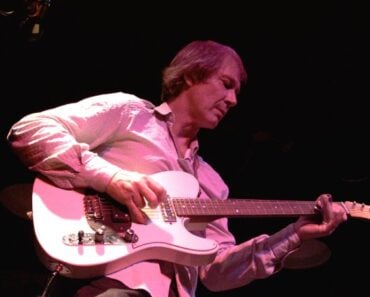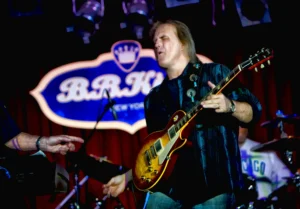
Feature Photo by Arnie Goodman
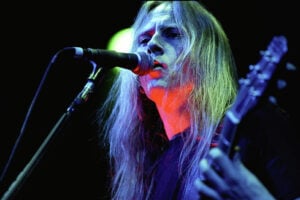
As a low-key Texas legend who came up alongside Eric Johnson, Stevie Ray, Jimmie Vaughan, and Billy Gibbons, Rocky Athas has influenced Brian May (more on that later) and lent his links to Glenn Hughes, Buddy Miles, John Mayall, and Black Oak Arkansas.
Beyond that, Athas has had a fruitful solo career, releasing five albums. The first, That’s What I Know, and the latest, Livin’ My Best Life, dropped in 2024. At 71, Athas is still living out his dream and playing rippin’ guitar in the image of the players he grew up idolizing, like Freddie King and Leslie West.
It’s with this in mind that during a break in the action, Rocky Athas beamed in with ClassicRockHistory.com to look back on a life spent rocking and rolling.
What are your earliest memories of music in your life?
Well, of course, I was like every other kid who first loved The Beatles, [The Rolling] Stones, The Animals. Wow, I really love those early ‘60s rock ‘n’ roll bands. [laughs] They made me feel good.
I even asked my mom if I could have a Beatle haircut. [laughs] She said, “Yes!” That’s when I asked for my first guitar. The rest is history. Long story short, the early ‘60s groups got me started on a path to great music.
When did the guitar come into the picture, and when did you decide what sort of player you wanted to be?
At first, it didn’t matter. I just wanted to learn. I liked George Harrison a lot, and then Keith Richards. From there on out, I started loving [Jimi] Hendrix, [Eric] Clapton, and The Yardbirds. Somewhere out of all that, I eventually found my own style.
How did you make the jump from amateur to professional musician?
[laughs] I had my first gig in the eighth grade! It was to play at a party of my childhood friend, Mario Martinez. We were a three-piece band, and we made seven dollars each. I was officially a professional. [laughs]
What gear were you working with early on, and what inspired those choices?
I started with an Epiphone Comet amp. From there, I got a custom amp, and finally, after I saw Mountain and Leslie West on a show called The Show. Weird name! [laughs] It was Leslie West’s amps that made me want one so bad.
I used it for years. It was a 4x 12 Sunn amp and a Sunn Sceptre head. I still own that today. Then, of course, I moved up to a Marshall stack. All of that was stolen in Austin, Texas. Finally, I have ended up still using my Lab-L5 Lab Series.
Early on, you had a notable—and influential—encounter with Queen’s Brian May. What’s the story there?
Okay, I saw that there were a lot of musicians who came out to see us play at Mother Blues in Dallas, Texas. On one of the breaks, I was talking to Scott Gorman from Thin Lizzy, and standing with them was Brian May.
He asked me where I got the touch harmonics from. I told Brian that I saw Billy Gibbons do a lick very much like that, and from there, I kind of learned to do it all over the neck. I developed a style from that.
So, then Brian May told me he was going to steal that lick from me. I said, “Go for it!” [laughs] I actually got to speak to Brian several times – thanks to you for lining that up! In interviews, he could not remember my name when he talked about it.
He said, “A guitar player from Dallas, Texas, I picked it up from him.” Thanks to you… you had written an article about this event. You lined us up, and we finally spoke several times. Great visit, we had. Thank you, Andrew!
How did you join Black Oak Arkansas?
Weird… I opened up for Black Oak Arkansas. About a month or two later, Jim Dandy asked me if I would like to join his band. I said, “Yes, I would.” I did three albums with Black Oak Arkansas and also did a greatest hits record with them. I wrote three songs for that greatest hits CD. I had a lot of fun.
Tell us about working with Buddy Miles.
I loved Buddy Miles’ singing style. He came up with the idea of doing an album called The Bluesberries. Buddy wanted [Stevie Ray Vaughan’s backing band] Double Trouble to be our rhythm section. The album was called Come Get a Piece. It was a really good record. We did do several gigs with that lineup. Sadly, Buddy died not long after we put the album out.
What was it like working with Glenn, who can be a handful?
I think a lot of people misunderstand performers’ desire for perfection and see them as divas. Glenn is known for his great voice and is a beast on bass guitar. But he expects everyone to bring their A-game. Can you blame him? I love working with him. We toured together for the Tommy Bolin Tribute shows, and he was super sweet.
How about John Mayall? What was that like?
It was fantastic! John was so good to work with. I played with John for eight years. I did four albums with John and wrote with John. Great experience. Before that, I played with Glenn Hughes, and we did an album together. Also toured with Glenn. Great friends to this day.
Where does your rig stand today, and what goes into your choices?
Okay, I still use Lab Series L-5. I changed out the original speakers with Celestion speakers. I also got rid of the reverb unit in the L-5 and put a [Fender] Twin Reverb tank in it. What a great sound. I did this to all my Labs.
Do you have any regrets? On the flipside, what are you most proud of?
No regrets to speak of. I feel like my whole path was a learning experience. As far as the most proud, when I got to let my son, Rocky Athas II, be my bass player. I’m most proud of that.
What’s next for you in all lanes?
I want to focus on writing good songs and sharing them with the whole world. We love making music!
Check out similar articles on ClassicRockHistory.com Just click on any of the links below……
Read More: Artists’ Interviews Directory At ClassicRockHistory.com
Read More: Classic Rock Bands List And Directory
An Interview With Rocky Athas, Formerly Of John Mayall And Black Oak Arkansas article published on ClassicRockHistory.com© 2026
Classicrockhistory.com claims ownership of all its original content and Intellectual property under United States Copyright laws and those of all other foreign countries. No one person, business, or organization is allowed to republish any of our original content anywhere on the web or in print without our permission. All photos used are either public domain Creative Commons photos or licensed officially from Shutterstock under license with ClassicRockHistory.com. All photo credits have been placed at the end of the article. Album Cover Photos are affiliate links and the property of Amazon and are stored on the Amazon server. Any theft of our content will be met with swift legal action against the infringing websites.