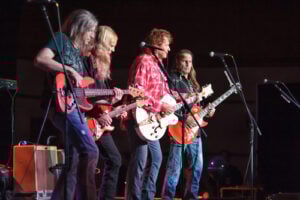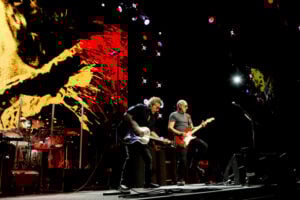
Feature Photo: Sven Mandel, CC BY-SA 4.0 <https://creativecommons.org/licenses/by-sa/4.0>, via Wikimedia Commons
The legacy of this great progressive rock band began in Nyack, New York, in 1995. Known initially as Shabütie before adopting their current name in 2001. Over the course of their career, they’ve released eleven studio albums, three live albums, and various special editions, with six of their releases reaching the Billboard Top 10. Known for their ambitious concept albums based on Claudio Sanchez’s science fiction saga “The Amory Wars,” the band has built a unique musical identity by blending progressive rock, pop, heavy metal, and post-hardcore elements. Their only non-conceptual album was 2015’s “The Color Before the Sun,” with their most recent work, “Vaxis – Act III: The Father of Make Believe,” released in 2025, continuing their narrative-driven approach to music.
The band’s origins trace back to March 1995 when Claudio Sanchez and Travis Stever’s previous band, Toxic Parents, dissolved, leading them to form Beautiful Loser with drummer Nate Kelley and bassist Jon Carleo. After this short-lived project disbanded following an argument over gas money, Stever departed while the remaining members renamed themselves Shabütie. In 1999, they released two EPs—”Plan to Take Over the World” and “The Penelope EP”—with Stever eventually rejoining the group. During a 1998 trip to Paris, Sanchez developed what would become “The Amory Wars” storyline, inspiring the band to rename themselves after two of the story’s protagonists, Coheed and Cambria, officially adopting this identity in 2001.
Throughout their history, the band has maintained a dedicated following while expanding their sound and continuing to develop their ambitious sci-fi narrative across albums. Their work combines technical proficiency with emotional depth, creating a distinctive place in modern rock music. Their output includes not just music but also comic books and novels that expand “The Amory Wars” universe, cementing their reputation as innovators who transcend traditional genre boundaries.
Claudio Sanchez
Claudio Paul Sanchez III, born March 12, 1978, has been Coheed and Cambria’s frontman, primary songwriter, and creative visionary since the band’s inception. As lead vocalist, guitarist, and keyboardist, Sanchez’s distinctive high tenor vocals have become one of the band’s most recognizable elements. His musical journey began in various short-lived bands before establishing Shabütie, which eventually transformed into Coheed and Cambria. During a 1998 trip to Paris, Sanchez conceived “The Bag.On.Line Adventures,” later renamed “The Amory Wars,” which became the conceptual backbone for nearly all the band’s albums.
Sanchez’s creative output extends beyond music into comic books, graphic novels, and literature. He’s authored “The Amory Wars” comic series, collaborated with his wife Chondra Echert on “Key of Z” and “Kill Audio” comics, and co-wrote the novel “Year of the Black Rainbow” with Peter David. In 2006, he launched his side project, The Prize Fighter Inferno, releasing “My Brother’s Blood Machine,” a concept album that serves as a prequel to the Coheed and Cambria saga through the perspective of the character Jesse.
As the band’s primary lyricist, Sanchez has crafted intricate narratives across albums including “The Second Stage Turbine Blade” (2002), “In Keeping Secrets of Silent Earth: 3” (2003), the two-part “Good Apollo” series (2005, 2007), “Year of the Black Rainbow” (2010), the “Afterman” double album (2012-2013), and the ongoing “Vaxis” series (2018-2025). His instrumental versatility includes playing theremin and synthesizers alongside his primary instruments. Sanchez’s creative vision has established Coheed and Cambria as pioneers in concept-driven progressive rock, blending personal experiences with science fiction to create a unique musical universe.
Travis Stever
Travis Stever, born November 25, 1978, is Coheed and Cambria’s lead guitarist and co-founder, being the only continuous member alongside Claudio Sanchez. His musical partnership with Sanchez dates back to their band Toxic Parents, which split in 1995, leading them to form Beautiful Loser with Nate Kelley. After briefly leaving the band when it transitioned to Shabütie, Stever rejoined in 1999, remaining an integral part of the group ever since. Known for his intricate guitar work, he shares lead duties with Sanchez, often employing a dueling guitar style reminiscent of 1970s rock.
Stever’s contributions to Coheed and Cambria extend beyond standard electric guitar, as he also provides backing vocals and plays lap steel guitar, banjo, mandolin, and dobro on various tracks. He occasionally contributes to the band’s songwriting, notably penning the lyrics for “Ten Speed” from their third album. His distinctive guitar style has been essential in shaping the band’s sound across all eleven studio albums, from 2002’s “The Second Stage Turbine Blade” through 2025’s “Vaxis – Act III: The Father of Make Believe.”
Outside Coheed and Cambria, Stever has pursued several side projects. He fronted Fire Deuce, an 1980s-style metal band that released “Children of the Deuce” in 2005. He also released “The English Panther” in 2006 and formed Davenport Cabinet, releasing “Nostalgia In Stereo” (2008), “Our Machine” (2013), and “Damned Renegades” (2014). In 2021, he joined members of Skarhead and Full Scale Riot to form Zero Trust, where he plays bass guitar instead of his usual lead guitar role. Additionally, he has contributed to Sanchez’s Prize Fighter Inferno project, playing lap steel on “Wayne Andrews, The Old Beekeeper,” and during the late 2010s, worked as a music teacher at School of Rock Orangeburg.
Josh Eppard
Josh Eppard, born December 6, 1979, has had a non-linear but significant journey with Coheed and Cambria as their drummer. He initially joined the band in late 1999, replacing original drummer Nate Kelley, after previously playing in his brother Joey Eppard’s progressive rock band 3. His first tenure with Coheed and Cambria spanned from 2000 to 2006, contributing to their formative albums “The Second Stage Turbine Blade” (2002), “In Keeping Secrets of Silent Earth: 3” (2003), and “Good Apollo I’m Burning Star IV, Volume One: From Fear Through the Eyes of Madness” (2005).
In November 2006, Eppard departed Coheed and Cambria due to personal struggles with drug addiction exacerbated by the band’s demanding tour schedule. During his absence, he pursued a solo career as rapper Weerd Science and later joined the rock supergroup Terrible Things. After a five-year hiatus, Eppard officially rejoined Coheed and Cambria in November 2011, replacing Chris Pennie who had served as the band’s drummer in the interim. Since his return, he has recorded on “The Afterman: Ascension” (2012), “The Afterman: Descension” (2013), “The Color Before the Sun” (2015), and the entire “Vaxis” saga (2018-2025).
Eppard is known for his distinctive open-handed drumming style and preference for a single bass drum pedal to maintain better groove. Beyond drums, he also contributes keyboards and backing vocals to the band’s sound. His technical yet groove-oriented approach has been crucial to Coheed and Cambria’s musical evolution, particularly in their progressive rock elements. Despite initially stating in interviews that neither he nor other band members were “big” Rush fans (a band to which Coheed is often compared), his drumming style remains a foundational element of the band’s signature sound.
Zach Cooper
Zach Cooper joined Coheed and Cambria as bassist in April 2012, becoming the band’s third and current bass player. His recruitment came during a significant transitional period for the band, following the departure of longtime bassist Michael Todd in 2011. According to interviews, Coheed and Cambria’s manager Blaze James “cold-called” Cooper, who previously played with the band AM to AM, to audition for the position based on a personal recommendation. Cooper quickly integrated into the group and began recording with them at Applehead Studios for their upcoming album.
Cooper made his recording debut with Coheed and Cambria on their 2012-2013 double album “The Afterman,” consisting of “The Afterman: Ascension” (2012) and “The Afterman: Descension” (2013). His contributions have continued through “The Color Before the Sun” (2015), “Vaxis – Act I: The Unheavenly Creatures” (2018), “Vaxis – Act II: A Window of the Waking Mind” (2022), and “Vaxis – Act III: The Father of Make Believe” (2025). As a versatile musician, Cooper provides not only bass but also backing vocals, adding to the band’s layered sound.
Cooper’s playing style brings both technical proficiency and groove to Coheed and Cambria’s complex compositions. In interviews, he has mentioned collaborating with frontman Claudio Sanchez on bass lines, sometimes building from Sanchez’s ideas or contributing his own, as with the main bass line for “Number City.” His stage rig has included Aguilar units like the Agro and Octamizer, a Mantic Effects Vitriol, and a Line 6 DL4 MkII, demonstrating his attention to tone and effects. Since joining, Cooper has become an integral part of the band’s current lineup, contributing to their evolving sound while maintaining the rhythmic foundation necessary for their progressive rock ambitions.
Michael Todd
Michael Todd served as Coheed and Cambria’s primary bassist from the band’s early days as Shabütie in 1996 until his departure in July 2011. Originally a guitarist, Todd learned to play bass specifically to join the band after being recruited by drummer Nate Kelley to replace departing bassist Jon Carleo. Todd’s bass work can be heard on the band’s early releases as Shabütie, including “Plan to Take Over the World” and “The Penelope EP,” both from 1999, as well as 2000’s “Delirium Trigger.”
Todd continued as bassist when the band renamed itself Coheed and Cambria, playing on their debut album “The Second Stage Turbine Blade” (2002) and breakthrough release “In Keeping Secrets of Silent Earth: 3” (2003), which gained mainstream attention with singles “A Favor House Atlantic” and “Blood Red Summer.” He also performed on their major label debut, “Good Apollo I’m Burning Star IV, Volume One: From Fear Through the Eyes of Madness” (2005). In November 2006, Todd left the band alongside drummer Josh Eppard for personal reasons, but rejoined in April 2007 in time to record “Good Apollo I’m Burning Star IV, Volume Two: No World for Tomorrow” (2007) and “Year of the Black Rainbow” (2010).
Todd’s final departure from Coheed and Cambria came in July 2011 following personal issues. He was temporarily replaced by Wes Styles before the band officially parted ways with him in August 2011. Throughout his tenure, Todd’s bass playing provided a solid foundation for the band’s complex arrangements while complementing Claudio Sanchez and Travis Stever’s guitar work. In interviews, Todd dismissed rumors that the band was influenced by the progressive rock band Saga, stating he had never even heard of them. After his departure, he was eventually succeeded by current bassist Zach Cooper in 2012.
Nate Kelley
Nate Kelley was Coheed and Cambria’s original drummer, though his tenure predates the band adopting that name. In March 1995, Kelley formed the band Beautiful Loser with Claudio Sanchez and Travis Stever following the dissolution of their previous project, Toxic Parents. The short-lived Beautiful Loser, which also featured Jon Carleo on bass, broke up by June 1995 after a disagreement over gas money. When Stever left, the remaining members—Sanchez, Kelley, and Carleo—formed Shabütie, the precursor to Coheed and Cambria.
As Shabütie’s drummer, Kelley helped the band experiment with diverse musical styles including punk rock, indie rock, acoustic rock, funk, and heavy metal. When Carleo left in August 1996, Kelley recruited Michael Todd to play bass. Kelley performed on Shabütie’s early releases, including their first studio demo “Plan to Take Over the World” (1999) and “The Penelope EP” (1999). His time with the band came to an end during a performance in late 1999 when he left mid-show.
Despite his departure before the band became Coheed and Cambria, Kelley’s drumming was still featured on their 2000 release “Delirium Trigger,” though his replacement Josh Eppard was credited in the liner notes. Kelley’s contributions to the band’s formative years helped establish the foundation for what would become their distinctive sound, even though he didn’t participate in their later success. After Kelley’s exit, the remaining members, along with new drummer Josh Eppard, would soon rename themselves Coheed and Cambria in 2001, inspired by characters from Sanchez’s science fiction story “The Amory Wars.”
Chris Pennie
Chris Pennie served as Coheed and Cambria’s drummer from June 2007 to November 2011, joining the band following the departure of original drummer Josh Eppard in 2006. Before joining Coheed, Pennie had established himself as a technically proficient drummer with the mathcore band The Dillinger Escape Plan. His arrival coincided with the return of bassist Michael Todd, who had also briefly left the band in 2006, as Coheed prepared to record their fourth studio album.
Despite joining the band in 2007, Pennie was unable to perform on the album “Good Apollo I’m Burning Star IV, Volume Two: No World for Tomorrow” due to contractual restrictions with his former record label. Instead, Foo Fighters drummer Taylor Hawkins recorded the drum parts, though Pennie provided input on the compositions through correspondence with vocalist Claudio Sanchez. Pennie’s first full recording with the band was “Year of the Black Rainbow” (2010), the prequel to the band’s Amory Wars saga, where his technical drumming style added new dimensions to Coheed’s sound.
Pennie’s tenure with Coheed and Cambria ended in November 2011 when he departed by mutual agreement due to creative differences. His exit paved the way for original drummer Josh Eppard to return to the band after a five-year absence. Though Pennie’s time with Coheed was relatively brief compared to other members, his technical proficiency and different stylistic approach contributed to the band’s evolution during a transitional period in their career. After leaving Coheed, Pennie continued his musical career with other projects, while the band moved forward with Eppard resuming his role behind the drum kit.
Check out similar articles on ClassicRockHistory.com Just click on any of the links below……
Complete List Of Coheed And Cambria Albums and Discography
Top 10 Coheed and Cambria Songs
An Interview With Claudio Sanchez Of Coheed And Cambria
Travis Stever of Coheed and Cambria: 10 Albums That Changed My Life
Read More: Artists’ Interviews Directory At ClassicRockHistory.com
Read More: Classic Rock Bands List And Directory
Complete List Of Coheed And Cambria Band Members article published on ClassicRockHistory.com© 2025
Classicrockhistory.com claims ownership of all its original content and Intellectual property under United States Copyright laws and those of all other foreign countries. No one person, business, or organization is allowed to re-publish any of our original content anywhere on the web or in print without our permission. All photos used are either public domain Creative Commons photos or licensed officially from Shutterstock under license with ClassicRockHistory.com. All photo credits have been placed at the end of the article. Album Cover Photos are affiliate links and the property of Amazon and are stored on the Amazon server. Any theft of our content will be met with swift legal action against the infringing websites.