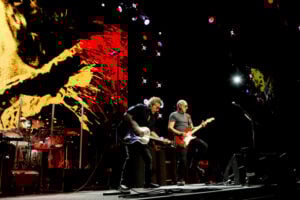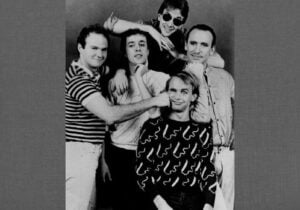
Feature Photo: MTV, Public domain, via Wikimedia Commons
A sharp mix of reggae rhythms, pop hooks, and offbeat instrumentation pushed Men at Work out of the Melbourne club scene and onto the global stage in a remarkably short time. The band formed in 1979 around Colin Hay and Ron Strykert, soon solidifying with Greg Ham, Jerry Speiser, and John Rees, a lineup that quickly developed a distinctive sound built on flute lines, tight arrangements, and Hay’s unmistakable vocal delivery. Before signing a major deal, the group released the independent single “Keypunch Operator” backed with an early version of “Down Under,” and by 1980 they had already built a strong reputation as a live act. Their appearance at the Rock Against Racism concert in Melbourne that same year placed them in a broader cultural context beyond the standard pub circuit.
Momentum accelerated in 1981 after signing with CBS Records, when “Who Can It Be Now?” climbed to Number 2 in Australia and stayed on the charts for 24 weeks. Produced by Peter McIan, the debut album Business as Usual followed and reached Number 1 in Australia before expanding its reach internationally. “Down Under” was re-recorded and released as a single, hitting Number 1 in Australia and later topping the charts in the United States. By January 1983, Men at Work held the Number 1 album and Number 1 single in the United States at the same time, with Business as Usual and “Down Under,” while “Who Can It Be Now?” also reached Number 1 on the Billboard Hot 100. The album spent 15 weeks at Number 1 on the Billboard 200, establishing the band as a major international force.
The follow-up album, Cargo, arrived on May 2, 1983, and maintained that commercial strength. It reached Number 1 in Australia, Number 3 in the United States, and Number 8 in the United Kingdom. Its singles continued the band’s run of major hits, with “Overkill” reaching Number 3 in the United States, “It’s a Mistake” climbing to Number 6, and “Dr. Heckyll & Mr. Jive” charting strongly in multiple territories. During this period, “Down Under” also became closely associated with Australian national identity when it was used as the theme of the successful Australia II America’s Cup campaign in 1983. Across these releases, Men at Work produced a concise but highly effective catalog that included “Down Under,” “Who Can It Be Now?,” “Be Good Johnny,” “Overkill,” and “It’s a Mistake,” all of which received significant international airplay.
Behind the success, internal tension began to reshape the group. In 1984, Jerry Speiser and John Rees were dismissed, leaving Hay, Ham, and Strykert to continue with session musicians for the recording of Two Hearts. Jeremy Alsop handled bass duties and Mark Kennedy played drums, while Hay and Ham produced the album. Released in 1985, Two Hearts reached Number 16 in Australia and Number 50 in the United States. The singles “Everything I Need,” “Man with Two Hearts,” “Maria,” and “Hard Luck Story” followed, though only “Everything I Need” charted in both Australia and the United States. During this era, the band also performed at the Oz for Africa concert as part of the Live Aid program, delivering “Maria,” “Overkill,” and “The Longest Night.” The group disbanded in early 1986, closing out its original run.
A return came a decade later when Colin Hay and Greg Ham revived Men at Work in 1996, touring South America with a new lineup that included Stephen Hadley, Simon Hosford, and John Watson. That tour produced the live album Brazil ’96 in 1997, later reissued internationally with the additional studio track “The Longest Night,” marking the first new studio recording under the band’s name since Two Hearts. Hay and Ham continued performing together until 2002. After Ham’s death on April 19, 2012, Hay carried the band forward again, reviving Men at Work in 2019 with a new touring lineup while remaining the only constant member throughout the band’s history.
Recognition for Men at Work reflects both commercial success and long-term impact. The band won the Grammy Award for Best New Artist in 1983 and was inducted into the ARIA Hall of Fame in 1994. “Down Under” was ranked Number 4 in the APRA list of Top 30 Australian songs in 2001, and Business as Usual earned a place in the 100 Best Australian Albums. The group sold more than 30 million albums worldwide, supported by a string of international hit singles that continue to receive radio play decades later.
Their work connected strong songwriting with distinctive instrumentation, giving their recordings a character that remains immediately recognizable. Beyond record sales, appearances at events such as Rock Against Racism and Oz for Africa helped tie the band to broader cultural moments, reinforcing a legacy that extends well beyond the charts.
Complete List Of Men At Work Songs From A to Z
- Be Good Johnny – Business as Usual – 1981
- Blue for You – Cargo – 1983
- Catch a Star – Business as Usual – 1981
- Children on Parade – Two Hearts – 1985
- Crazy – Business as Usual – 1981
- Down by the Sea – Business as Usual – 1981
- Down Under – Business as Usual – 1981
- Dr. Heckyll & Mr. Jive – Cargo – 1983
- Everything I Need – Two Hearts – 1985
- F-19 – Business as Usual – 1981
- Fallin’ Down (live) – Cargo – 1983
- Giving Up – Two Hearts – 1985
- Hard Luck Story – Two Hearts – 1985
- Helpless Automaton – Business as Usual – 1981
- High Wire – Cargo – 1983
- I Can See It in Your Eyes – Business as Usual – 1981
- I Like To – Cargo – 1983
- It’s a Mistake – Cargo – 1983
- Man with Two Hearts – Two Hearts – 1985
- Maria – Two Hearts – 1985
- No Restrictions – Cargo – 1983
- No Sign of Yesterday – Cargo – 1983
- Overkill – Cargo – 1983
- People Just Love to Play with Words – Business as Usual – 1981
- Sail to You – Two Hearts – 1985
- Settle Down My Boy – Cargo – 1983
- Shintaro – Cargo – 1983
- Snakes and Ladders – Two Hearts – 1985
- Stay at Home – Two Hearts – 1985
- Still Life – Two Hearts – 1985
- The Longest Night (live) – Cargo – 1983
- ‘Till the Money Runs Out – Cargo – 1983
- Touching the Untouchables – Business as Usual – 1981
- Underground – Business as Usual – 1981
- Underground (live) – Business as Usual – 1981
- Upstairs in My House – Cargo – 1983
- Upstairs in My House (live) – Cargo – 1983
- Who Can It Be Now? – Business as Usual – 1981
- Who Can It Be Now? (live) – Business as Usual – 1981
Albums
Business as Usual (1981): 14 songs

Cargo (1983): 15 songs

Two Hearts (1985): 10 songs

Check out similar articles and more…all on ClassicRockHistory.com
Read More: Artists’ Interviews Directory At ClassicRockHistory.com
Read More: Classic Rock Bands List And Directory
Complete List Of Men At Work Songs From A to Z article published on ClassicRockHistory.com© 2026
Classicrockhistory.com claims ownership of all its original content and Intellectual property under United States Copyright laws and those of all other foreign countries. No one person, business, or organization is allowed to re-publish any of our original content anywhere on the web or in print without our permission. All photos used are either public domain Creative Commons photos or licensed officially from Shutterstock under license with ClassicRockHistory.com. All photo credits have been placed at the end of the article. Album Cover Photos are affiliate links and the property of Amazon and are stored on the Amazon server. Any theft of our content will be met with swift legal action against the infringing websites.