Feature Photo: Jim Vallee / Shutterstock.com
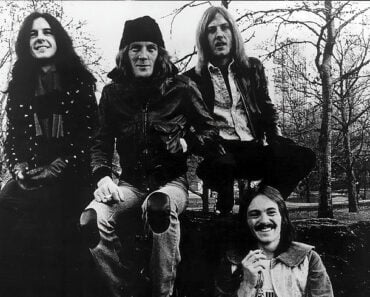
The Moody Blues band was formed in Birmingham in 1964. The group initially came together as a rhythm and blues-based band but quickly evolved, embracing a more symphonic sound that established them as pioneers of progressive rock. The band’s landmark album, Days of Future Passed, released in 1967, famously integrated orchestral music with rock, setting a new standard in the genre. Over the years, The Moody Blues released sixteen studio albums, achieving significant commercial success and critical acclaim. They sold over 70 million albums worldwide and were inducted into the Rock and Roll Hall of Fame in 2018. The band’s lineup saw several changes over the decades, with some members pursuing successful solo careers. Their sixteenth and final studio album, December, was released in 2003. The Moody Blues continued touring until Graeme Edge retired in 2018; Justin Hayward later said that without Edge, it could no longer be The Moody Blues.
Justin Hayward
Justin Hayward joined The Moody Blues in 1966, replacing Denny Laine as the lead vocalist and guitarist. His arrival marked a significant turning point for the band, heralding their shift toward symphonic rock. Hayward’s songwriting and tender vocals were central to the band’s success, contributing timeless classics such as “Nights in White Satin” and “Tuesday Afternoon.” His ability to craft evocative lyrics and memorable melodies helped to define the band’s sound on seminal albums like Days of Future Passed and Seventh Sojourn. Hayward remained with The Moody Blues through the band’s final touring year in 2018. Beyond The Moody Blues, Hayward has enjoyed a productive solo career, releasing several well-received albums and singles.
John Lodge
John Lodge joined the band in 1966 alongside Hayward and quickly became an integral member as the bass guitarist and vocalist. Lodge’s contributions to the band’s songwriting and harmony vocals were significant, penning hits such as “Ride My See-Saw” and “Isn’t Life Strange.” His dynamic playing and vocal abilities were instrumental across the band’s discography, particularly noted on albums like To Our Children’s Children’s Children. Lodge remained with The Moody Blues through their final touring year in 2018 and continued performing the band’s music in his solo career afterward. John Lodge died on October 10, 2025, at the age of 82.
Read More: An Interview With John Lodge Of The Moody Blues
Graeme Edge
Graeme Edge, a founding member of The Moody Blues, served as the band’s drummer and provided spoken-word poetry, adding a unique element to their music. His contributions are most notably heard on tracks like “Late Lament” and throughout the band’s core albums. Edge’s innovative drumming techniques and poetic interludes left a lasting imprint on the band’s style. He was the only member to remain with the group through every phase of its history and played on all sixteen studio albums. Edge retired from performing in 2018, bringing The Moody Blues’ touring career to an end. He died on November 11, 2021, at the age of 80.
Ray Thomas
Ray Thomas was one of the founding members of The Moody Blues and contributed significantly as a vocalist and flautist until his retirement in 2002. Thomas’s distinctive flute playing is a hallmark of The Moody Blues’ sound, particularly memorable on tracks like “Legend of a Mind.” His abilities as a singer and songwriter also shone on songs such as “Veteran Cosmic Rocker.” Thomas released solo albums that, while less commercially successful than the band’s work, were cherished by fans for their depth and artistry. He died on January 4, 2018, at the age of 76, several months before The Moody Blues were inducted into the Rock and Roll Hall of Fame.
Mike Pinder
Mike Pinder, another founding member, played a crucial role as the band’s keyboardist until his departure in 1978. Pinder was instrumental in introducing the Mellotron to rock music, which became a signature sound of The Moody Blues and influenced the broader rock genre. He contributed significantly to the band’s songwriting and production, particularly during their most influential period in the late 1960s and 1970s. After leaving the band, Pinder released solo work and remained involved in music and technology. Mike Pinder died on April 24, 2024, at the age of 82.
Denny Laine
Denny Laine was an original member of The Moody Blues and played a crucial role in the band’s early years. He joined the band at its formation in 1964 and was the lead vocalist and guitarist. Laine was instrumental in the band’s initial success with the hit “Go Now,” which became a UK chart-topper and achieved significant popularity in the United States. His tenure with the band was marked by a more R&B and blues-influenced style that characterized their early sound.
After leaving The Moody Blues in 1966, Denny Laine became a founding member of Paul McCartney and Wings, contributing significantly to their success in the 1970s. As a member of Wings, Laine co-wrote songs, provided lead and backing vocals, and played multiple instruments. After The Moody Blues, his career also included solo projects and collaborations. Denny Laine died on December 5, 2023, at the age of 79.
Patrick Moraz
Patrick Moraz joined The Moody Blues’ touring and recording lineup in 1978 after Mike Pinder’s departure. He played keyboards on albums including Long Distance Voyager, The Present, The Other Side of Life, Sur la Mer, and Keys of the Kingdom. Moraz’s background in progressive rock bands like Yes added a fresh dimension to the band’s sound during his tenure. He remained with the group until 1991, after which he continued his career with solo projects and collaborations.
Clint Warwick
Clint Warwick was the original bassist for The Moody Blues and was part of the band’s formation in 1964. Warwick played on the band’s early hits, including their breakout single “Go Now,” which brought them international fame. His tenure with the band was relatively brief, as he left in 1966, shortly after their initial success. Despite his short period with the band, his contributions were integral during their formative years, helping to define their early sound that mixed R&B with rock influences. Warwick moved away from the music industry and returned to his earlier trade as a carpenter. He died on May 15, 2004.
Read More: Top 10 Moody Blues Songs
Rod Clark
Rod Clark was briefly a member of The Moody Blues, stepping in as the bassist in 1966 after Clint Warwick left the band. Clark’s tenure was extremely short-lived; he participated in the band during a transitional phase before John Lodge joined and took over the bass responsibilities permanently later that same year. Clark contributed backing vocals and bass during this brief period, including on the recording later released as “Life’s Not Life.” He did not appear on any of the band’s studio albums. Rod Clark died on March 17, 2025.
Read More: Complete List Of The Moody Blues Albums
Updated August 27, 2026.
Complete List Of The Moody Blues Band Members article published on ClassicRockHistory.com © 2026