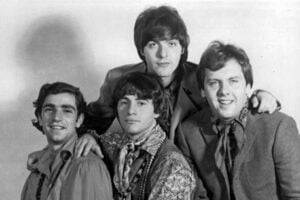
Photo: NBC Television [Public domain]
Herman’s Hermits were fronted by English singer, songwriter, and actor Peter Noone. The well-versed Englishman was the face and sound of Herman’s Hermits. Throughout his career, both before and after Herman’s Hermits, Peter Noone maintained his celebrity as an actor, singer, and even radio host in the 21st century on Sirius Satellite Radio. He had a personality that was perfect for the British Invasion, and those catchy songs made him one of the most recognizable singers of the decade.
After the success of their debut single, Herman’s Hermits released their first American album in 1965, entitled Herman’s Hermits, also known as Introducing Herman’s Hermits. The group’s albums were released in different configurations in the United States and United Kingdom, something that happened quite frequently with British groups during the 1960s. American fans also received Herman’s Hermits on Tour in 1965 and Hold On! in 1966.
The group continued releasing albums throughout the decade, including Both Sides of Herman’s Hermits in 1966, There’s a Kind of Hush All over the World in 1967, Blaze in 1967, and Mrs. Brown, You’ve Got a Lovely Daughter in 1968. Those records contained everything from straightforward British beat music to covers of American rock and roll songs, music-hall numbers, and some surprisingly sophisticated pop recordings.
One of the things I’ve always enjoyed about Herman’s Hermits is that they never seemed to take themselves too seriously. While other bands were trying to establish themselves as important artistic statements, Peter Noone and his group were releasing songs that made people happy. There’s nothing wrong with that. In fact, I think there was something wonderful about a band that could record one catchy single after another and make it seem so effortless. The musicians were talented, the melodies were memorable, and those records were everywhere during the British Invasion.
We originally put together a Top 10 list celebrating the band’s most popular songs and some of its better album tracks. But Herman’s Hermits recorded far too much great music to stop there. We’ve expanded the list to twenty songs, including some major American hits that weren’t in our original countdown and a few later British hits that deserve more attention. We’re keeping our original top ten in the same order while adding ten more recordings that remind us just how successful this band was during the 1960s. Let’s get started.
# 20 – East West
We open our expanded Herman’s Hermits list with a wonderful recording that doesn’t always receive the same attention as the band’s biggest hits. “East West” is one of those songs that demonstrates the group was capable of doing more than simply recording cheerful, lightweight pop tunes. I’ve always enjoyed the way this recording has a slightly different atmosphere from some of their earlier singles. Peter Noone’s voice sounds terrific, and the melody has a wistful quality that makes the song especially enjoyable. It’s a great example of how much popular music was changing during the mid-1960s.
“East West” was written by Graham Gouldman and released by Herman’s Hermits as a single in December 1966. Gouldman was one of the most talented songwriters working in British popular music during this period, having already written major recordings for The Yardbirds, The Hollies, and Herman’s Hermits. The song later appeared on the 1967 album There’s a Kind of Hush All over the World. “East West” reached number twenty-seven on the Billboard Hot 100 and number thirty-three on the UK Singles Chart, continuing the band’s remarkable run of international singles.
What makes this song interesting is the way it captures the feeling of being separated from someone you care about. There is something almost bittersweet about the melody, and Noone’s vocal performance fits the arrangement beautifully. I’ve always thought Graham Gouldman had an extraordinary talent for writing songs that sounded simple on the surface but contained very clever musical ideas. “East West” is certainly one of those compositions. It might not be the first Herman’s Hermits song most people remember, but it’s a terrific way to open our expanded countdown.
# 19 – Sunshine Girl
Now here’s a song that sounds exactly like its title. “Sunshine Girl” is one of those wonderfully cheerful pop recordings that immediately brings back memories of the late 1960s. I’ve always loved the way Herman’s Hermits could make a song sound so light and enjoyable without losing the quality of the melody. Peter Noone had that wonderful, youthful voice that fit these kinds of arrangements perfectly. The recording has a bright atmosphere, a catchy chorus, and the kind of musical personality that made the band so successful during the British Invasion.
“Sunshine Girl” was written by Geoff Stephens and John Carter and released as a single in July 1968. Both songwriters had already established successful careers in British popular music. Stephens was responsible for compositions including “There’s a Kind of Hush” and “Winchester Cathedral,” while Carter had written several other successful British pop recordings. Produced by Mickie Most, the Herman’s Hermits single reached number eight on the UK Singles Chart. Although it did not become a comparable American hit, it demonstrated that the group still had a substantial audience in Britain several years after its original breakthrough.
What I’ve always enjoyed about “Sunshine Girl” is that the arrangement doesn’t try to do anything complicated. The song simply has a great melody, an enjoyable rhythm, and a vocal performance that makes you want to hear it again. I’ve always believed that writing a catchy pop song is much more difficult than people imagine. There is a real art to making something sound this effortless. Herman’s Hermits released plenty of records that accomplished exactly that, and “Sunshine Girl” is one of their most enjoyable later singles.
# 18 – Don’t Go Out into the Rain (You’re Going to Melt)
Anybody who remembers the British Invasion knows that the song titles were sometimes almost as entertaining as the records themselves. “Don’t Go Out into the Rain (You’re Going to Melt)” is a perfect example. How can you not want to hear a song with a title like that? I’ve always loved the way Herman’s Hermits could take a somewhat unusual composition and turn it into a catchy little pop record. Peter Noone had such a distinctive voice, and he knew how to bring out the humor in a song without making it sound like a novelty recording.
“Don’t Go Out into the Rain (You’re Going to Melt)” was written by Kenny Young and released by Herman’s Hermits in 1967. Young was an accomplished songwriter whose compositions were recorded by several major pop artists during the 1960s. An earlier version was recorded by a group called the Seagulls, which featured Young. Herman’s Hermits released their recording as an American single, and it reached number eighteen on the Billboard Hot 100. The song also appeared on the group’s 1967 American album Blaze, one of the more interesting records from the later years of the band’s original run.
What makes this recording so entertaining is the combination of its unusual lyrics and the band’s cheerful musical approach. The melody is infectious, and the arrangement has the unmistakable sound of 1960s pop radio. I’ve always thought these kinds of recordings were an important part of what made the British Invasion so much fun. Not every song needed to change the world. Sometimes it was enough to have a terrific melody, a little humor, and a performance that made people smile. This song certainly accomplishes that.
# 17 – This Door Swings Both Ways
“This Door Swings Both Ways” is one of those Herman’s Hermits songs that reminds us just how many hits the group recorded during the middle of the 1960s. I’ve always enjoyed this one because it has a slightly harder edge than some of their more lightweight pop recordings. The rhythm is fantastic, the melody is catchy, and Peter Noone delivers the song with plenty of personality. It’s the kind of recording that sounds great coming out of an old AM radio. There was something special about those mid-1960s singles, and Herman’s Hermits certainly knew how to make them.
The song was written by Estelle Levitt and Don Thomas and released as a single in June 1966. It also appeared on the American edition of the album Both Sides of Herman’s Hermits. The single reached number twelve on the Billboard Hot 100 and number eighteen on the UK Singles Chart. The recording was produced by Mickie Most, whose work with Herman’s Hermits helped establish the band’s enormously successful commercial sound. Most had a remarkable ear for choosing songs that were perfectly suited to Peter Noone’s vocal style.
What I’ve always enjoyed about “This Door Swings Both Ways” is the way the song uses a simple idea to make a point about relationships and human behavior. The melody is immediately memorable, and the arrangement keeps everything moving along at a terrific pace. I’ve always thought the best British Invasion singles were the ones that combined a catchy chorus with a little musical attitude. Herman’s Hermits weren’t known as a particularly aggressive rock band, but they certainly could deliver an energetic performance when the song called for it. This is one of their best examples.
# 16 – My Sentimental Friend
I’ve always thought it was interesting how some American music fans tend to remember Herman’s Hermits almost entirely for their mid-1960s recordings. The band continued enjoying considerable success in Britain long after those early American hits stopped dominating the charts. “My Sentimental Friend” is one of the finest examples. This is a beautiful pop song with a wonderful melody, and Peter Noone delivers a vocal performance that demonstrates how much his singing had developed over the years. It’s one of those recordings that deserves to be discovered by anyone who only knows the band’s biggest American hits.
“My Sentimental Friend” was written by Geoff Stephens and John Carter and released as a single in April 1969. The recording became one of Herman’s Hermits’ biggest later hits in the United Kingdom, reaching number two on the UK Singles Chart. It spent twelve weeks on the British chart and demonstrated that the band remained popular with audiences even as musical tastes were changing considerably. The song featured a more polished late-1960s pop arrangement than many of the group’s earlier recordings, with the melody and Noone’s voice remaining the central attractions.
What makes this song so enjoyable is its nostalgic feeling. The melody is beautiful, and there is something touching about the way Noone delivers the lyrics. I’ve always enjoyed discovering recordings that were enormous hits in one country but never received the same attention somewhere else. It’s one of the most fascinating parts of music history. American audiences sometimes missed some outstanding British singles, just as British fans occasionally overlooked great American recordings. “My Sentimental Friend” is a perfect example of a song that deserves much more recognition on this side of the Atlantic.
# 15 – Sleepy Joe
Now here’s another wonderful example of Herman’s Hermits doing what they did best. “Sleepy Joe” has a great rhythm, a terrific melody, and plenty of that good old-fashioned British pop personality. I’ve always enjoyed the way Peter Noone could make a song sound so cheerful, even when the lyrics were telling a little story. There was something about his voice that made these kinds of recordings immediately recognizable. You could hear the song for the first time and probably know it was Herman’s Hermits before the first chorus was finished.
“Sleepy Joe” was written by John Carter and Russell Alquist and released as a single in 1968. The recording was produced by Mickie Most and reached number twelve on the UK Singles Chart. It was also an international hit, reaching number sixty-one on the Billboard Hot 100 and performing well in several other countries. The song arrived during a period when popular music was moving toward heavier rock sounds, elaborate studio productions, and longer album-oriented compositions. Herman’s Hermits continued concentrating on the catchy melodies that had made them successful in the first place.
What makes “Sleepy Joe” particularly enjoyable is that it never tries to sound more complicated than it needs to be. The band delivers a lively performance, and the song moves along with an infectious rhythm. I’ve always thought there was something refreshing about the way Herman’s Hermits continued recording this kind of music while so many other bands were changing their sound completely. They understood their audience, and they knew how to make records that people enjoyed. “Sleepy Joe” is a great example of that talent and a wonderful addition to our list.
# 14 – Leaning on the Lamp Post
Here’s one of those songs that could only have become a hit for a band like Herman’s Hermits. I’ve always enjoyed the way Peter Noone embraced the traditional British music-hall style on certain recordings. While groups like The Rolling Stones and The Yardbirds were exploring American blues and harder rock sounds, Herman’s Hermits were perfectly comfortable recording an old-fashioned British novelty song. And the funny thing is, they made it work. “Leaning on the Lamp Post” is a wonderful example of how charming these records could be when the right performer got hold of them.
“Leaning on the Lamp Post” was written by Noel Gay and originally became popular through British entertainer George Formby during the 1930s. Herman’s Hermits recorded their version for the soundtrack album Hold On!, released in 1966. The song became an American hit, reaching number nine on the Billboard Hot 100. It was one of the recordings that demonstrated how successfully Peter Noone could bring traditional British entertainment styles to American audiences. His performance retained the humor and charm of the original composition while surrounding it with the more contemporary sound of a 1960s pop group.
I’ve always thought this song was a reminder that the British Invasion was about much more than just rock and roll. British performers brought their own musical traditions into American popular culture, including music hall, skiffle, and various styles of British pop. Herman’s Hermits were particularly successful at combining those influences. “Leaning on the Lamp Post” might not have had the musical seriousness of some of the great rock recordings of 1966, but it certainly entertained a lot of people. Sometimes a good song is simply one that makes you smile, and this one does exactly that.
# 13 – Just a Little Bit Better
Now we’re getting into some of the biggest Herman’s Hermits hits that weren’t included in our original top ten. “Just a Little Bit Better” is a great British Invasion single with a wonderful melody and one of those choruses that stays in your head all day. I’ve always loved the way Peter Noone could deliver a pop song with so much personality. His voice wasn’t particularly powerful in the way some other British rock singers were, but he had a natural charm that worked perfectly with this material. That was one of the reasons Herman’s Hermits became so enormously popular.
“Just a Little Bit Better” was written by Kenny Young and released as a single by Herman’s Hermits in 1965. The recording became another major American hit, reaching number seven on the Billboard Hot 100. It also reached number fifteen on the UK Singles Chart. The song appeared on the American compilation The Best of Herman’s Hermits, released later that year. Produced by Mickie Most, the recording featured the bright guitar sound, catchy vocal melody, and upbeat arrangement that had become the group’s commercial trademark.
What makes this song so enjoyable is the straightforward confidence of the performance. There’s nothing overly complicated about the arrangement, but the band sounds terrific, and the melody is incredibly catchy. I’ve always thought that some of the finest pop records of the 1960s were built around very simple musical ideas. The trick was finding the right melody and delivering it with enough personality to make people want to hear it again. Herman’s Hermits mastered that approach, and “Just a Little Bit Better” is one of their finest examples.
# 12 – A Must to Avoid
“A Must to Avoid” is another one of those great Herman’s Hermits singles that proves the group had an extraordinary run during the 1960s. I’ve always enjoyed this song because it has a little more attitude than some of their sweeter pop recordings. Peter Noone sounds terrific, and the arrangement has a sharp rhythm that really makes the song stand out. The title is also pretty funny when you think about it. How many times have we all known somebody who probably should have come with a warning label? That’s basically the idea behind this one, and Herman’s Hermits delivered it with plenty of charm.
The song was written by P.F. Sloan and Steve Barri and released by Herman’s Hermits in late 1965. Sloan and Barri were an important American songwriting partnership whose work included recordings by The Grass Roots and other successful artists of the period. “A Must to Avoid” reached number eight on the Billboard Hot 100 and number six on the UK Singles Chart. The recording was produced by Mickie Most and became another major success for Herman’s Hermits during an incredibly busy period in the band’s career.
What makes this song such a terrific recording is the combination of its catchy melody and those slightly sarcastic lyrics. Noone delivers the performance with just the right amount of attitude, while the band provides an energetic arrangement that never loses its momentum. I’ve always enjoyed pop songs that had a little humor mixed into the writing, particularly when the musicians didn’t overplay the joke. “A Must to Avoid” is a wonderful example of that approach. It’s also one of those recordings that reminds us just how many great singles the band released in a relatively short period.
# 11 – Wonderful World
Just missing our original top ten is a wonderful Herman’s Hermits recording of one of the greatest pop songs ever written. I’ve always loved Sam Cooke’s original version of “Wonderful World,” but Herman’s Hermits certainly did a terrific job with the composition. Peter Noone’s voice fit the melody beautifully, and the band brought its own bright British Invasion sound to the recording. It’s one of those songs that sounds so simple that you almost forget how extraordinary the songwriting really is. The melody is magnificent, and the lyrics have a charm that never seems to get old.
“Wonderful World” was written by Sam Cooke, Lou Adler, and Herb Alpert and originally recorded by Cooke in 1959, before becoming a hit in 1960. Herman’s Hermits released their interpretation in 1965, turning the composition into another major international success. Their recording reached number four on the Billboard Hot 100 and number seven on the UK Singles Chart. Produced by Mickie Most, the single became one of the band’s biggest American hits during the height of the British Invasion. The group’s version retained the innocence and charm of Cooke’s composition while presenting it with a brighter pop arrangement.
What I’ve always enjoyed about “Wonderful World” is the way the song celebrates something that seems so simple. It’s basically a love song about somebody who might not know much about school subjects but knows how he feels about another person. The melody is beautiful, and there’s something wonderfully innocent about the whole recording. I’ve always thought that great songs could survive just about any musical arrangement when the songwriting was strong enough. Sam Cooke proved that with his original, and Herman’s Hermits demonstrated it again with their own version. It’s a terrific way to finish our ten new selections before returning to the original top ten.
# 10 – Little Boy Sad
We open our original top ten Herman’s Hermits songs list with the track “Little Boy Sad.” The song was released on the Both Sides of Herman’s Hermits album, which was released in 1966. “Little Boy Sad” was the album’s opening track on the British edition. Wayne Walker wrote the song. Johnny Burnette originally recorded it and had a big hit with it in 1961.
I’ve always enjoyed listening to the way different performers interpret the same song, especially when those performers come from completely different musical backgrounds. Johnny Burnette was one of the great early rock and roll singers, and his recording had a wonderful energy. Herman’s Hermits brought their own British beat-group sound to the composition, giving it a different musical personality. Peter Noone’s vocal performance works well with the melody, and the band delivers a lively arrangement that makes the recording very enjoyable.
One of the great things about the British Invasion was how many American rock and roll songs found new audiences through British groups. Those musicians grew up listening to American records, and when they began making music themselves, they brought those influences into their own performances. “Little Boy Sad” is a good example of that musical exchange. It might not be as famous as some of the group’s enormous hits, but it’s a terrific album track and a reminder that Herman’s Hermits recorded some great material beyond their biggest singles.
# 9 – Listen People
The great Herman’s Hermits song “Listen People” was released on their Both Sides of Herman’s Hermits album in 1966. The song was a big hit for the band, reaching number three on the U.S. Billboard Hot 100. “Listen People” was written by the great songwriter Graham Gouldman, who would compose several Herman’s Hermits hits. Besides his songwriting contributions to Herman’s Hermits, Graham Gouldman was also famous for writing the song “For Your Love,” recorded by The Yardbirds. Graham Gouldman was also a founding member of the band 10cc.
I’ve always thought “Listen People” was one of the finest melodies Herman’s Hermits ever recorded. The song has a beautiful, almost gentle quality that makes it stand apart from some of their more energetic singles. Peter Noone delivers a wonderful vocal performance, and the arrangement allows the melody to remain the center of attention. Graham Gouldman had a remarkable ability to write songs that sounded completely natural, even when the melodies were more sophisticated than they initially appeared.
What makes this recording especially enjoyable is its positive message. There is something very appealing about a song that encourages people to appreciate love and kindness without making the lyrics sound overly sentimental. Herman’s Hermits recorded so many cheerful songs during the 1960s, but this one has always seemed particularly sincere. It’s a beautiful example of the band’s ability to deliver a softer recording while maintaining the musical personality that made the group so successful.
# 8 – Dandy
Herman’s Hermits’ big hit “Dandy” was released in 1966. Ray Davies of The Kinks wrote the song, which was initially released by The Kinks on their album Face to Face before Herman’s Hermits released their single. The song became a big hit for Peter Noone and his band, reaching number five on the Billboard Hot 100 in the United States. It was another example of the extraordinary songwriting talent of Ray Davies.
I’ve always loved the way Herman’s Hermits approached this song because it fits Peter Noone’s personality so well. Ray Davies was one of the greatest observers of human behavior in rock songwriting, and “Dandy” is a perfect example of his ability to create a memorable character. The song has a terrific melody, and the lyrics are filled with humor. Noone delivers the performance with just the right amount of charm, making the recording sound like something the band could have written specifically for him.
What makes “Dandy” particularly interesting is the difference between The Kinks’ original recording and the Herman’s Hermits version. Both are enjoyable, but each has its own musical personality. I’ve always thought that was one of the wonderful things about the 1960s. Great songs frequently moved between artists, and different performances could reveal something new about the composition. Herman’s Hermits made “Dandy” one of their biggest American hits, and it remains a terrific example of the British Invasion’s lighter side.
Read More: Dave Davies Of The Kinks: The ClassicRockHistory.com Interview
# 7 – No Milk Today
The Herman’s Hermits single “No Milk Today” was a big hit in several countries, particularly in the United Kingdom, where it reached number seven. Graham Gouldman wrote the song. It was released in 1966 and appeared on the U.S. and U.K. albums There’s a Kind of Hush All over the World in 1967. The recording also received American chart exposure, although it did not match the success it enjoyed in Britain. It’s one of the most memorable compositions Herman’s Hermits ever recorded.
I’ve always loved this song because it tells a wonderfully sad story through a beautiful pop arrangement. The title sounds almost funny when you first hear it, but the lyrics reveal something much more emotional. That’s what made Graham Gouldman such an extraordinary songwriter. He could take an ordinary everyday detail, like a bottle of milk not being delivered to somebody’s doorstep, and turn it into a song about a broken relationship. There aren’t too many songwriters who could make that idea work as beautifully as Gouldman did.
The arrangement is also one of the finest Herman’s Hermits ever recorded. Peter Noone delivers a wonderfully restrained vocal performance, while the instrumental accompaniment gives the song an atmosphere that is both cheerful and melancholy. I’ve always admired recordings where the music and lyrics communicate slightly different emotions. Sometimes that contrast makes the song even more powerful. “No Milk Today” is a perfect example and one of the most sophisticated pop recordings in the band’s catalog.
# 6 – Can’t You Hear My Heartbeat
Continuing with our Top 20 Herman’s Hermits songs list, we turn to their big hit “Can’t You Hear My Heartbeat.” The song reached number two for the band on the U.S. Billboard Hot 100. It was written by John Carter and Ken Lewis and released in 1965. The recording became one of the group’s most successful American singles during an extraordinary period when Herman’s Hermits seemed to be everywhere on the radio.
I’ve always loved the energy of this song. The guitar introduction is fantastic, the rhythm section moves along at a wonderful pace, and Peter Noone delivers a terrific vocal performance. There’s something about these early Herman’s Hermits recordings that immediately takes you back to the British Invasion. The melodies are so catchy, and the arrangements sound so fresh. It’s easy to understand why American audiences embraced the band so enthusiastically during 1965.
What makes “Can’t You Hear My Heartbeat” particularly enjoyable is how perfectly it captures the excitement of young love. The lyrics are straightforward, but the music gives them an infectious energy. I’ve always thought that some of the greatest rock and roll singles were the ones that didn’t waste a second. They started with a great riff or melody, delivered a terrific chorus, and finished before the listener had a chance to lose interest. Herman’s Hermits certainly knew how to make that kind of record.
# 5 – There’s a Kind of Hush All Over the World
The classic Herman’s Hermits song “There’s a Kind of Hush” was one of the most memorable songs of the 1960s. Some may argue otherwise, but there is no denying the popularity of the melody, which became one of the most familiar songs heard in elevators and doctors’ offices as a major easy-listening favorite. But before it became such a popular standard, Herman’s Hermits delivered a wonderful recording that was a major hit during the British Invasion. I’ve always thought the song had one of those melodies that seemed impossible to forget once you heard it.
“There’s a Kind of Hush (All Over the World)” was written by Geoff Stephens and Les Reed. Herman’s Hermits released their recording in 1967, and it became another major international success. The single reached number four on the Billboard Hot 100 and number seven on the UK Singles Chart. The song also served as the title track of the band’s 1967 album. It would later become closely associated with other performers, including The Carpenters, whose version introduced the composition to another generation of listeners during the 1970s.
What makes the Herman’s Hermits recording so enjoyable is Peter Noone’s gentle vocal performance. The arrangement is beautiful, and the melody has a romantic quality that works perfectly with his voice. I’ve always thought some songs were simply destined to become standards because the melodies were so strong. “There’s a Kind of Hush” is one of those compositions. Whether you prefer the Herman’s Hermits version or one of the later interpretations, there is no denying that it’s one of the most memorable pop songs of the decade.
# 4 – I’m Henry the Eighth, I Am
Anyone who remembers the 1990 movie Ghost probably remembers Patrick Swayze’s character annoying Whoopi Goldberg’s character by singing this song over and over until she couldn’t take it anymore. “Second verse, same as the first.” The song was a monster hit for Herman’s Hermits, becoming a number-one hit in the United States in 1965. I’ve always thought it was one of the funniest examples of a British music-hall song becoming a major American pop hit.
“I’m Henry the Eighth, I Am” was written by Fred Murray and R. P. Weston and originally became popular in Britain during the early twentieth century. Herman’s Hermits recorded their version in 1965, bringing the old composition to a completely new audience. The group’s recording reached number one on the Billboard Hot 100, becoming one of their two American chart-topping singles. Peter Noone’s exaggerated British delivery and the band’s cheerful arrangement helped turn the song into one of the most memorable novelty recordings of the British Invasion.
What I’ve always enjoyed about this song is that it never pretends to be anything other than good fun. The entire recording is filled with personality, and Noone sounds like he’s having a wonderful time singing it. Some people might dismiss songs like this because they aren’t particularly serious, but I think that’s missing the point. Rock and roll has always been about entertainment, and Herman’s Hermits certainly entertained millions of people with this recording. It’s one of those songs that almost everybody knows, even if they can’t remember where they first heard it.
# 3 – Silhouettes
It’s amazing how many Top 10 hits Herman’s Hermits had in the 1960s. The band had another one with its great recording of “Silhouettes.” The song hit number five on the U.S. Billboard Hot 100 in 1965. It’s one of those classic pop recordings that has a wonderful melody and a story that immediately captures your attention. I’ve always enjoyed the way Peter Noone could take a song originally recorded by another group and make it sound perfectly suited to Herman’s Hermits.
“Silhouettes” was written by Bob Crewe and Frank Slay and originally became a hit for The Rays in 1957. Herman’s Hermits recorded their version in 1965, giving the composition a bright British beat-group arrangement. The song also became a hit in the United Kingdom, where it reached number three on the singles chart. The recording was another example of the tremendous influence American rock and roll and rhythm and blues had on the British groups that became internationally successful during the 1960s.
What makes “Silhouettes” so enjoyable is the storytelling. The lyrics describe a romantic misunderstanding that turns into a wonderfully entertaining little drama. The melody is catchy, and the band delivers it with plenty of enthusiasm. I’ve always thought the best pop songs were the ones that could tell a complete story in just a couple of minutes without sacrificing the musical excitement. Herman’s Hermits accomplished exactly that with “Silhouettes.” It’s one of their finest early recordings and certainly deserves its place near the top of our countdown.
# 2 – I’m into Something Good
Herman’s Hermits flew out of the gate with this one. The great song “I’m into Something Good” went straight to number one for the band when it was released in the United Kingdom in 1964. The song was written by the legendary songwriting team of Gerry Goffin and Carole King. It became the recording that introduced Peter Noone and Herman’s Hermits to a huge audience and helped establish the band as one of the most successful groups of the British Invasion.
The composition was originally recorded by American singer Earl-Jean before Herman’s Hermits released their version. Produced by Mickie Most, the band’s recording reached number one on the UK Singles Chart and number thirteen on the Billboard Hot 100 in the United States. The single was followed by a remarkable series of successful recordings that would make Herman’s Hermits one of the most popular British groups in America during the middle of the decade. For a debut single, that’s a pretty extraordinary way to begin a recording career.
I’ve always loved the way this song sounds so optimistic from beginning to end. The guitar arrangement is terrific, Peter Noone’s voice fits the melody perfectly, and the chorus is one of those that almost everybody remembers. There was something special about the sound of these early British Invasion recordings. The songs were simple, the performances were enthusiastic, and the bands seemed to be having the time of their lives. “I’m into Something Good” captures that spirit beautifully. More than sixty years later, it’s still one of the most enjoyable pop singles of the era.
Read More: Top 10 Carole King Songs
# 1 – Mrs. Brown, You’ve Got a Lovely Daughter
As we come to a close on this Top 20 Herman’s Hermits songs list, we turn to the band’s huge number-one single “Mrs. Brown, You’ve Got a Lovely Daughter.” The song was released in 1965 and hit number one on the U.S. Billboard Hot 100. The song was recorded as almost a throwaway track. Yet it became one of the most popular Herman’s Hermits songs ever released. Come on, you know you loved this song; everybody sang this one all the time. It was one of those great ’60s songs that became ingrained in pop culture.
“Mrs. Brown, You’ve Got a Lovely Daughter” was written by Trevor Peacock and had been performed in Britain before Herman’s Hermits recorded their version. The band’s recording became an enormous American success in 1965, spending three weeks at number one on the Billboard Hot 100. It was one of two number-one American singles Herman’s Hermits enjoyed that year, the other being “I’m Henry the Eighth, I Am.” The recording featured the band’s distinctive combination of British music-hall influences and contemporary pop, with Peter Noone delivering one of his most memorable vocal performances.
I’ve always thought there was something wonderfully charming about this recording. Peter Noone’s delivery is almost conversational, and the arrangement has a simplicity that makes the melody incredibly memorable. The lyrics tell a little story, and Noone brings the characters to life with that unmistakable British accent. It’s the kind of song that you hear once and then find yourself singing for the rest of the day. Herman’s Hermits had a tremendous ability to make records that were both entertaining and immediately recognizable, and this was certainly one of their greatest achievements.
There were so many great Herman’s Hermits recordings released throughout the 1960s that narrowing them down to twenty was not easy. But “Mrs. Brown, You’ve Got a Lovely Daughter” remains our number-one choice because it captures so much of what made the band special. It’s funny, memorable, wonderfully performed, and absolutely impossible to separate from the history of the British Invasion. Peter Noone and Herman’s Hermits might not have been the most influential rock band of the decade, but they certainly made a lot of people happy. That’s an accomplishment worth celebrating.
For more on Herman’s Hermits, check out our Complete List of Herman’s Hermits Songs from A to Z for the band’s full catalog.
If you enjoy that catchy, upbeat ’60s pop-rock sound, we’ve covered plenty of similar acts from the era, including The Turtles, The Dave Clark Five, and Gary Puckett and the Union Gap.
Updated November 21, 2026
Top 20 Herman’s Hermits Songs article published on ClassicRockHistory.com © 2026