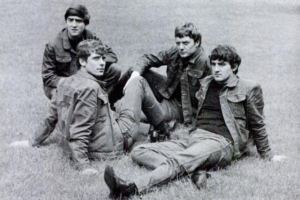
The top 10 Ozark Mountain Daredevils songs start by looking at a Southern country rock band that officially got its start in Springfield, Missouri, in 1972. Two signature songs from the group’s musical repertoire stood out the most, at least among fans and critics, as all-time favorites. “If You Wanna Get to Heaven” was the first in 1974 and was followed by “Jackie Blue” in 1975. According to bassist Michael Granda, the full name was Cosmic Corn Cob & His Amazing Ozark Mountain Daredevils after the group learned that the original name, Family Tree, was already taken. At the height of their popularity, the Ozark Mountain Daredevils were often compared to the Eagles, Firefall, and the Flying Burrito Brothers.
Family Tree
Before becoming Ozark Mountain Daredevils, the band was originally founded in 1971 as Family Tree. The founding members were Elizabeth Anderson, Rick Campanelli, Randle Chowning, Steve Cash, John Dillon, Michael Granda, Bill Jones, and Larry Lee. Together, they recorded a demo that led “Rhythm of Joy” to a music executive in New York named John Hammond. During the summer of 1972, a producer was sent to Aldrich, Missouri, to meet with the band at the Ruedi-Valley Ranch. Chowning and his brother, Rusty, were renting a house on the property owned by his university teacher. His band was permitted to rehearse there, and it was at this location that The Lost Cabin Sessions would be recorded as another demo tape intended for American Artists. Even after producer Michael Sunday offered the band money to record a second demo, the band ultimately decided not to sign a contract with the label.
Instead, as Family Tree, the group sent a demo tape to the management team of fellow Missouri musicians, Brewer & Shipley. Paul Peterson and Stan Plesser, who owned and operated the Kansas City-based Good Karma Productions, agreed to become the band’s managers. However, the crew learned that, at the time, Family Tree was already used by another musical act, so a new name was needed. The result was Ozark Mountain Daredevils. In addition to the band’s name change, the lineup changed. Campanelli and Jones were out and were replaced by a piano player named Buddy Brayfield. Anderson, who was romantically linked with Dillon, also decided to opt out as she decided to retire from the stage. Campanelli’s decision to leave the band was to pursue a master’s degree in music. With Jones, he occasionally performed as a guest musician with the Ozark crew on various recording sessions and concert performances.
Ozark Mountain Daredevils
Between 1972 and 1973, the Ozark Mountain Daredevils performed at various venues in and around Kansas City, Missouri, as well as St. Louis. It would be from these two cities Archive Alive would be put together and released as a CD in 1997. This came about long after Ozark Mountain Daredevils signed with A&M Records, as its producer, David Anderle, was looking for a country-rock band to add to the label’s repertoire. However, when he and fellow producer Glyn Johns performed at the Cowtown Ballroom, the Missouri home of the Ozarks, the March 10, 1973, show wasn’t up to par.
The nervousness the Ozark crew felt at the time compromised its ability to perform as world-class musicians. As a result, Peterson invited Anderle and Johns to his home to hear the band perform an unplugged set by candlelight. This time, the producers heard exactly what they came for. After the Ozark Mountain Daredevils signed a contract with A&M Records in May 1973, the crew was sent to London, England, to record their first album at Olympic Studios.
December 1973 marked the release date of The Ozark Mountain Daredevils, along with the debut single, “If You Wanna Get to Heaven.” By the summer of 1974, this became a number twenty-five hit on the US Billboard Hot 100. To this day, it remains a fan favorite among country-rock fans. Overall, the album received favorable reviews from music critics for the group’s eclectic approach to a relatively laid-back, Southern-style country-rock album. This was followed by the 1974 release of It’ll Shine When It Shines.
This time, it was recorded using a mobile recording truck located just outside the band’s rehearsal base. It was during this time that Glyn Johns overheard pianist Larry Lee playing a song about some mysterious friend who also happened to be a drug dealer. The melody inspired John to encourage Lee and his bandmates to use it for a song, with the storyline changed to reference a girl rather than drugs. Lee and Steve Cash agreed, and “Jackie Blue” became the result.
Thanks to the success of “Jackie Blue,” A&M Records hoped the Ozark Mountain Daredevils would stick to a musical sound that scored the group its first top-ten hit. The success of this single, along with the album’s performance, prompted 1975’s The Car Over the Lake Album to feature a tracklist similar to the group’s previous recordings. However, it failed to produce any hits. At one point, the group was offered the opportunity to move to Southern California by A&M’s Jerry Moss. The Ozark Mountain Daredevils had no desire to move away from their Missouri base, making it difficult for the label to further capitalize on what they looked at as a cash cow. It also marked a reversal of fortune for the band, as A&M began to lose interest in working with a band it felt had started out with so much promise.
Shaking the Mountain
After embarking on a European tour in 1976, the weary Ozark Mountain Daredevils met with a disastrous final performance during a concert show in Copenhagen, Denmark. The sound quality at its Daddy’s Dance Hall venue was terrible, and a flustered Randle Chowning cranked up his amplifier in response. As a result, his bandmates couldn’t hold back their frustration,s and what should have been a regular concert performance became an on-stage confrontation. By the time everybody went home, Chowning refused to have anything further to do with the Ozark cre,w so they ultimately replaced him with Rune Walle, a Norweigan musician the group met when they were in Europe. The US tour featured Walle in the lineup, starting with a July 23, 1976, performance in Kansas City, Missouri, at Arrowhead Stadium.
While the Ozark Mountain Daredevils moved forward, Chowning created his own group, the Randle Chowning Band. Before 1976 was over, the Ozark Mountain Daredevils recorded their fourth album, Men From Earth. Originally, it was supposed to be titled “Nuclear Fishing,“ but A&M Records demanded that it be changed. While this one didn’t release any hits either, it once again featured Larry Lee as one of the group’s prized songwriters, along with Steve Cash and John Dillon. It was the fourth studio album in a row that featured A&M’s Anderle as the group’s producer.
Buddy Brayfield opted out of the lineup so he could study medicine. He was replaced by Ruell Chappell. However, the three album releases by Ozark Mountain Daredevils witnessed a gradual decline in the group’s popularity as recording artists. During this time frame, Jerry Mills was part of the lineup as its mandolin player. After 1978’s It’s Alive, he was let go. The group’s musical direction also shifted, with fewer acoustic performances during live shows.
1978 saw various bandmates from Ozark Mountain Daredevils dabble in side projects, including White Mansions, an album Steve Cash and John Dillon collaborated on that musically documented life in the Confederacy during the American Civil War. Guest musicians Eric Clapton, Jessi Colter, Waylon Jennings, and Bernie Leadon each contributed to the album’s tracklist as guest musicians. 1978 also marked the year Larry Lee put together a solo album for A&M, but it remained unreleased. While still as a group, the Ozark Mountain Daredevils were flown to Hollywood to appear on The Midnight Special. A&M’s Jerry Moss was unimpressed when he saw the group at their worst during their performance on the show. This led the label to drop the Ozarks.
Moving Mountains
In 1979, the Ozark lineup signed with Columbia Records and in 1980, released Ozark Mountain Daredevils. In charge of production was John Boylan. He brought in session players in place of Steve Canaday and Ruell Chappell because he wanted the album to have a California-style country-rock sound. Unfortunately, the popularity of country rock at this time began to decline and groups like the Ozarks found themselves having to make an important decision where to go from here.
In an effort to regain that popularity, the country-rock sound that made the Ozark Mountain Daredevils popular to begin with was sidelined in favor of a harder rock sound. However, this wound up being a decision that failed to win over the record stores. As a result, Columbia dropped the Ozark crew from the label. After this, Rune Walle and Ruell Chappell left the lineup. Terry Wilson came in, primarily as Walle’s replacement. Before 1980 ended, Ozark Mountain Daredevils held two reunion concerts that led to the 2006 release of 1980 Reunion Concert: Rhythm and Joy.
As for the band’s lineup throughout the 1980s, Larry Lee was the next to leave after he and his wife finalized their divorce in 1982. He moved to Nashville, Tennessee, and debuted with his solo album, Marooned. He also put his production and songwriting talent to good use for other stars such as Alabama and Juice Newton. When Lee left the Ozark Mountain Daredevils, the lineup was reduced to Steve Canaday, Steve Cash, John Dillon, Mike Granda, and Terry Wilson. However, this didn’t last for long as Cash and Dillon decided to opt out before the year was over.
Granda and now a returning Randle Chowning put together a reformation of Ozark Mountain Daredevils. They brought in Bobby Hicks, Gary Smith, and Joe Terry. Canaday remained in the role of the band’s road manager, a position he had already held. This new roster didn’t last long, as Chowning left again and Hicks moved on to join a new group, the Morells. After this, Cash and Dillon rejoined the Ozarks. Soon afterward, Smith moved on. Chowning would join for the third time.
Overall, the Ozark Mountain Daredevils have recorded and released eight studio albums between 1973 and 2018. It also has six live albums and six compilation albums to its credit. Two of them were United States releases, while the other four were in Europe. There are also two live DVDs and fourteen singles. The two biggest hits were “If You Wanna Get to Heaven” and “Jackie Blue.” There were four other singles that also became hits on the music charts, starting with “Look Away.” The legacy of the Ozark Mountain Daredevils was featured in It Shined, a 2008 book by Mike Granda. He covered everything from how he and his bandmates got their start and how their lives were before, during, and after the Ozark Mountain Daredevils rose to fame.
Top 10 Ozark Mountain Daredevils Songs
# 10 – Standin’ On a Rock
“Standin’ On a Rock” was an anti-war song performed through the eyes of a young boy who simply wanted the world to learn how to get along. Eager to grow up, he was also eager to realize his own dreams, which included finding a home in the country as a proud citizen of the nation he called home. This was one of many country-rock gems on the Ozark Mountain Daredevils’ debut album, released in December 1973. The beauty of this song was its sharing of what so many boys and girls experienced while living in a city environment, where the influences of city life didn’t feel like a life-altering disease. It was simple and country. It was also Ozark Mountain Daredevils at its finest as it bridged the gap between down-to-earth grassroots and rowdy rock.
# 9 – Mr. Powell
“Mr. Powell” was written as a historical ballad by Larry Lee, who served as a drummer, keyboardist, and pianist for the Ozark Mountain Daredevils, one of its original members. The song told the story of John Wesley Powell, who led a party of ten men to explore the Colorado River in 1869. This beauty was part of the 1975 tracklist for the group’s third studio album, The Car Over the Lake Album. John Dillon’s mandolin performance can be heard here, as well as the harpsichord intro that played a key role in turning “Mr. Powell” into a gem, especially among fans who fancy themselves American history buffs. “Mr. Powell” is as entertaining to listen to as it is educational. It revealed a piece of American history to be proud of, as the earliest explorers braved the elements to help the nation realize its true potential.
# 8 – Country Girl
“Country Girl” was a song written by Randle Chowning that focused heavily on harmonica, a favorite, and shared qualities with “Take It Easy” by the Eagles. This became a classic favorite among fans of the Ozark Mountain Daredevils and their self-titled debut album. The album was released in late 1973, and “Country Girl” was among the gems that highlighted the bluegrass roots of a country-rock band that won a solid American, Canadian, and European audience. This song was about the positive influence of a down-to-earth woman who can help kick out the blues in favor of some good old-fashioned country-style fun.
# 7 – E.E. Lawson
Written by Steve Cash, “E.E. Lawson” was a rootsy Southern-style rocker that defined the Ozark Mountain Daredevils as a country rock band with a solid grassroots background. This came from It’ll Shine When It Shines, the second studio album by a group that often demonstrated that great country songs don’t always have to come across as woeful ballads about lost loves and bad lifestyle choices. In the lyrics, “E.E. Lawson” was a man who ran the local general store and seemed to have something for everyone. People from the Ozarks or the Appalachians are familiar with their own version of an “E.E Lawson” that had a store that also doubled as a speakeasy. These establishments offered food, drink, and a local band for locals and travelers to simply hang out and have some fun.
# 6 – It’ll Shine When It Shines
The beauty behind “It’ll Shine When It Shines” lies in its lyrics, which point out that no matter how hard you try to control fate, whatever it has in store for you will always do exactly what it is designed to do. The key to happiness is to take in the blessings as they come and use them to your advantage when life isn’t so peachy. As a song that best captures what defines country and grassroots music, “It’ll Shine When It Shines” was also the title of an album that had the Ozark Mountain Daredevils shine like they never had before.
While “Jackie Blue” became the big hit that got most of the attention, the title track was equally deserving of earning mention as a musical gem. When it first came out, it was a party favorite, with people singing it at the top of their lungs. Today, as new fans are introduced to classic country rock, “It’ll Shine When It Shines” becomes a favorite for guitarists and singers to gather around and jam to.
# 5 – If I Only Knew
Released as a single in 1976, “If I Only Knew” came from the album The Car Over the Lake Album. It peaked at number sixty-five on the US Billboard Hot 100, number seventy-one on the US Cash Box chart, and number seventy-four in Canada. This was a laid-back favorite that shared the same musical style as It’ll Shine When It Shines. What’s cool about this song is the brush with nostalgia it brings, as someone looking back on a lifetime of memories, along with all the adventures and misadventures that went with them.
If there was ever an unofficial album that could have worked with The Dukes of Hazzard, The Car Over the Lake Album would have been it. Songs like “If I Only Knew” would make the perfect theme song for some of the older characters, like Uncle Jessie or even Sheriff Rosco Coltrane. Interestingly, the release of this album came after 1975’s Moonrunners became a box office hit. This was the movie that spawned the 1979 series, The Dukes of Hazzard. 2007’s The Dukes of Hazzard: The Beginning actually used one of Ozark Mountain Daredevils’ songs in a scene that showed how the great “General Lee” became the beating heart of one of the most beloved television series of all time.
# 4 – Homemade Wine
“Homemade Wine” came from the fourth studio album recorded by Ozark Mountain Devils, Men from Earth. This 1976 production once again featured Larry Lee’s songwriting. Although it wasn’t technically released as a single, it was one of the highlights of an album featuring the musical talent of a group that stuck to its roots as a country-rock act, also known for hints of bluegrass and pop. This was a lively song that showcased a mix of country and rock flair, prompting labels like A&M Records to pay attention to its brand of music. If you’re looking for a great song to dance to, perhaps after a sip or two of wine, “Homemade Wine” would be it. If there isn’t any wine around, perhaps some moonshine or any kind of spirit will do.
# 3 – You Know Like I Know
Written by Larry Lee, “You Know Like I Know” was a standout favorite from Men from Earth, the fourth album recorded and released by Ozark Mountain Devils. Although it wasn’t released as a single and didn’t become a hit on any official music charts, it became a popular fan favorite. Once again, Lee’s masterful songwriting and piano genius were highlights. On the US Billboard Hot 100, it reached number seventy-four, while the US Cash Box chart saw it peak at number fifty-five.
In Canada, it was a number sixty-two hit. “You Know Like I Know” was a calm ballad that offered assurances that, no matter how hard things get, faith that things will work out in the long run makes them feel a bit more tolerable. This was a musical trademark that shaped most of the music from Ozark’s core lineup, and it’s why they still have a strong fan following even after performing for over fifty years.
# 2 – If You Wanna Get to Heaven
“If You Wanna Get to Heaven” became a number twenty-five hit on the US Billboard Hot 100 and a number twenty-three hit in Canada after it was released in late 1973 as a single from its debut album, The Ozark Mountain Daredevils. On the US Cashbox chart, it peaked at number twenty-one. Nine years later, it was covered by Hank William Jr. on his album High Notes. It was covered again in 1997 by Jeff Carson for his album, Butterfly Kisses. The original version of this song was featured on the Rebel Radio tracklist for the popular video game Grand Theft Auto V. The 2013 release of this racing-based RPG became one of the most popular games published by Rockstar Games, and fans seemed to enjoy the music as much as the gameplay.
In addition to making its mark in the video game industry, “If You Wanna Get to Heaven” was also playing in the background during a scene from the 2007 movie, The Dukes of Hazzard: The Beginning. Fans of the popular television series watched the iconic General Lee pulled out of the water, and the 1969 Dodge Charger restored to its former glory. The song, “If You Wanna Get to Heaven,” pointed out that in order to get there, one had to raise a little hell. According to the fans who can’t get enough of this song, they’re in complete agreement. At the time of release, the Ozark Mountain Daredevils sported long hair and strutted about as country-style rockers with attitude. It was a formula that worked in their favor and got them noticed by record labels, starting with A&M.
#1 – Jackie Blue
“Jackie Blue” began as a song by Larry Lee, who was playing the piano, and Glyn Johns overheard his performance. The former Eagles producer loved the melody so much that he wanted to make sure the Ozark Mountain Daredevils made a full song from it. After its 1974 release as a single, it became a number three hit on the US Billboard Hot 100. Since then, “Jackie Blue” has become the signature song that fans of the Ozark Mountain Daredevils most associate with the band.
Before “Jackie Blue” was birthed as a full song, the melody Lee performed as his own song was about a bartending friend who sold drugs on the side. However, by request, the storyline was altered to focus on a reclusive girl as a performance Johns believed would earn the Ozark Mountain Daredevils another hit on the radio. As it turned out, he was right. It took about half an hour for Lee and Steve Cash to come up with the lyrics. In cities such as Baltimore, Maryland, and Chicago, Illinois, “Jackie Blue” became so popular that A&M Records hoped the Ozark Mountain Daredevils would stick to a Jackie-style theme while the group was still signed to the label. However, there can only be one “Jackie Blue” and that was established over the course of the next three albums recorded and released by the band from Missouri.
Feature Photo: IFA-International Famous Agency/ A&M Records, Public domain, via Wikimedia Commons
Updated February 13, 2026
Top 10 Ozark Mountain Daredevils Songs article published on Classic RockHistory.com© 2026
Classicrockhistory.com claims ownership of all its original content and Intellectual property under United States Copyright laws and those of all other foreign countries. No one person, business, or organization is allowed to re-publish any of our original content anywhere on the web or in print without our permission. All photos used are either public domain Creative Commons photos or licensed officially from Shutterstock under license with ClassicRockHistory.com. All photo credits have been placed at the end of the article. Album Cover Photos are affiliate links and the property of Amazon and are stored on the Amazon server. Any theft of our content will be met with swift legal action against the infringing websites.