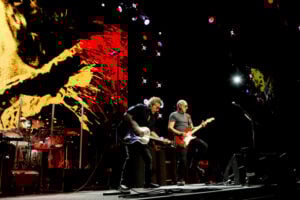
Feature Photo by O.Kemppainen Licensed from Shutterstock
Iron Maiden’s self-titled debut (1980), which helped launch one of the biggest heavy metal bands of all time, was a much rawer record than the band would later establish itself as. Featuring original vocalist Paul Di’Anno, whose vocal style was much more gruff and punk-esque than his successor Bruce Dickinson’s, it is clear on this album that the band was still finding its style, not yet playing to the level of musicianship they would later master.
Opening with the track “Prowler,” which began with a riff followed by energetic drums from then-drummer Clive Burr, it definitely had a punk energy that came in full force. Di’anno had a unique charisma in his voice, sounding like an outlaw, with the lyrics telling a rather sinister story of a stalker spying on young women.
As soon as this was over, the band slowed down with “Remember Tomorrow,” where they got an opportunity to show more of their technical skill,s somewhat, with guitarist Dave Murray and Dennis Stratton, in his only recording with Maiden, showing their ability to perform the dual playing that Murray would later perfect with Stratton’s replacement Adrian Smith.
After this, undoubtedly the highlight of the album and still a fan favorite to this day, was “Running Free.” A true fist-in-the-air anthem about teenage rebellion, it was a track that was Di’Anno to a tee, his gruff style suiting it perfectly. Although Dickinson has definitely performed the song live over the years, this is very much a Di’Anno song; his style just gives it that slight sense of street power it needed, which Dickinson’s more operatic style can’t quite deliver.
Next was “Phantom of the Opera,” which is also one of the most played songs from the album today. One song that Stratton played a big part in: he originally added backing vocals, which the rest of the band did not like because it apparently sounded too much like Queen. At 7 minutes long, it is one of bassist Steve Harris’s favorite tracks, and with its time and mood changes, it was arguably the first song in Maiden’s career to show their proggy side.
What follows next is “Transylvania,” an instrumental composed by Harris, which was notably covered by Iced Earth on their album “Horror Show”. A track that gave the guitarists another chance to show their capabilities, the song, not having Di’annos vocals over it gave the band as a whole a chance to show their technical proficiency.
“Strange World” then saw Di’anno make a welcome return and show a different side to his vocal capabilities. A slow number, he actually SANG here rather than the raspy shout he was known for. This is a song that would not be out of place on any of the Dickinson material, and it is a mystery why it has not been played live much over the years, as Dickinson’s more wide-ranging style could arguably do it more justice than it is given here.
The next song is “Charlotte the Harlot” and is notable for two reasons- one for being the only ever Maiden song to have been solely written by Murray, and it is the first of four tracks in the band’s catalogue to be about a fictional prostitute named Charlotte, although Murray has stated that it was based on a true story. Given the song’s subject matter, it has a moody, somewhat sad tone, with the lyrics offering a sympathetic view of the character. It is still fast and energetic, but downbeat at the same time.
The album closed with the title track and the band’s namesake, “Iron Maiden,” in particularly epic fashion. It was relentlessly energetic from start to finish and obviously a live staple to this very day. Lyrically, it was basically about the band being who they were, which at this time was a young and upcoming band destined for great things, which they soon achieved over the next few years. Strangely lacking a solo, it definitely had the punk feel that was prevalent throughout this album, whether the band felt that way or not.
Viewing this album retrospectively, its importance will never be irrelevant, as it was the sound of a young band that is now one of the biggest in the world. Nearly 40 years on, it sounds of its time, but it still sounds exciting, with the feel of a band that had the ambition to go to great places.
Other than that, it is generally still a very good album. Definitely a strong debut; many of its tracks are now regarded as classics. With this album, Maiden got off to a good start; it is not a weak debut like many other bands have. One thing their later, more polished albums lacked was the rawness and rebellious attitude.
Compared to later albums such as “Number of the Beast” and “Seventh Son of a Seventh Son,” it was not as musically adventurous. It was more of a straight-ahead rock album. As previously stated, Di’anno’s style was very different from Dickinson’s, which undoubtedly played a role. Many people agree that Di’anno did not have the vocal range to perform some of the material they would later produce on their more progressive, epic records, which is why it sounds somewhat more limited compared to those records.
Check out similar articles on ClassicRockHistory.com Just click on any of the links below……
Top 10 Iron Maiden Songs
Complete List Of Iron Maiden Albums And Discography
Top 10 Iron Maiden Album Covers
Top 10 Iron Maiden Albums
Iron Maiden The Number of the Beast: Album Review
Iron Maiden The Book of Souls: Album Review
Read More: Artists’ Interviews Directory At ClassicRockHistory.com
Read More: Classic Rock Bands List And Directory
Read More: 100 Essential Albums From The 1960s That Everyone Should Own
Updated February 11, 2026
Looking Back At Iron Maiden’s Debut Album article published on ClassicRockHistory.com© 2026
Classicrockhistory.com claims ownership of all its original content and Intellectual property under United States Copyright laws and those of all other foreign countries. No one person, business, or organization is allowed to re-publish any of our original content anywhere on the web or in print without our permission. All photos used are either public domain Creative Commons photos or licensed officially from Shutterstock under license with ClassicRockHistory.com. All photo credits have been placed at the end of the article. Album Cover Photos are affiliate links and the property of Amazon and are stored on the Amazon server. Any theft of our content will be met with swift legal action against the infringing websites.