Feature Photo: Ralf Liebhold / Shutterstock.com
AC/DC is undeniably one of the greatest rock bands to come out of Australia, and their impact on rock and roll is still felt decades after their formation. Since their debut in the early 1970s, the band has carved out an unmatched legacy with their high-energy performances, hard-hitting riffs, and unforgettable songs. Known for their distinctive sound, driven by the raw guitar playing of Angus Young and the iconic vocals of Bon Scott and later Brian Johnson, AC/DC has released 17 studio albums, along with multiple live records and compilations.
Over their career, they’ve sold more than 200 million records worldwide, and albums like Back in Black and Highway to Hell have become legendary touchstones in rock music history. With each release, their cover art has become an integral part of the band’s identity—bold, direct, and full of the same rebellious energy that defines their music. Many of their albums, like Let There Be Rock, Powerage, and Dirty Deeds Done Dirt Cheap, have covers that have become almost as iconic as the music itself.
In this list of the top 10 AC/DC album covers, we’ll explore how the visual design of each record played a key role in defining the band’s image and how these covers connected with fans across generations. From the electrifying image of Angus Young on High Voltage to the minimalist but powerful statement of Back in Black, these covers are not just artistic expressions—they are snapshots of a band that’s always been larger than life.
# 10 – High Voltage

In 1976, High Voltage electrified the world with the first internationally released album by Australian hard rock legends AC/DC. This album marked the beginning of the band’s global rise, compiling tracks from their earlier Australian-only releases High Voltage and T.N.T., both from 1975. The cover art is unforgettable, featuring guitarist Angus Young in his signature schoolboy uniform, mid-power stance, with a lightning bolt symbolizing the raw energy of the music. The vibrant yellow streak slicing through the cover represents the sheer force of AC/DC’s sound, evoking the high-voltage shock that their music delivers. With flames licking the edge of the frame, this album cover captures the rebellious spirit of rock and roll, mirroring the band’s hard-hitting, no-nonsense approach.
# 9 – Powerage

Powerage, released in May 1978, marks the fifth studio album by Australian hard rock giants AC/DC. This album holds a special place in the band’s discography because it introduced bassist Cliff Williams to the fold. Known for its raw energy and uncompromising sound, Powerage is a fan favorite, even without a defining title track—something rare for an AC/DC album at that time.
The album’s cover features an electrified image of Angus Young, with multicolored cables bursting from his hands, an image that perfectly reflects the volatile and charged nature of the music within. His facial expression, caught mid-yell, almost seems like a scream powered by an overwhelming jolt of electricity. The bold, distorted white, yellow, and red fonts for “AC/DC” and “Powerage” add to the chaotic, powerful feel, echoing the album’s sound. The dark backdrop intensifies the drama, suggesting a loss of control and the band’s explosive energy at their peak.
# 8 – Stiff Upper Lip

Stiff Upper Lip, AC/DC’s fourteenth studio album, was released on February 28, 2000, and was produced by George Young, the older brother of Angus and Malcolm Young. George Young’s involvement marked the last time he produced for the band before his death in 2017. This album showcases AC/DC’s classic sound, with gritty rock-and-roll energy, solidifying the band’s enduring legacy into the new millennium.
The album cover features a towering bronze statue of Angus Young in his signature schoolboy outfit, mid-stride, playing his Gibson guitar. The statue stands defiant, much like the attitude suggested by the album’s title, Stiff Upper Lip. Behind this rock-and-roll monument, skyscrapers glow in the nighttime cityscape, contrasting the metallic structure and giving the scene a timeless feel of AC/DC’s larger-than-life presence in rock music. The band’s name is carved in rugged, metallic block letters across the top of the cover, matching Angus’s indestructible image and serving as a fitting tribute to the band’s enduring rock legacy.
# 7 – Ballbreaker

Ballbreaker, released in 1995, is AC/DC’s thirteenth studio album and marks a triumphant return to the raw, bluesy hard rock that made the band famous. The release also welcomed back drummer Phil Rudd, restoring the rhythm section that powered many of the band’s classic recordings.
The album cover imagery is as electrifying as the music it represents. Angus Young is shown on top of a giant stone ball, gripping his guitar mid-stride, while bolts of lightning surround him. The scene feels as if Angus is bursting out of a dark, mysterious industrial world, with looming structures in the background. The cover’s deep blues and dark shadows, along with the title Ballbreaker carved into the massive stone, suggest impending chaos and uncontainable energy. The electrified bolts only add to the feeling that this album is about to unleash something wild, true to the power and aggression fans expect from AC/DC.
# 6 – Blow Up Your Video

Released in 1988, Blow Up Your Video marked a turning point for AC/DC, not only as their eleventh studio album but also as the last studio album to feature Simon Wright on drums. Produced by Harry Vanda and George Young, who had worked on the band’s earlier records, the album saw the band reconnecting with longtime collaborators. Recorded in the south of France at Studio Miraval, it remains quintessentially AC/DC.
The album cover features Angus Young, mid-leap, smashing through a television screen, guitar in hand. His iconic schoolboy outfit adds playful destruction, perfectly capturing the album’s spirit. The image plays into the album’s title, Blow Up Your Video, suggesting that the band’s explosive sound is so powerful that it breaks through the confines of technology itself. The shattered TV screen visually underscores the band’s intention to transcend traditional media, inviting listeners to experience the energy and mayhem of AC/DC in its purest form: live and loud.
The cover art, while less visually elaborate than some of their earlier albums, embodies the relentless force of AC/DC’s music. It hints at the visual culture of the ’80s, particularly the rise of music videos on platforms like MTV, while rejecting it—AC/DC was never a band that relied on visual gimmicks. The focus remains squarely on Angus Young’s signature dynamism, reminding fans that it’s always been about the music, the riffs, and the unrelenting power of rock and roll.
# 5 – For Those About to Rock (We Salute You)

For Those About to Rock (We Salute You), released in November 1981, stands as one of AC/DC’s most iconic albums. Following the massive success of Back in Black, this record pushed AC/DC further into the stratosphere of rock greatness, becoming their first album to reach number one in the U.S. Featuring the powerful production of Robert John “Mutt” Lange, the album cemented their legacy with its timeless anthem and title track, “For Those About to Rock (We Salute You).”
The album’s cover art is unmistakable, featuring a large cannon against a plain brown background. The cannon symbolizes the explosive energy and raw power of AC/DC’s music. It declares the band’s ongoing sonic assault on the rock world, a fitting tribute to their ever-growing army of fans. The minimalistic design, coupled with the boldness of the cannon, reflects AC/DC’s no-frills, hard-hitting style, both visually and musically.
Compared with previous album covers, this design takes a different, more militaristic direction, yet it fits perfectly with the album’s title and theme. The idea to incorporate cannons into the song and album imagery came while the band was recording in Paris and watching the televised wedding of Prince Charles and Diana. The cannon itself became a part of the band’s live shows, firing salutes during performances of the title track. This image, much like the music it represents, became an enduring symbol of AC/DC’s power.
# 4 – Let There Be Rock

Let There Be Rock is AC/DC’s fourth studio album, first released in Australia in March 1977 and later issued internationally in different markets. It was a pivotal album in the band’s career and marked bassist Mark Evans’s final studio appearance before he was replaced by Cliff Williams. On this album, the band refined the sound that would soon make them global rock icons.
The cover of the international version of Let There Be Rock is significant for introducing AC/DC’s now-famous lightning-bolt logo, designed by Gerard Huerta. The image captures the band’s raw energy, especially the power of lead guitarist Angus Young, who is shown mid-jump with his Gibson SG, dominating the stage. Rock photographer Keith Morris took the photograph for the international cover at the Kursaal Ballroom in Southend, Essex, in March 1977.
Drenched in shadow and lit by dramatic stage lights, this cover art conveys the intensity and spectacle of AC/DC’s live performances. Angus’s iconic schoolboy uniform and larger-than-life persona are front and center, reflecting the album’s no-holds-barred approach to rock. The surrounding band members, Bon Scott, Malcolm Young, and Phil Rudd, are partially obscured, symbolizing how Angus often took the visual spotlight during shows. The title, Let There Be Rock, is more than an album name—it is a declaration of AC/DC’s commitment to creating earth-shattering rock anthems that would resonate through the decades.
# 3 – Dirty Deeds Done Dirt Cheap

Dirty Deeds Done Dirt Cheap was first released in Australia in September 1976 with a different cover and track sequence. The modified international edition featuring the familiar Hipgnosis artwork was released in the UK in November 1976, while the album was withheld from the United States until March 1981, more than a year after Bon Scott’s death. That delayed American release gave the record a unique second life at the height of AC/DC’s popularity.
Hipgnosis designed the album’s international cover, the celebrated design group known for surreal, enigmatic artwork for bands such as Pink Floyd and Led Zeppelin. This cover is no exception, featuring an eerie scene with people whose eyes are blacked out, creating anonymity and intrigue. The setting, combined with the obscured faces, evokes a strange world where “dirty deeds” are carried out in the most ordinary places, underscoring the album’s rebellious spirit.
The simplicity of the visuals belies the aggressive and rebellious energy AC/DC is known for. The cover art plays into the album’s title and lyrical themes of underhanded, nefarious deeds, adding an ironic twist by placing them in such an everyday environment. The cover’s sinister undertone and the album’s raw, unapologetic energy would go on to make it a defining release in the band’s discography.
# 2 – Highway to Hell

Highway to Hell, released in July 1979, stands as a pivotal album in AC/DC’s career, marking the end of an era with Bon Scott’s final studio appearance as lead singer before his death in 1980. Produced by Robert John “Mutt” Lange, it was the first of three collaborations with Lange that would elevate AC/DC’s sound and commercial appeal, helping to cement their place in hard rock history. This album remains one of AC/DC’s most celebrated releases, defining their raw, energetic style.
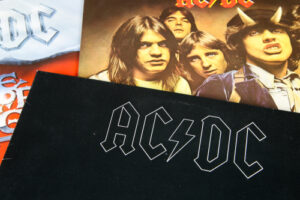
The international album cover for Highway to Hell is iconic in its own right. With Angus Young front and center, wearing his schoolboy uniform and devil horns, the image instantly captures the band’s rebellious, devil-may-care attitude. His smirk, paired with his bandmates’ no-nonsense expressions, sets the tone for the blistering rock inside the album. A red devil’s tail curls upward near Angus at the bottom of the image, deepening the devilish theme without overwhelming the straightforward band portrait. Jim Houghton photographed the cover, with art direction by Bob Defrin.
In all its versions, this album cover has become synonymous with AC/DC’s legacy. The Australian edition added flames and a bass-guitar neck to the same band photograph, while other regional editions also varied. Highway to Hell marks a crucial moment for the band, and its imagery and unforgettable music make it one of the most memorable rock albums of the 20th century.
# 1 – Back in Black (1980)

Back in Black is not only one of AC/DC’s most iconic albums but also one of the greatest rock records of all time. Released on July 25, 1980, it marked a major transition for the band, as it was the first album to feature Brian Johnson as lead vocalist after Bon Scott’s death earlier that year. Despite the monumental loss, AC/DC made the bold decision to continue their musical journey, producing an album that would become their defining moment.
The all-black album cover, art-directed by Bob Defrin, serves as a somber tribute to Bon Scott. Conceived as a sign of mourning, the cover reflects the profound loss the band felt after Scott’s death, yet it also symbolizes their resilience. Atlantic Records wanted enough visible detail for the package to be recognizable on store shelves, leading to the restrained outline around the AC/DC logo and album title. The result is an almost featureless black sleeve—no flashy imagery, no distractions—just a powerful, respectful statement.
Musically, Back in Black solidified AC/DC’s place in rock history, with tracks like “Hells Bells,” “You Shook Me All Night Long,” and the title track “Back in Black” becoming anthems for rock fans around the globe. Robert John “Mutt” Lange’s production, which also shaped Highway to Hell, kept the band’s hard-hitting sound as explosive as ever, while Johnson’s distinctive voice added a new, electrifying dynamic. The album’s cover, much like its music, became a timeless rock symbol and a reminder of AC/DC’s unwavering spirit in the face of tragedy.
Check out our other AC/DC articles on ClassicRockHistory.com
Complete List Of AC/DC Albums And Discography
Top 10 Brian Johnson AC/DC Songs
Angus Young Becomes Last Man Standing In AC/DC
AC/DC Back in Black: The meaning behind the album cover
Angus Young Becomes Last Man Standing In AC/DC
Check Out The Rolling Stones and AC/DC Jamming Together Live
Updated September 11, 2026.
Our 10 Favorite AC/DC Album Covers article published on ClassicRockHistory.com © 2026