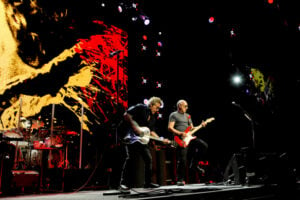
Feature Photo: Wonker, CC BY 2.0 <https://creativecommons.org/licenses/by/2.0>, via Wikimedia Commons
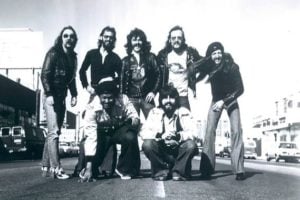
Mott the Hoople’s journey began in 1969 in Hereford, England, and their path from obscurity to rock stardom remains one of the most unique in music history. Known for their mix of hard rock and glam, the band initially struggled to gain traction, with their early releases failing to make a major commercial impact. Their fortunes changed when David Bowie offered them his song “All the Young Dudes,” which became a major hit in 1972 and elevated the group to international prominence. Mott the Hoople released seven studio albums during their original run, including Mott (1973) and The Hoople (1974), which solidified their place in the glam rock era.
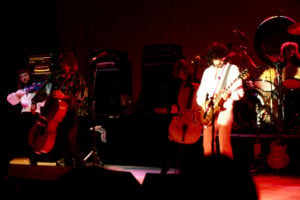
Despite internal tensions and lineup changes, Mott the Hoople earned critical acclaim and developed a loyal fan base. They were known for their theatrical performances, Ian Hunter’s distinctive voice, Mick Ralphs’ guitar work, and Pete Overend Watts’ larger-than-life stage presence. Their influence extended to numerous bands, including Queen and Def Leppard. The original Mott the Hoople era ended in late 1974 after Ian Hunter and Mick Ronson left, while Pete Overend Watts, Dale Griffin, and Morgan Fisher continued in the successor band Mott and later British Lions. Mott the Hoople reunited in 2009 and 2013, and the 1974-era lineup returned for performances in 2018 and a U.S. tour in 2019.
Ian Hunter
Ian Hunter joined the group in 1969 as lead vocalist, pianist, guitarist, and principal songwriter, quickly becoming Mott the Hoople’s central figure. His distinctive voice and songwriting helped define the band’s sound, particularly on albums such as Mott (1973), which featured “All the Way from Memphis.” Hunter’s ability to combine introspective lyrics with hard rock attitude became a hallmark of the group’s identity. His harmonica and piano work also added depth to songs throughout the catalog.
After leaving Mott the Hoople in late 1974, Hunter launched a successful solo career and continued his musical partnership with Mick Ronson. Albums such as Ian Hunter (1975) and You’re Never Alone with a Schizophrenic (1979) established his identity outside the band. Hunter returned for the 2009 and 2013 reunions and then fronted Mott the Hoople ’74 for performances in 2018 and 2019. His long solo career has continued alongside his enduring connection to the Mott the Hoople catalog.
Mick Ralphs
Mick Ralphs was a founding guitarist and songwriter for Mott the Hoople, becoming one of the key architects of the band’s early sound. His guitar work was central to albums including Brain Capers (1971), All the Young Dudes (1972), and Mott (1973). Ralphs also contributed important songs, including “One of the Boys” and “Ready for Love.” His combination of hard rock guitar and melodic songwriting helped give the band much of its musical range.
Ralphs left Mott the Hoople in 1973 and co-founded Bad Company with Paul Rodgers, Simon Kirke, and Boz Burrell. With Bad Company, he continued to achieve major success as the writer of songs including “Can’t Get Enough.” Ralphs returned to Mott the Hoople for the 2009 and 2013 reunions. He died in June 2025 at the age of 81, leaving behind a major legacy with both Mott the Hoople and Bad Company.
Verden Allen
Verden Allen was the original organist in the classic Mott the Hoople lineup and played a major role in shaping the band’s early sound. His Hammond organ gave the group’s first albums a distinctive texture that sat between hard rock, blues, and early progressive rock. Allen’s work can be heard across the band’s Island Records period and on songs such as “Half Moon Bay” and “The Moon Upstairs.” He left the band in late 1972 as Mott the Hoople entered its most commercially successful period.
Allen later released solo material and remained closely associated with the band’s history. He returned for the original-lineup reunion concerts in 2009 and again in 2013. His organ work remains one of the defining elements of Mott the Hoople’s earliest records.
Pete Overend Watts
Pete Overend Watts was Mott the Hoople’s bassist from the band’s formation in 1969 through the end of the original group in 1974. Known for his energetic playing, high boots, and flamboyant stage presence, Watts anchored the band’s music while helping shape its visual identity. His bass work drove songs including “Honaloochie Boogie,” “All the Way from Memphis,” and “The Golden Age of Rock ‘n’ Roll.” Watts played on all seven Mott the Hoople studio albums.
After Ian Hunter and Mick Ronson left, Watts continued with Dale Griffin and Morgan Fisher in the successor group Mott, which released Drive On in 1975 and Shouting and Pointing in 1976. He later continued with Griffin, Fisher, Ray Majors, and John Fiddler in British Lions. Watts returned to Mott the Hoople for the 2009 and 2013 reunion concerts. He died in 2017, leaving an enormous imprint on the band’s music, look, and live identity.
Dale “Buffin” Griffin
Dale “Buffin” Griffin was Mott the Hoople’s drummer throughout the band’s original 1969 to 1974 run. His drumming was a vital part of the group’s sound, driving songs such as “All the Young Dudes,” “Roll Away the Stone,” and “The Golden Age of Rock ‘n’ Roll.” Griffin also supplied backing vocals and percussion and became one of the band’s most recognizable personalities. His work appears on every Mott the Hoople studio album.
After the original group ended, Griffin continued with Mott and then British Lions alongside several of his former bandmates. He later became a successful BBC producer, including extensive work on John Peel sessions. Health problems prevented him from drumming through the full 2009 reunion shows, so Martin Chambers handled the main drum role while Griffin joined the band for the encores. Griffin died in 2016 at the age of 67.
Morgan Fisher
Morgan Fisher joined Mott the Hoople in 1973 after Verden Allen’s departure and became the band’s principal keyboardist during its final original phase. His piano, organ, and synthesizer work added a broader musical palette to The Hoople (1974) and the band’s live performances. Fisher also contributed backing vocals and occasionally played bass. His keyboard work became especially important as the band’s arrangements grew more theatrical.
After Mott the Hoople ended in 1974, Fisher remained with Pete Overend Watts and Dale Griffin in Mott and later British Lions. He subsequently pursued an adventurous solo and collaborative career. Fisher returned to the Mott the Hoople ’74 lineup for the 2018 performances and the 2019 tour, reconnecting him with Ian Hunter and Ariel Bender.
Ariel Bender
Ariel Bender, born Luther Grosvenor, joined Mott the Hoople in 1973 after Mick Ralphs left to form Bad Company. Already known for his work with Spooky Tooth, Bender brought a flamboyant stage presence and a more aggressive lead-guitar style to the band. He played on The Hoople (1974) and can be heard on recordings from the band’s celebrated 1974 live period. Songs such as “The Golden Age of Rock ‘n’ Roll” became closely associated with the energy of this lineup.
Bender left Mott the Hoople in 1974 and later worked with Widowmaker and on solo projects under his real name. He returned with Ian Hunter and Morgan Fisher for the Mott the Hoople ’74 performances in 2018 and the 2019 tour. His return recreated the core of the lineup associated with the band’s final studio album and last major original-era tours.
Mick Ronson
Mick Ronson joined Mott the Hoople in 1974 after Ariel Bender’s departure. Already famous for his work with David Bowie, Ronson brought a distinctive guitar sound and strong musical partnership with Ian Hunter. His time in the band was brief, but he participated in the final phase of Mott the Hoople and played on the 1974 single “Saturday Gigs.” The combination of Hunter and Ronson soon continued outside the band.
After Mott the Hoople ended, Ronson worked closely with Hunter on his early solo career while continuing his own projects and collaborations with numerous artists. His relationship with Hunter remained an important part of both musicians’ careers until Ronson’s death in 1993. His short period with Mott the Hoople remains one of the most fascinating lineup changes in the band’s history.
Ray Majors
Ray Majors was not a member of the original Mott the Hoople lineup but joined its successor band, Mott, in 1975 after Ian Hunter and Mick Ronson had departed. Majors became the group’s lead guitarist alongside vocalist Nigel Benjamin, Pete Overend Watts, Dale Griffin, and Morgan Fisher. He played on Drive On (1975) and Shouting and Pointing (1976). His guitar work helped give the post-Hunter band a harder and more direct sound.
Majors later continued with Watts, Griffin, Fisher, and John Fiddler in British Lions. His career also included work with other rock acts and solo material. Majors died in 2022, leaving behind an important role in the post-Mott the Hoople branch of the band’s history.
Nigel Benjamin
Nigel Benjamin became lead vocalist of the successor band Mott in 1975 after Ian Hunter left Mott the Hoople. He joined Pete Overend Watts, Dale Griffin, Morgan Fisher, and Ray Majors for Drive On (1975) and Shouting and Pointing (1976). His vocal style gave the renamed group a different identity while it attempted to continue the momentum built during the Mott the Hoople years. Benjamin also contributed guitar and songwriting during his tenure.
Benjamin left Mott in 1976 and later worked with other rock groups, including London. His time with Mott was brief but important because it represented the first full studio chapter after Ian Hunter’s departure. Benjamin died in 2019.
Steve Hyams
Steve Hyams was closely connected to the surviving Mott musicians during the transition that followed Nigel Benjamin’s departure. Rather than becoming part of a stable Mott the Hoople lineup, Hyams worked with Pete Overend Watts, Dale Griffin, Morgan Fisher, and Ray Majors on demo recordings in early 1977. There was briefly discussion of reviving the Mott the Hoople name, but the idea was abandoned. Hyams then pursued his own recording career.
The demos later surfaced on releases connected to Hyams, although his relationship with the group is better understood as a transitional collaboration than a full classic-era membership. He died in 2013. His brief involvement helps explain the path from Mott toward the formation of British Lions.
John Fiddler
John Fiddler did not sing on Mott’s Shouting and Pointing, which was recorded with Nigel Benjamin. After Mott ended, Fiddler joined Pete Overend Watts, Dale Griffin, Morgan Fisher, and Ray Majors in the new band British Lions in 1977. Already known for Medicine Head, Fiddler brought lead vocals, guitar, and harmonica to the group. British Lions released its self-titled debut in 1978 and later recorded Trouble with Women, which was released in 1980.
Fiddler’s role belongs to the successor history that grew directly from Mott rather than to the original Mott the Hoople recording lineup. After British Lions, he continued recording and performing in various projects. His connection remains part of the extended family tree created after Ian Hunter’s departure.
Mick Bolton
Mick Bolton joined Mott the Hoople as a touring Hammond organist in 1973 after Verden Allen’s departure. Morgan Fisher had taken the principal keyboard position, while Bolton supplied the additional organ part needed for the band’s expanding live arrangements. Bolton toured with the group during a key period as Mott became the band’s commercial breakthrough. His playing is represented on material from the band’s live era even though he did not become a long-term studio member.
Outside Mott the Hoople, Bolton worked with numerous artists and bands, including Dexys Midnight Runners and others. He remained an active musician for decades. Bolton died in 2021.
Blue Weaver
Blue Weaver joined Mott the Hoople as a touring keyboardist after Mick Bolton, working alongside Morgan Fisher during the band’s 1973 and 1974 touring period. The former Strawbs and Amen Corner musician contributed organ and keyboards to the expanded live sound. Weaver’s work can be heard on the band’s Live album, where he appears on material recorded during the U.S. performances. His time with Mott the Hoople also included the period when Queen appeared as a support act on the band’s American tour.
Weaver later became closely associated with the Bee Gees as a keyboardist, arranger, songwriter, and studio musician. His brief Mott the Hoople tenure remains an important part of the touring lineup that supported the band’s biggest years.
Martin Chambers
Martin Chambers, best known as the drummer for the Pretenders, joined Mott the Hoople for the 2009 reunion concerts because Dale Griffin’s health prevented him from handling the full shows. Griffin was still able to appear during the encores, while Chambers performed the main sets. Chambers returned when Mott the Hoople reunited again in 2013. His powerful drumming allowed the original members to revisit their classic material without compromising the energy of the performances.
Chambers’ career outside Mott the Hoople is defined primarily by his long association with the Pretenders. His role in the reunion years was that of a trusted touring musician rather than an original studio-era member.
James Mastro
James Mastro joined Mott the Hoople ’74 as a touring musician for the 2018 performances and 2019 tour. He contributed guitar, saxophone, mandolin, and backing vocals to a lineup centered on Ian Hunter, Ariel Bender, and Morgan Fisher. His multi-instrumental abilities helped recreate the layered arrangements associated with the band’s 1974 period.
Outside Mott the Hoople, Mastro has worked extensively with Ian Hunter and with the Bongos. His long connection to Hunter made him a natural choice for the later touring lineup.
Mark Bosch
Mark Bosch joined Mott the Hoople ’74 on guitar and backing vocals for the 2018 and 2019 reunion period. His guitar work helped support Ariel Bender and Ian Hunter while preserving the full-bodied sound of the 1974 material. Bosch had already spent years working with Ian Hunter and his Rant Band before joining the Mott the Hoople touring lineup.
His role was part of the expanded modern touring group rather than the original 1970s studio lineup. That familiarity with Hunter’s catalog helped the band reproduce the classic songs with authority onstage.
Dennis DiBrizzi
Dennis DiBrizzi joined Mott the Hoople ’74 on keyboards and backing vocals for the 2018 and 2019 performances. Working alongside Morgan Fisher, he helped recreate the keyboard-heavy arrangements associated with the band’s final original era. DiBrizzi was already a member of Ian Hunter’s extended musical circle before joining the reunion lineup.
His additional keyboard work gave the touring group the depth needed to perform material from The Hoople, Live, and the surrounding period. His role belongs specifically to the modern Mott the Hoople ’74 touring configuration.
Paul Page
Paul Page served as bassist for Mott the Hoople ’74 during the 2018 and 2019 reunion performances. He stepped into the role historically associated with Pete Overend Watts, who had died in 2017. Page’s bass work anchored a lineup that combined three members of the 1974-era band with musicians from Ian Hunter’s later touring circle.
Page has also worked extensively with Ian Hunter’s Rant Band. His familiarity with Hunter’s music made him an important part of the reunion lineup’s rhythm section.
Steve Holley
Steve Holley joined Mott the Hoople ’74 as drummer and backing vocalist for the 2018 and 2019 performances. His drumming brought both precision and power to the band’s classic material while filling the role originally held by Dale Griffin. Holley had previously worked with Paul McCartney and Wings and had a long association with Ian Hunter.
His experience with Hunter’s solo band made him well suited to the later Mott the Hoople lineup. Holley helped drive the 2019 U.S. tour, which marked the band’s first American tour in 45 years.
Check out more Mott The Hoople articles on ClassicRockHistory.com Just click on any of the links below……
Top 10 Mott The Hoople Songs
Complete List Of Mott The Hoople Albums And Discography
Read More: Artists’ Interviews Directory At ClassicRockHistory.com
Read More: Classic Rock Bands List And Directory
Updated September 21, 2026
Complete List Of Mott The Hoople Band Members article published on ClassicRockHistory.com © 2026