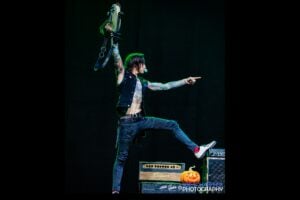
Feature Photo by Joe Schaeffer
Ace Von Johnson grew up as a punk rock kid, missing the vaunted ‘80s hair and glam metal scene by a few years. But after moving to L.A. and becoming a part of that scene in his 20s, things changed.
Things changed so much that Von Johnson found himself a member of not one, but eventually two classic groups from the Sunset Strip era: Faster Pussycat from 2010 to 2020, and since 2018, L.A. Guns.
As for what he’s learned along the way, Von Johson tells ClassicRockHistory.com, “Now 25-plus years in, and I have no delusions of grandeur as far as my playing goes.”
Adding, “I have always preferred players who had an emphasis on feeling over how many notes they can squeeze into each phrase. So, my approach still sits somewhere between that and my punk rock roots.”
What are your earliest memories of music in your life?
Absolutely driving around with my mom as a little boy, listening to the music she grew up on. Heavy on the ‘50s and’ 60s doo-wop type stuff, and some Eagles and The Doors. I think the first song I can specifically remember hearing was “People Are Strange.”
And then at around 10 years old, a neighbor kid gave me a cassette copy of Metallica’s Black Album. So, tape trading and tuning in to KROQ in Los Angeles turned me on to a lot of contemporary favorites from the early to mid ‘90s, as well as some iconic punk rock bands, courtesy of DJ Rodney Bingenheimer.
When did the guitar come into the picture, and when did you decide what sort of player you wanted to be?
I had an interest in picking up the guitar by about 13 years old. Somewhere in middle school. I really didn’t have much interest in becoming a lead player, per se. I just wanted to be able to master Ramones licks and your standard Chuck Berry fare.
I kinda kept that pace until I was in my early 20s, touring in and out of various punk bands, and that’s when I tried to spend my free time woodshedding. But ultimately, I was just trying to be Johnny Thunders, without the habit.
How did you make the jump from amateur to professional musician?
It definitely was not intentional. I dropped out of college to join a band that had a deal and was touring full-time, and that gig segued into another, and so on. Just via networking and being somewhat “professional” in my approach.
Then at some point, I realized I was now in my mid-20s, and that’s all I knew how to do: be a touring musician. Fortunately, I would find myself doing it full-time within a few short years. But it really wasn’t a conscious effort.
What gear were you working with early on, and what inspired those choices?
The gear I was predominantly using as a younger player, and to this day, is pretty similar. I’m a Marshall/Les Paul guy. I will always play a Paul. It’s just my favorite body style when it comes to guitars. My first decent guitar as a teenager was a Les Paul Jr., and currently I’m using a myriad of Standards and Studios.
I think seeing guys like Slash, Joe Walsh, and Mike Ness are some of the earliest memories of seeing a Les Paul on stage and thinking that was the style I preferred. Sonically, Marshall has just always been the standard for rock guitar.
And even though my live rig includes a HeadRush pedalboard for nearly everything, my default go-to is a JCM 800, because that’s what I had as a kid, and I loved the sound that thing made when it opened up.
I think growing up in the ‘90s is what programmed the idea of a wall of Marshall’s behind nearly every rock icon into my head. My father used to say, “If it ain’t broke, don’t fix it.”
Did you grow up loving classic glam and hair metal? Did you expect to end up in that space?
The over/under is no. I grew up with a love of many things very much adjacent to these bands, but not the genre itself. I missed it by about three years. By the time I was buying new music, for the time, it was 1993-94.
I remember seeing Motley Crue and Gn’R [Guns N’ Roses] on MTV every day as a kid, but I was just a little too young to have any interest yet. I think the only thing I recall was my friends having older siblings who collected those hard-rock trading cards.
I definitely remember seeing one of Tracii Guns and the Motley guys and thinking they looked cool. And also knowing the connection to Junkyard via Minor Threat. That was probably it until I was about 20 or so, and then I started trying to expand my musical repertoire.
I was beginning to get bored with punk rock as far as being a guitar player went. The only other glam thing that comes to mind is my early love for [David] Bowie, but that’s a very different era and type of glam, entirely. Ultimately, growing up before the Internet was a part of our everyday life, I wouldn’t become aware of the whole Sunset Strip scene until much later in life.
How did you join Faster Pussycat, and what was the key to locking in with that gig?
The short answer is I was living in Hollywood by 25 and jumping from gig to gig. At one point, I was playing in maybe 8 to 10 bands/side-projects at once. A lot of “the band featuring the one member from another band that maybe you’ve heard of” type situations.
And I was doing a lot of shows with an Americana-rock-punk group called Charlie & The Valentine Killers, who did some touring with Headcat, The Rev. Horton Heat, David Allen Coe, etc. And at one point, the rhythm section was Chad Stewart and Danny Nordahl from Faster Pussycat.
I met Taime Downe through that circle, and around 2009, they brought me in. Taime had me over to his place to hang and kind of suss me out, where I noodled on one of his Les Pauls, and he gave me a CD of songs to learn and told me, “Don’t suck.”
I still have the CD. That’s about it! I was officially a member within the year. It did feel like a lot of the “right place, right time” and maybe the right look kind of thing. Either way, it secured me a gig for the next 10 years.
Faster Pussycat and L.A. Guns are longtime friends and contemporaries. Is that how you met Phil Lewis and Tracii Guns?
Exactly. My first tour with Faster Pussycat in 2010 was with Tracii’s incarnation of the band, and we kept in touch from that point on. I think I befriended Phil from all of our repeat stints on Monsters of Rock Cruise, and by 2016 or so, I was regularly guesting with his version of the band for their encores and whatnot.
It’s definitely a family between the two camps, and though I can’t speak for the “old days,” I do know that for the last 20 years or so, it’s definitely two bands who have been well integrated and become synonymous. Ultimately, I’m proud to be a part of both of those legacies.
How did you end up in L.A. Guns, and what’s it been like playing alongside Tracii and Phil?
The post-reunion lineup had flirted with having me come in over the span of a few months, and eventually, my schedule allowed me to try it on for size. I knew everyone in the band, so it was an easy plug-and-play situation.
I love Tracii and Phil. As friends and as band mates. They’re both very talented, and easy going, yet quirky, but what artist isn’t? I’ve definitely learned a lot from Tracii as far as technicality and approach go. And Phil still has this youthful exuberance to everything he does that is unique to witness from a frontman.
He’s very calm and collected, then the moment you put him onstage, he turns on that rockstar presence. Same with Tracii. Everyone is really mellow, and then the five of us walk on deck, and it’s like the right ingredients to something explosive. It’s a fun concoction to be a part of.
What have you learned from Tracii as far as guitar playing goes, and how have you seen your role evolve?
Well, it’s his band. He’s literally the “Guns,” so he does the heavy lifting, which means it’s my role to fill in the gaps. I think my position in the band is to be more than just a straight rhythm player, as it includes plenty of harmonies and a few solos on my own.
But I have definitely learned plenty about my approach to melodies, amp modification, and a few fun tricks to pull out of my hat from the man. He’s always expanding his playing skills, which I admire, so I try to take note where I can.
At eight years in, I think my role within the group goes beyond just being the book-end guitar player; I’m there to put on a great show. I hope that when people leave an L.A. Guns gig, they feel like they got to witness those face-melting leads from Tracii Guns.
And then, maybe the takeaway on my end is the entertainment aspect of the concert. A little bit of danger, some fun, and maybe a drop of blood from time to time. It should be a spectacle. And I like contributing to that side of it.
This lineup of L.A. Guns has been remarkably stable, something that wasn’t always the case. What’s the reason for that?
I think you could contribute it to a healthy combination of “with age comes wisdom” and the right pairing of personalities and skill sets. We’ve all been friends for decades now, in various combinations. So, it’s like working with a bunch of friends you’ve known for (in my case) 10 to 20 years.
What’s next for you and L.A. Guns in all lanes?
Next, we have a heavy workload for the rest of the year, domestic and European touring. A live album is coming out soon, and I’m sure another new studio record will follow. I write a lot when I’m home and am always staying busy doing various writing projects.
Beyond the band, I spend my time doing some occasional voice-over work, volunteering at my local animal shelter, and staying heavily active with my dog-rescue advocacy. Plus, I’m always creating new content for my Patreon, which keeps me busy—no such thing as downtime in my world.
Check out similar articles on ClassicRockHistory.com Just click on any of the links below……
Read More: Artists’ Interviews Directory At ClassicRockHistory.com
Read More: Classic Rock Bands List And Directory
Read More: 100 Essential Albums From The 1960s That Everyone Should Own
An Interview With Ace Von Johnson Of L.A. Guns article published on ClassicRockHistory.com© 2026
Classicrockhistory.com claims ownership of all its original content and Intellectual property under United States Copyright laws and those of all other foreign countries. No one person, business, or organization is allowed to republish any of our original content anywhere on the web or in print without our permission. All photos used are either public domain Creative Commons photos or licensed officially from Shutterstock under license with ClassicRockHistory.com. All photo credits have been placed at the end of the article. Album Cover Photos are affiliate links and the property of Amazon and are stored on the Amazon server. Any theft of our content will be met with swift legal action against the infringing websites.