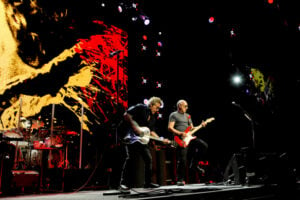
Feature Photo: DFree / Shutterstock.com
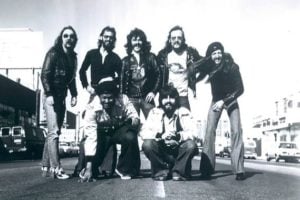
Velvet Revolver was an American hard rock supergroup consisting of former Guns N’ Roses members Slash on lead guitar, Duff McKagan on bass and backing vocals, and Matt Sorum on drums and backing vocals, alongside Dave Kushner on rhythm guitar and Scott Weiland of Stone Temple Pilots on lead vocals. The band achieved remarkable commercial success with its 2004 debut album Contraband, which debuted at number one on the Billboard 200 and was certified double platinum, spawning hit singles including “Slither,” “Fall to Pieces,” and “Dirty Little Thing.” “Slither” won the 2005 Grammy Award for Best Hard Rock Performance, while Contraband and “Fall to Pieces” received additional Grammy nominations. Their follow-up album Libertad (2007) debuted at number five on the Billboard 200, though internal tensions and Weiland’s continuing struggles with addiction contributed to his dismissal in 2008 and the band’s subsequent inactivity.
The story of Velvet Revolver is ultimately one of both triumph and tragedy, representing what might have been one of rock’s greatest second acts cut short by personal demons and creative differences. The project had grown out of the post-Guns N’ Roses careers of Slash, McKagan, and Sorum, who reconnected musically at a 2002 benefit for drummer Randy Castillo and then began building a new band with Kushner. Although Velvet Revolver worked on new material and auditioned singers after Weiland’s departure, no third studio album was completed. Slash, McKagan, Sorum, and Kushner performed together at the Road Recovery benefit in New York in September 2011, and the full five-member lineup reunited with Weiland for a one-off four-song set on January 12, 2012, at a benefit for the late John O’Brien. That was the final Velvet Revolver performance with Weiland before his death on December 3, 2015. As of October 4, 2026, Velvet Revolver remains inactive and no permanent replacement vocalist or new album has been announced.
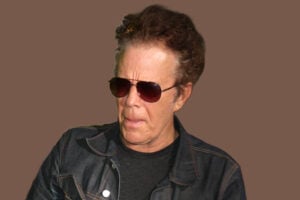
Scott Weiland
Scott Weiland served as Velvet Revolver’s lead vocalist from 2003 to 2008, bringing his distinctive voice and charismatic stage presence from Stone Temple Pilots to create one of the most successful supergroups of the 2000s. Scott Richard Weiland (/ˈwaɪlənd/, WY-lənd; né Kline; October 27, 1967 – December 3, 2015) was an American singer and songwriter. He was best known as the lead vocalist of the rock band Stone Temple Pilots from 1989 to 2003 and again from 2008 to 2013, recording six albums with them. His journey to Velvet Revolver came at a crucial time when both he and the former Guns N’ Roses members were seeking new creative outlets.
Weiland’s path to joining Velvet Revolver was somewhat serendipitous, as he had previously encountered all the future band members through various circumstances. Throughout his career, Weiland had become acquainted with the four musicians; he became friends with McKagan after attending the same gym, was in rehab at the same time as Sorum and once played on the same bill as Kushner. When the band initially sent him material, Weiland was not immediately impressed, feeling that the first disc “sounded like Bad Company gone wrong.” However, he was more receptive to their second attempt, comparing it to Core-era Stone Temple Pilots, though he initially turned them down because Stone Temple Pilots had not yet separated.
His tenure with Velvet Revolver marked both the peak of the band’s success and the source of their greatest challenges. Weiland completed the lineup in 2003, and the band released its debut album Contraband in 2004. The album debuted at No. 1 on the Billboard 200 and was certified double platinum in the United States. At the 2005 Grammy Awards, Velvet Revolver won Best Hard Rock Performance for “Slither,” while Contraband was nominated for Best Rock Album and “Fall to Pieces” was nominated for Best Rock Song. Weiland’s vocal performances on tracks like “Slither” and “Fall to Pieces” demonstrated his ability to adapt his distinctive style to the band’s hard rock approach while maintaining his own artistic identity.
However, Weiland’s ongoing struggles with substance abuse created persistent challenges for the band. Velvet Revolver was confronted from the start with Weiland’s drug and legal problems as it juggled performance schedules, recording sessions and promotional work to accommodate his court dates and rehab. The tensions that had plagued his previous bands eventually surfaced in Velvet Revolver as well. “This band is all about its fans and its music and Scott Weiland isn’t 100% committed to either,” guitarist Slash said in a news release. “Among other things, his increasingly erratic onstage behavior and personal problems have forced us to move on.” His departure in April 2008 effectively ended the band’s most successful period. Weiland died on December 3, 2015, at age 48; the Hennepin County Medical Examiner ruled the death an accidental overdose involving cocaine, alcohol, and MDA.
Slash
Slash served as Velvet Revolver’s lead guitarist and primary musical architect from the band’s formation in 2002 until their hiatus following Weiland’s departure, bringing his legendary guitar skills and songwriting abilities from Guns N’ Roses to create the band’s signature sound. However, disagreements with singer Axl Rose resulted in Slash leaving the band in 1996 and McKagan departing in 1997 shortly before Sorum was fired. His departure from Guns N’ Roses had been acrimonious, leaving him with both musical ambitions and personal grievances that would fuel his involvement in Velvet Revolver.
The formation of Velvet Revolver provided Slash with an opportunity to reconnect with his former bandmates and create something new while proving their collective worth. “The chemistry that I have with Duff is not something you can emulate,” he says. “I didn’t have any intention of getting this whole thing rolling, but the day after the gig, Duff and I talked on the phone and were like, ‘Maybe we should do this!'” The initial chemistry between the former Guns N’ Roses members was immediately apparent when they performed together at a benefit concert for the late Randy Castillo, leading to the decision to form a permanent band.
Slash’s guitar work became the defining element of Velvet Revolver’s sound, blending his classic rock sensibilities with a more modern approach suited to the 2000s rock landscape. Slash – lead guitar, talkbox, backing vocals (2002-2008; reunion appearances in 2011 and 2012) demonstrates his central role in the band’s creative process. His riffs and solos on songs like “Slither” and “Fall to Pieces” showcased his ability to create memorable, radio-friendly material while maintaining the technical proficiency and emotional depth that had made him famous. The New York Post commented that “Slash’s guitar riffs throughout this new record are as aggressive as a caged cat” when reviewing their work.
Following Weiland’s departure and the band’s subsequent hiatus, Slash continued to express hope for Velvet Revolver’s future while pursuing other projects. On May 12, 2014, in an interview at the MusiCares benefit concert, Slash said that the band might audition another singer in the future, although his solo commitments kept him occupied. Slash returned to Guns N’ Roses in 2016 and has continued his solo work as well, while Velvet Revolver has remained inactive. His contributions to the band remain among his most celebrated post-Guns N’ Roses work.
Duff McKagan
Duff McKagan served as Velvet Revolver’s bassist and backing vocalist from 2002 to 2008, providing the rhythmic foundation that anchored the band’s sound while also contributing significantly to their songwriting and overall musical direction. McKagan was the last member of the Appetite for Destruction lineup to leave Guns N’ Roses, resigning as bassist in August 1997. McKagan had recently become a father and wrote about his decision to leave in his autobiography, stating “Guns had been paying rent on studios for three years now, from 1994 to 1997, and still did not have a single song. The whole operation was so erratic that it didn’t seem to fit with my hopes for parenthood, for stability.”
When the opportunity arose to reunite with his former bandmates, McKagan initially showed reluctance, having built a stable life away from the rock and roll lifestyle. Of Velvet Revolver’s members, Duff McKagan seems to have had the least interest in returning to the rock and roll wars. Newly remarried and happily resettled in his hometown of Seattle, McKagan was in his third year at Seattle University when Slash and Sorum asked him to join their new project. His academic pursuits reflected his desire for intellectual growth and stability, making his decision to rejoin his former bandmates all the more significant.
McKagan’s role in Velvet Revolver extended beyond just playing bass, as he brought a level of maturity and professionalism that helped balance the band’s more volatile elements. Duff McKagan – bass, backing vocals (2002-2008; reunion appearances in 2011 and 2012) indicates his consistent presence throughout the band’s active period. His songwriting contributions and backing vocals were essential to tracks like “Fall to Pieces” and “Slither,” while his solid bass playing provided the foundation that allowed Slash’s guitar work to soar and Weiland’s vocals to shine.
Following the band’s hiatus, McKagan reflected philosophically on the Velvet Revolver experience and its challenges. “A bunch of years with Velvet Revolver were logistically challenging. I’d be somewhere like Des Moines, Iowa and it’d be like, ‘I miss my family and that gig we just did was… OK, but not worth me being gone,'” McKagan noted in retrospective interviews. We formed that band and once Scott [Weiland] joined it really became a fire-breathing, ‘fuck you’ kind of band. We put that first record out and went on the road with a chip on our shoulders.” Despite the band’s challenges, McKagan acknowledged the positive aspects of their collaboration while recognizing the practical difficulties that ultimately contributed to the band’s long-term inactivity.
Matt Sorum
Matt Sorum served as Velvet Revolver’s drummer and backing vocalist throughout the band’s entire active period, providing the powerful rhythmic foundation and contributing to the songwriting that made the band’s sound distinctive from both Guns N’ Roses and Stone Temple Pilots. Matthew William Sorum (born November 19, 1960) is an American drummer. He is best known as both a former member of the hard rock band Guns N’ Roses, with whom he recorded three studio albums, and as a member of the supergroup Velvet Revolver. His departure from Guns N’ Roses had been particularly bitter, as he was fired from the band rather than choosing to leave like his former bandmates.
Sorum viewed Velvet Revolver as an opportunity for creative redemption and to prove his worth as a founding member rather than just a replacement musician. “That was the biggest success for me because we were able to create something, and I was a founder,” shares Sorum. “We wanted to have huge success with that band. When you come back from having been kicked out of one of the biggest bands in the world, it’s a real feather in your cap.” His perspective on the band was shaped by his experience as what he called a “replacement drummer” in Guns N’ Roses, making Velvet Revolver’s success particularly meaningful to him personally.
Sorum’s drumming style adapted perfectly to Velvet Revolver’s sound, which blended elements of classic rock, grunge, and modern hard rock. Matt Sorum – drums, percussion, backing vocals (2002-2008; reunion appearances in 2011 and 2012) demonstrates his central role in the band’s rhythm section and creative process. His powerful, precise drumming on tracks like “Slither” and “Fall to Pieces” provided the driving force that propelled the band’s songs, while his backing vocals added depth to their harmonic arrangements. His ability to play both with restraint and explosive power helped define the band’s dynamic range.
Throughout Velvet Revolver’s career, Sorum often found himself mediating between the various personalities in the band while dealing with his own perspectives on the music industry and fame. Being taken seriously remained important to Sorum, who had long carried the “replacement drummer” label from his Guns N’ Roses years, making his role as a founding member of Velvet Revolver particularly significant to him. After the band became inactive, Sorum continued with projects including his memoir Double Talkin’ Jive and Kings of Chaos. In a January 2026 interview, he said Velvet Revolver “could have been” as big as Guns N’ Roses if it had lasted longer, underscoring the pride he still takes in the band’s brief run.
Dave Kushner
Dave Kushner served as Velvet Revolver’s rhythm guitarist throughout the band’s active period, providing the harmonic foundation and punk-influenced edge that distinguished their sound from typical hard rock supergroup efforts. Dave Kushner – rhythm guitar (2002-2008; reunion appearances in 2011 and 2012) demonstrates his consistent presence throughout all of Velvet Revolver’s incarnations. His background in the punk band Wasted Youth brought a different musical perspective to the group, complementing the classic rock sensibilities of the former Guns N’ Roses members and the grunge influences of Scott Weiland.
Kushner’s addition to the band came through his reconnection with Duff McKagan, with whom he had a prior relationship through the Los Angeles music scene. During a Loaded show at West Hollywood’s Viper Room, McKagan reintroduced Dave Kushner to Slash; Kushner and Slash had previously been friends in junior high and high school. Kushner was invited to jam with the group and was soon invited to join with Slash, stating that “Dave brought a cool vibe to what [they] were doing. There was no deliberation; that was it, it was a perfect fit.” His integration into the band was seamless, suggesting that his musical chemistry with the other members was natural and immediate.
Despite being the only member of Velvet Revolver without a high-profile musical background, Kushner’s contributions were essential to the band’s overall sound and dynamic. Years before Velvet Revolver, Weiland’s pre-Stone Temple Pilots band Mighty Joe Young opened for Electric Love Hogs, whose guitarist Dave Kushner would later co-found Velvet Revolver, giving Kushner and Weiland a musical connection that predated the supergroup by many years. His rhythm guitar work provided the textural foundation that allowed Slash’s lead guitar to shine while maintaining the punk sensibility that kept the band’s sound from becoming overly polished.
Kushner maintained a lower public profile than his bandmates, focusing primarily on the musical aspects of the band rather than the media attention. Dave Kushner is the secret weapon of that band, as McKagan noted in retrospective interviews, acknowledging the often-overlooked but crucial role that Kushner played in Velvet Revolver’s success. His steady presence and musical reliability provided stability during the more turbulent periods of the band’s career, and his willingness to participate in reunion shows demonstrated his continued commitment to the band’s legacy even after their official hiatus.
Musical Legacy and Impact
Velvet Revolver’s brief but impactful career demonstrated that supergroups could still achieve both commercial success and artistic credibility in the modern music landscape, despite the inherent challenges of bringing together established musicians with strong individual identities. Critics initially described Velvet Revolver as a mere combination of Stone Temple Pilots and Guns N’ Roses, and criticized the band for a “disconnection” between Scott Weiland and the rest of the band. However, the band ultimately transcended these initial criticisms through their musical chemistry and commercial achievements, proving that their collaboration was more than just the sum of its parts.
Their debut album Contraband represented a high-water mark for hard rock in the mid-2000s, demonstrating that there was still an audience for guitar-driven rock music in an era increasingly dominated by alternative and nu-metal sounds. Songs such as “Let it Roll” and “She Mine” have seen some comparisons to the Doors, the Rolling Stones and the Stooges, as noted by San Francisco Chronicle reviewer Jaan Uhelszki, indicating that the band successfully drew from classic rock influences while creating something contemporary and relevant. Their ability to craft radio-friendly singles that maintained artistic integrity helped bridge the gap between the classic rock era and modern hard rock.
The band’s collapse and long inactivity highlighted both the creative potential and inherent limitations of supergroup collaborations, particularly when dealing with members who have significant personal and professional baggage. Erlewine also stated that “too often, there are concessions between Weiland and the others during the course of a song,” pointing to the creative tensions that ultimately proved unsustainable. Despite these challenges, Velvet Revolver’s music continues to influence hard rock bands and serves as a template for how established musicians can collaborate to create something new while honoring their individual legacies.
Scott Weiland’s death in 2015 ended any possibility of another reunion of Velvet Revolver’s original five-member lineup and gave the band’s story a poignant finality. “We are deeply saddened to learn of the loss of our old friend and bandmate,” members of Velvet Revolver wrote at the time. “We experienced a good chunk of life with Scott, and even in his darkest times, we all had hope and love for him. His artistry will live on, of that, there is no doubt.” Their brief but intense collaboration remains a testament to the power of musical chemistry and the tragic consequences of addiction, serving as both an inspiration and a cautionary tale for future supergroup endeavors.
Check out more Velvet Revolver articles on ClassicRockHistory.com Just click on any of the links below……
Top 10 Velvet Revolver Songs
Complete List Of Velvet Revolver Albums And Discography
Read More: Artists’ Interviews Directory At ClassicRockHistory.com
Read More: Classic Rock Bands List And Directory
Updated October 4, 2026
Complete List Of Velvet Revolver Band Members article published on ClassicRockHistory.com © 2026