Feature Photo: irish10567 from Little Falls, NJ, USA, CC BY 2.0 <https://creativecommons.org/licenses/by/2.0>, via Wikimedia Commons
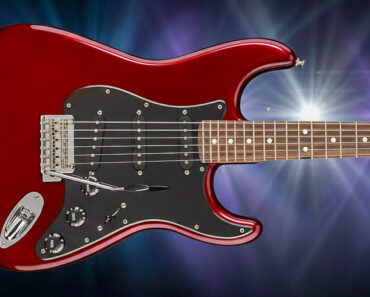
The Fender Stratocaster is not merely an electric guitar; it is a foundational element of modern music, an icon of industrial design, and a cultural touchstone that has transcended its original purpose. From its inception in the early 1950s, the Stratocaster has provided a revolutionary combination of form, function, and versatility that has been embraced, adapted, and popularized by a staggering range of artists. Its history is a story of groundbreaking innovation, a near-fatal period of decline, and a strategic rebirth that cemented its status as the most recognizable electric guitar in the world.
The Originals: Inventing a New Standard
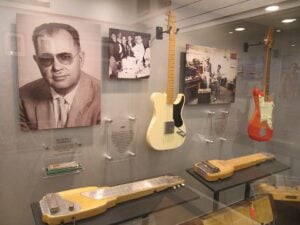
The Stratocaster was born from the imagination of Leo Fender. A relentless inventor rather than a musician, Fender had already revolutionized the music world with the Telecaster (originally the Broadcaster) and the Precision Bass. These were utilitarian, slab-bodied instruments designed for simple mass production. By 1952, Fender was already focused on his next “deluxe” model, one that would incorporate the feedback he had received from musicians who found the Telecaster’s sharp edges uncomfortable during long performances.
Feature Photo: Mr. Littlehand, CC BY 2.0 <https://creativecommons.org/licenses/by/2.0>, via Wikimedia Commons
Working closely with his core team, which included designer George Fullerton, draftsman Freddie Tavares, and musician/marketer Bill Carson, Leo Fender set out to create a guitar that was a leap forward in every respect. The result, released in 1954, introduced three groundbreaking innovations. First was the “Comfort Contour” body. Featuring a beveled cutaway for the player’s arm and a “belly cut” on the back, the guitar was ergonomically sculpted to fit the human body, a concept that was revolutionary at the time.
Second, the Stratocaster featured three single-coil pickups with staggered height pole pieces, offering a broader palette of tones than the Telecaster’s two. It was initially equipped with a three-way switch allowing the player to select the bridge, middle, or neck pickup individually. Finally, and perhaps most complex, was the “Synchronized Tremolo” system. It was incorrectly named “tremolo” by Fender when its function was actually vibrato. This integrated bridge and tailpiece mechanism allowed players to bend the pitch of all six strings simultaneously and return to tune (in theory), opening up a new world of expressive possibilities.
Despite its futuristic design, the Stratocaster was not an immediate runaway success. Its first major ambassador was Buddy Holly, whose appearance on The Ed Sullivan Show in 1957 playing his sunburst Stratocaster was a formative moment for an entire generation of young musicians. In the United Kingdom, where American instruments were scarce and highly coveted, Hank Marvin of The Shadows used a Fiesta Red Stratocaster to create a clean, echo-drenched sound that inspired countless guitarists.
The CBS Era and Cultural Explosion
The Stratocaster’s cultural ascent continued into the 1960s, becoming the guitar of choice for the burgeoning surf rock scene, most notably with Dick Dale, who collaborated with Fender to push the instrument’s capabilities and amplification to new limits. However, the guitar’s true cultural apotheosis arrived in the middle of the decade. In 1965, Bob Dylan infamously “went electric” at the Newport Folk Festival, trading his acoustic guitar for a Stratocaster and creating an immediate rift in the folk community, but simultaneously signaling the birth of folk rock.
A year later, an unknown American guitarist named Jimi Hendrix landed in London. Hendrix redefined the possibilities of the instrument, using his upside-down Strats to unleash a torrent of feedback, dive bombs, and sonic textures previously unimaginable. His fiery performance at the 1967 Monterey Pop Festival, culminating in him setting his guitar ablaze, became one of the most iconic images in rock history. Hendrix, along with other British-based players like Eric Clapton and David Gilmour of Pink Floyd, propelled the Stratocaster to the forefront of rock music.
Behind the scenes, a monumental corporate shift had occurred. In 1965, Leo Fender sold his company to the CBS conglomerate for $13 million. Initially, the transition was smooth; however, by the 1970s, the “CBS Era” was characterized by a clear shift from quality to quantity. Cost-cutting measures and mass production goals led to widely criticized design changes, including a larger headstock, a less stable three-bolt neck plate with a “Micro-Tilt” adjustment, and thick, resonant, dampening polyester finishes. While artists like Ritchie Blackmore of Deep Purple, The Edge of U2, and Nile Rodgers of Chic were creating definitive music on 1970s-era Strats, the Fender brand itself was suffering from a reputation for declining quality control and heavy, inconsistent instruments.
Rebirth and the Modern Era
By the early 1980s, Fender was in a dire financial state. In 1985, CBS sold the company to a small group of investors led by Bill Schultz, a music industry executive who had been with the company. The Schultz led team purchased the name and patents but not the main Fullerton, California, factory. For a short period, American production of Fender guitars ceased entirely, and the company relied on its high-quality Japanese-made instruments (including the Squier brand) to stay afloat.
Schultz’s mission was to restore Fender’s reputation. In 1987, a new, smaller factory was opened in Corona, California, and Fender launched the American Standard Stratocaster. This model was a statement, blending the best of the original design with modern, player-focused updates like 22 frets, a flatter 9.5-inch fingerboard radius, and an improved two-point tremolo system. That same year, the company also founded the Fender Custom Shop, a “dream factory” dedicated to high-end, vintage-accurate reissues and custom-built instruments for artists.
This new focus on quality was perfectly timed. The Stratocaster was being championed by a new generation of guitar heroes who celebrated its legacy. Stevie Ray Vaughan had single-handedly revitalized blues rock, playing his battered “Number One” Stratocaster with a power and ferocity that inspired millions. In Europe, Yngwie Malmsteen was using his scalloped fretboard Stratocasters to pioneer neo-classical shred. At the same time, Mark Knopfler of Dire Straits demonstrated the guitar’s clean, crystalline elegance with his signature fingerpicking style.
Fender embraced this artist-driven resurgence, launching its first Signature Series guitar in 1988: the Eric Clapton Stratocaster. This model, featuring Lace Sensor (and later, Noiseless) pickups and an active mid boost circuit, became immensely popular. It was soon followed by successful signature models for Jeff Beck, Stevie Ray Vaughan (released posthumously), and others.
The Fender Stratocaster continues to be one of the most popular guitars among contemporary musicians. Here is a comprehensive list of notable guitarists who have prominently used the Stratocaster in the 21st century:
John Mayer has become one of the most prominent Stratocaster players of this era. His thick and deep bluesy guitar licks were all created on his Strats, as well as his virtuoso solos, using various models ranging from 3-tone sunburst to Olympic white guitars. The John Mayer Stratocaster has unique features including string trees placed towards the end of the headstock to allow for more leverage when bending behind the nut, a thick C-shaped neck, and ‘Big Dipper’ pickups with a scooped midrange.
Joe Bonamassa has maintained an extensive collection of Stratocasters throughout his career. When he was 12 years old, Bonamassa played a crimson 1972 Fender Stratocaster, and in 2018 stated that he has more than 1000 guitars, a large fraction of which are Fender Stratocasters.
Kenny Wayne Shepherd represents the post-Stevie Ray Vaughan generation of blues guitarists. A prodigious talent, he found his holy grail guitar at the age of 16 when he and his father visited Los Angeles and spied the ’61 Sunburst Strat he fell for.
Albert Hammond Jr. of The Strokes became a torchbearer for the Stratocaster at the turn of the century. The Strokes’ guitarist is perhaps the most loyal to the Strat and is rarely seen on stage without it, with his relentless power chords forming the bedrock of 2000’s indie generation.
Alex Turner of Arctic Monkeys rose to fame with his Stratocaster. Within weeks, Turner, his band and his fittingly Arctic White Standard Strat had rocketed to the top of the charts, clocking up the fastest-selling debut album in UK history. His style incorporates punk, 50s-inspired twang, surf, and drop-tuned riffing.
Courtney Barnett has built a unique sound in the indie scene. Combining somberly honest poeticism and a combatting mixture of grungy and hypnotically melodic songwriting, this lefty from down under has ridden the wave of her talents across the globe, using both a black-on-black and white-on-white Stratocaster.
Jawny represents the newer generation of Stratocaster players. Jawny, who has over 350,000 followers and 426 million streams of his No. 1 song “Honeypie” on Spotify, toured the United States with a wildly colorful, custom-painted Stratocaster.
Cory Wong has become known for his distinctive funk style. Wong has long been loyal to his Sapphire Blue Highway One Stratocaster, rocking it onstage and in the studio for the majority of his career, with his funky and glassy rhythm-guitar riffs featured prominently on albums like The Beautiful Game.
H.E.R. has brought the Stratocaster into contemporary R&B. A proud Stratocaster player while performing and recording, H.E.R. has a signature Strat with Fender that boasts a drop-dead-gorgeous Chrome Glow finish, with her fluttering elegance across the fingerboard emblematic of her sound.
Tom Misch blends neo soul and nu jazz influences. London-born guitarist Tom Misch’s mellow-natured songwriting has an undeniable grasp on genres like neo soul and nu jazz, with his first official studio album being 2018’s Geography.
Jason Isbell represents contemporary southern rock. Known from the Drive-By Truckers, the 400 Unit, and his solo work, Jason Isbell is the real deal when it comes to 21st-century southern rock, having amassed eight studio albums and four live albums and earned four Grammys. He tours frequently with his prized 1960 Stratocaster.
Billie Joe Armstrong of Green Day has used Stratocasters extensively. Armstrong, lead singer and guitarist of Green Day, uses a heavily stickered Fernandes Stratocaster copy nicknamed “Blue”.
Tom DeLonge used Stratocasters in the first half of his career with Blink-182. From the founding of Blink-182 until recording their debut album Cheshire Cat (1995), he used a fiesta red Squier Stratocaster, then switched to a white 40th Anniversary Edition Stratocaster heavily modified with stickers and custom pickups.
John Frusciante of Red Hot Chili Peppers has been a Stratocaster devotee throughout his tenure with the band. Frusciante’s 1968 Stratocaster was stolen in 1990, but was the main tool for Chili Peppers’ albums leading up to Mother’s Milk, creating the funky riffs and jabbing chords that became signature sounds for the band. He is most well associated with playing the beat-up 1962 sunburst Strat.
Billy Corgan of The Smashing Pumpkins continues to use various Stratocasters. Corgan has played a range of Stratocasters from the start of his career, including his famous “Bat Strat” which was a 1990s reissue ’57 Strat still used today. In 2009, Fender issued a custom shop Billy Corgan signature Stratocaster.
David Gilmour of Pink Floyd continues to tour and record with Stratocasters in the 21st century. David Gilmour played a custom black Stratocaster nicknamed the “Black Cat” for the sticker on the upper horn for much of his Luck and Strange tour in 2024.
Check out similar articles on ClassicRockHistory.com Just click on any of the links below……
Read More: Artists’ Interviews Directory At ClassicRockHistory.com
Read More: Classic Rock Bands List And Directory
History Of The Fender Stratocaster article published on ClassicRockHistory.com© 2025
Classicrockhistory.com claims ownership of all its original content and Intellectual property under United States Copyright laws and those of all other foreign countries. No one person, business, or organization is allowed to re-publish any of our original content anywhere on the web or in print without our permission. All photos used are either public domain Creative Commons photos or licensed officially from Shutterstock under license with ClassicRockHistory.com. All photo credits have been placed at the end of the article. Album Cover Photos are affiliate links and the property of Amazon and are stored on the Amazon server. Any theft of our content will be met with swift legal action against the infringing websites.