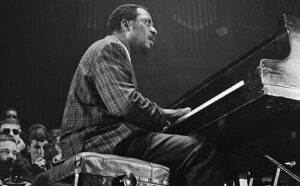
Feature Photo: Anefo, CC0, via Wikimedia Commons
Thelonious Sphere Monk was born on October 10, 1917, in Rocky Mount, North Carolina. His family relocated to Manhattan’s San Juan Hill neighborhood in 1922, settling into the Phipps Houses on West 63rd Street. The young Monk initially took up the trumpet before switching to piano at age nine, receiving lessons from a neighbor named Alberta Simmons who taught him in the stride style of Fats Waller, James P. Johnson, and Eubie Blake. His mother also taught him hymns, and he would sometimes accompany her singing at church. Monk attended Stuyvesant High School, a public institution for gifted students, though he did not graduate.
For two years, he studied classical piano under Simon Wolf, an Austrian pianist and violinist who had trained under the concertmaster of the New York Philharmonic. Monk learned pieces by Bach, Beethoven, Mozart, and Liszt, but his favorites were Chopin and Rachmaninoff. Those lessons ended when it became clear that jazz was his true calling.
Monk assembled his first band at age 16, picking up restaurant and school gigs wherever he could find them. At 17, he toured with an evangelist, playing church organ, and in his late teens he began finding steady work playing jazz. By the early to mid 1940s, he had become the house pianist at Minton’s Playhouse, a Manhattan nightclub that served as a laboratory for what would become bebop. His work there was absolutely crucial to the formulation of this revolutionary style, which would later be furthered by Dizzy Gillespie, Charlie Christian, Kenny Clarke, Charlie Parker, and Miles Davis.
Mary Lou Williams, who mentored Monk and his contemporaries, spoke of his rich inventiveness during this period and noted how vital such innovation was, since fellow musicians commonly incorporated overheard ideas into their own work without giving credit. In 1944, Monk cut his first commercial recordings with the Coleman Hawkins Quartet, and Hawkins became one of the earliest established musicians to champion the young pianist.
In 1947, Ike Quebec introduced Monk to Lorraine Gordon and her husband Alfred Lion, co founder of Blue Note Records. Gordon became a tireless advocate for Monk’s genius, though she faced enormous resistance. Record store owners in Harlem would tell her that Monk had two left hands and could not play. She never wavered. Shortly after that introduction, Monk made his first recordings as a leader for Blue Note, showcasing his talents as a composer of original melodies for improvisation.
Those Blue Note sessions ran from 1947 to 1952. After a parked car incident in August 1951 where police found narcotics belonging to his friend Bud Powell, Monk refused to testify against Powell, and authorities confiscated his New York City Cabaret Card. This effectively barred him from playing venues where liquor was served, severely restricting his ability to perform for several years. He spent most of the early and mid 1950s composing and performing at theaters, outer borough clubs, and out of town venues.
After his Blue Note years, Monk signed with Prestige Records from 1952 to 1954, cutting several highly significant albums including collaborations with Sonny Rollins, Art Blakey, and Max Roach. He later moved to Riverside Records, where the label bought out his Prestige contract for a mere $108.24. With Riverside’s consent, he recorded two albums of jazz standards to broaden his appeal: Thelonious Monk Plays Duke Ellington in 1955 and The Unique Thelonious Monk in 1956.
His 1956 album Brilliant Corners, featuring the complex title track that had to be edited together from multiple takes because it was so difficult to play, became his first real commercial success. After having his cabaret card restored in 1957, Monk relaunched his New York career with a landmark six month residency at the Five Spot Cafe, leading a quartet with John Coltrane on tenor saxophone. That engagement changed everything, cementing his reputation as a major force in jazz.
In 1962, Monk signed with Columbia Records, where producer Teo Macero helped him reach his largest audience. His quartet during this period featured tenor saxophonist Charlie Rouse, who worked with Monk from 1959 to 1970, making this his longest serving band. His first Columbia album, Monk’s Dream, released in 1963, became the best selling LP of his lifetime. On February 28, 1964, he appeared on the cover of Time magazine in an article titled “The Loneliest Monk,” though the piece had been delayed from November 1963 due to the assassination of President Kennedy.
Monk continued recording studio albums during the Columbia years, including Criss Cross in 1963 and Underground in 1968. By this point, his compositional output had slowed considerably, and only Underground featured a substantial number of new tunes, including his only piece in triple time, “Ugly Beauty.” His final studio recordings as a leader came in November 1971 for the English Black Lion label, near the end of a worldwide tour with the Giants of Jazz.
The compositions Monk left behind represent some of the most enduring work in jazz history. His major contributions to the standard repertoire include “‘Round Midnight,” “Blue Monk,” “Straight, No Chaser,” “Ruby, My Dear,” “In Walked Bud,” and “Well, You Needn’t.” He holds the distinction of being the second most recorded jazz composer after Duke Ellington. His playing style featured dissonances and angular melodic twists, often using flat ninths, flat fifths, unexpected chromatic notes, low bass notes with stride piano elements, and fast whole tone runs.
He attacked the keyboard with a percussive intensity, combining this with abrupt, dramatic use of silences and hesitations. Soprano saxophonist Steve Lacy, who performed as Monk’s accompanist in 1960, once said that Monk’s music contained “profound humanity, disciplined economy, balanced virility, dramatic nobility, and innocently exuberant wit.” Monk himself famously declared, “The piano ain’t got no wrong notes.”
The awards and recognition that came to Monk reflected the deep impact he had on American music. In 1993, he was posthumously awarded the Grammy Lifetime Achievement Award. In 2006, he received a special Pulitzer Prize for “a body of distinguished and innovative musical composition that has had a significant and enduring impact on the evolution of jazz.” He became one of only five jazz musicians ever to appear on the cover of Time magazine, joining Louis Armstrong, Dave Brubeck, Duke Ellington, and Wynton Marsalis in that exclusive company.
He was inducted into the North Carolina Music Hall of Fame in 2009. The Thelonious Monk Institute of Jazz was established in 1986 by his family and Maria Fisher, with a mission to offer public school based jazz education programs for young people around the globe. That institute has hosted an annual International Jazz Competition since 1987 and helped designate April 30, 2012, as the first International Jazz Day through its partnership with UNESCO.
Both devotion and struggle marked Monk’s personal life. He married Nellie Smith in 1947, and together they had a son, T. S. Monk, who became a jazz drummer, and a daughter, Barbara, who died of cancer in 1984. Throughout his career, Baroness Pannonica de Koenigswarter, a member of the Rothschild family, served as a close friend and patron. She paid Monk’s bills, took him to doctors, and put him and his family up in her own home when necessary. In 1958, when police discovered marijuana in her car during a traffic stop, she took the blame to protect him and served a few nights in jail.
As Monk’s health declined in his later years, he spent his final six years at her home in Weehawken, New Jersey. He did not play the piano during this time, even though one sat in his room, and he spoke to very few visitors. Monk died of a stroke on February 17, 1982. His funeral was held at the Sanctuary of St. Peter’s Church, and he was buried in Ferncliff Cemetery in Hartsdale, New York. What he left behind was nothing less than a complete reimagining of what jazz piano could be.
# 10 – Little Rootie Tootie
“Little Rootie Tootie” opens the 1953 Thelonious Monk album Thelonious, recorded at Beltone Studios in New York on October 15, 1952, with Thelonious Monk on piano, Gary Mapp on bass, and Art Blakey on drums. The song runs three minutes and six seconds and appears as the first track on Side A of the Prestige ten inch release catalog number PRLP 142. Monk recorded additional tracks for the same album on December 18, 1952, with Mapp joined by Max Roach on drums, but “Little Rootie Tootie” remained the standout introduction to the project by presenting Monk’s sharply articulated rhythms and the bold piano lines that defined his early Prestige period.
# 9 – Monk’s Dream
“Monk’s Dream” was recorded October 31, November 1, 2 and 6, 1962 at Columbia 30th Street Studio in New York City and released in January 1963; the album’s personnel comprises Thelonious Monk on piano, Charlie Rouse on tenor saxophone, John Ore on bass and Frankie Dunlop on drums, with Teo Macero as producer. The title track features Monk’s trademark rhythmic bounce and playful use of harmonic tension as he revisits earlier material including “Monk’s Dream,” “Bye-Ya,” and “Sweet and Lovely” in fresh settings. This project marked Monk’s first album for Columbia following a five-year tenure at Riverside Records and is widely regarded as a pivotal work in his discography, capturing his quartet at a moment of clarity and creative purpose.
# 8 – Epistrophy
“Epistrophy” holds a central place in Thelonious Monk’s legacy as the first tune he ever copyrighted, registered on June 2, 1941, and written in collaboration with Kenny Clarke. Clarke originally introduced the piece under the titles “Fly Rite” and “Iambic pentameter.” The tune became a defining part of Monk’s live performances and served as the closing number in nearly every set dating back to his time at Minton’s Playhouse. The earliest recording was made by Cootie Williams on April 1, 1942, followed by Clarke’s band recording the piece on September 5, 1946. Monk did not record “Epistrophy” until the July 2, 1948 Wizard of the Vibes session with Milt Jackson, and he later revisited the tune on Monk’s Music, with an additional version created as an outtake during the sessions for It’s Monk’s Time.
# 7 – Brilliant Corners
“Brilliant Corners” opens the 1957 album of the same name by Thelonious Monk, recorded across three sessions in 1956 on October 9, October 15, and December 7 for the Riverside label. On the title track, the personnel included Monk on piano, Ernie Henry on alto saxophone, Sonny Rollins on tenor saxophone, Oscar Pettiford on bass, and Max Roach on drums. Orrin Keepnews produced the sessions, with Jack Higgins serving as recording engineer. The piece lasts approximately seven minutes and forty-two seconds on the original LP
# 6 – Well, You Needn’t
“Well You Needn’t” sits deep within the heart of Genius of Modern Music, Volume One as track ten, recorded on October 24, 1947 at WOR Studios in New York City with Thelonious Monk on piano, Gene Ramey on bass, and Art Blakey on drums. Produced by Alfred Lion and engineered by Doug Hawkins, the recording captures Monk shaping one of his most enduring compositions during the remarkable series of Blue Note sessions that defined his early catalogue. The take preserves the sharp rhythmic edges and the harmonic ideas that became essential to his legacy, standing beside the other groundbreaking pieces from the October and November 1947 dates that were later compiled on the 1956 twelve inch edition of Genius of Modern Music, Volume One.
# 5 – In Walked Bud
“In Walked Bud” was composed in 1947 by Thelonious Monk as a tribute to his friend and fellow pianist Bud Powell, and is based in part on the chord progression of Irving Berlin’s “Blue Skies.” Over the course of his career, Monk recorded the composition multiple times, its earliest appearance emerging in the sessions later compiled for Genius of Modern Music, and the last version appearing on his 1968 album Underground featuring vocals and lyrics by Jon Hendricks.
# 4 – Blue Monk
“Blue Monk” appears on the album Thelonious Monk Trio, originally released by Prestige in mid-1950s, with recordings made on October 15, 1952 (tracks 1-4) and December 18, 1952 (tracks 5-6, 9-10) in New York, and on September 22, 1954 (tracks 7-8) in Hackensack, New Jersey. The album features Thelonious Monk on piano, Gary Mapp on bass for most tracks, Percy Heath on bass for the 1954 session, Art Blakey and Max Roach on drums at various dates. “Blue Monk” is track 7 of the original sequence and is credited as one of Monk’s most frequently recorded compositions, first captured on this album. Produced by Bob Weinstock and released under Prestige label catalog PRLP-7027, the album has been hailed for the trio format allowing Monk’s piano to take full expressive shape
# 3 – Ruby My Dear
Recorded on October 24, 1947 at WOR Studios in New York as part of the sessions compiled for the Genius of Modern Music Vols. One & Two albums produced by Alfred Lion, “Ruby My Dear” appears among tracks that helped establish Monk’s early compositional voice and trio performance style. The volume one LP (BLP 1510) on Blue Note includes this piece, with Monk on piano, Gene Ramey on bass, and Art Blakey on drums; these sessions were engineered by Doug Hawkins and released in 1956 as a twelve-inch compilation of recordings from 1947 to 1952.
# 2 – Straight, No Chaser
On the 1967 album Straight, No Chaser, recorded for Columbia between 1966-1967 and produced by Teo Macero, Monk leads a quartet of himself on piano, Charlie Rouse on tenor saxophone, Larry Gales on bass, and Ben Riley on drums. The track “Straight, No Chaser” appears as the 10-minute-plus third track on Side One and showcases Monk’s trademark angular harmonic structure alongside a rhythm section locked into the composed groove yet open to subtle improvisation. Recorded in New York for Columbia, the album opened a late chapter in Monk’s career where his writing and playing felt simultaneously refined and daring.
# 1 – Round Midnight
“’Round Midnight” stands as one of Thelonious Monk’s most important compositions, first taking shape in the early nineteen forties before being formally recorded in 1947 for the Savoy label. The song’s structure reflects Monk’s signature approach to harmony and melody, built around a haunting theme that became instantly recognizable to musicians across the jazz world. Its early recordings circulated quickly, and the composition grew into one of the most performed pieces in the jazz repertoire. Monk’s arrangement set the foundation for countless interpretations, and its reputation as a central part of his legacy has only strengthened with time, making it the most recorded jazz standard written by a jazz musician.
Check out similar articles on ClassicRockHistory.com Just click on any of the links below……
Read More: Artists’ Interviews Directory At ClassicRockHistory.com
Read More: Classic Rock Bands List And Directory
Top 10 Thelonious Monk Songs article published on ClassicRockHistory.com© 2025
Classicrockhistory.com claims ownership of all its original content and Intellectual property under United States Copyright laws and those of all other foreign countries. No one person, business, or organization is allowed to re-publish any of our original content anywhere on the web or in print without our permission. All photos used are either public domain Creative Commons photos or licensed officially from Shutterstock under license with ClassicRockHistory.com. All photo credits have been placed at the end of the article. Album Cover Photos are affiliate links and the property of Amazon and are stored on the Amazon server. Any theft of our content will be met with swift legal action against the infringing websites.