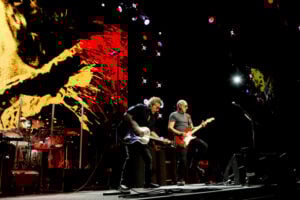
Photo: By Yves Lorson from Kapellen, Belgium (Ray Davies) [CC BY 2.0 (http://creativecommons.org/licenses/by/2.0)], via Wikimedia Commons
In the northern London suburb of Muswell Hill, Frederick and Annie Davies raised Ray and Dave, the only boys out of eight children. Surrounded by their parents’ music hall favorites, big band sounds, and the early rock and roll of their sisters, the family proved fertile musical soil even as some relationships were tested.
The Ray Davies Quartet was formed while Ray and Dave were still in school. Ray played rhythm guitar and provided lead vocals. Dave played lead guitar and sang. Dave’s friend Pete Quaife was on bass, and John Start, later replaced by Mick Avory, was on drums. Well received at school dances, they began playing in local pubs and bars. Evolving and performing under names like the Ramrods and the Ravens, the band would land a contract with Pye Records in early 1964. Renamed the Kinks, the band covered Little Richard’s “Long Tall Sally” in February 1964, followed quickly by “You Still Want Me.” Both singles were tremendous flops, and Pye Records drew a line in the sand. The third single would be a hit, or the Kinks could hit the road.
Pye wanted to release the first take of “You Really Got Me” and be done with the band. Ray hated it and stood his ground, but Pye wouldn’t let them re-record. The stalemate was broken when it was re-recorded with the band’s management financing the project. The Kinks were truly born by standing their ground and producing what they wanted instead of Pye.
The band packed their gear and egos for the road, with commercial success coming quickly. Starting in 1965, tensions began to grow on tour in Australia and New Zealand. By May, they were back in England. At the Capitol Theater in Cardiff, Wales, Dave and Mick boiled over in an onstage brawl. Dave kicked Mick over his drum set, and in return, Mick gave Dave 16 stitches to the head courtesy of his high hat. The dark cloud of sibling rivalry hung overhead, and Ray and Dave later admitted they hated the sight of each other during this period. Nevertheless, the tour of America was approaching.
The trip to America was like a nightmare family road trip. The Kinks were billed erroneously as the Kings in places, and marketing suggested they were a Beatles knockoff. Several advertisements even proclaimed, “Straight from Liverpool!” Onstage performances were forced, and there were angry affairs in front of empty seats. On July 2, backstage at Dick Clark’s “Where the Action Is,” a staff member accused them of being late for taping. Insults (including anti-British comments) grew to shouts that grew to shoves that grew to punches. Two days later, at San Francisco’s Cow Palace, the promoter could not pay the band in cash as promised, so they refused to play. Complaints were lodged to the American Federation of Musicians. The result was an outright ban. Without the union, work visas would be denied, and the Kinks couldn’t play in America.
Social commentary and satire would find an easy pen with Ray’s songwriting as the Kinks stayed focused on English life. Nervous breakdowns, physical altercations (including one with a fashion designer where Ray would brag, “I kicked him, and I kicked his girlfriend up the arse”), and frantic schedules would continue to take their toll. Yet some of their most iconic tunes were written and recorded through the late sixties as the band moved through experimental projects.
In early 1969, Pete Quaife left the band and was replaced by John Dalton. The ban on America was lifted later that year, thanks in part to a signed confession that “everyone signed and no one read.” Tour dates were booked, but few gigs were played due to lackluster sales and various band members’ illnesses. A second tour faced the same problems the following year, but in the downtime, Ray would pen their next single, “Lola.”
Lola Versus Powerman and the Moneygoround, Part One (Pye in the UK, Reprise in the US, 1970) would be the Kinks’ most significant success since the mid-60s. It would chart on both sides of the pond and bring the Kinks back onto America’s radar. Yet, the follow-up album, Percy, released in 1971, would not be released in the United States. The primarily instrumental album would mark the end of the Kinks’ contract.
Flush with a new contract and a million-dollar advance from RCA, the Kinks broke ground on Konk, their recording studio. While finding success with the latest studio and label, the usual egos and outside problems plagued the Kinks. Ray’s marriage crumbled, and he would suffer another breakdown and period of depression. John Dalton said that Ray was never the same.
But the Kinks soldiered on, finally cracking the American stadium concert threshold. In 1990, they were inducted into the Rock and Roll Hall of Fame. Despite talk of reuniting, the Kinks played their last performance together in 1996.
# 10 – Come Dancing
The childhood memories of the Davies’ home provide the background and inspiration of “Come Dancing” (Arista, 1982). Ray and Dave’s older sisters were known to frequent the local dance halls, and it was a tribute to his sister, Rene. On Ray’s 13th birthday, Rene visited Canada and gifted him his first guitar. Later that night, Rene suffered a heart attack and died on the dance floor of the local ballroom. The Kinks’ music video was a mainstay on the fledgling MTV network, introducing millions of new fans to the Band. MTV propelled the song to #6 on the US Billboard Hot 100. Though the first release of the single failed to chart in the UK, it was re-released after the American buzz and reached #12 on the UK Singles chart.
Ray had mulled over “Come Dancing” for years before writing the song. Ray’s storytelling lyrics accompany the musical journey through time. The result is a heady cocktail of musical styles throughout history. The horns bring forth the big-band feel of the older sisters, giving way to the bridge with its mid-50s doo-wop backing vocals, followed by Dave’s classic Kinks power-chord riffs.
Read More: Dave Davies Of The Kinks Interview With ClassicRockHistory.com
# 9 – See My Friends
Jetlagged and unable to sleep, Ray found himself on the early morning beach in Mumbai (then called Bombay) during a tour of Asia. He encountered two fishermen chanting their way to work. The chant and spiritual beliefs of the soul crossing rivers inspired Ray to write this earlier tribute to his sister, Rene. The backing tracks were slowed down in the studio before the vocals were added. The raga feel of the music and the drum rhythm make “See My Friends” almost a meditation. Ray held the Kinks song in close enough regard to be disappointed and angry when it was not highly received.
Released as a single (Pye Records) in July 1965, “See My Friends” ignited a wave of what would be “Raga rock” though the term (coined by The Byrds’ publicist) would not be used for almost a year. Upon hearing the single for the first time, Pete Townsend of The Who would say, ‘See My Friends’ was the next time I pricked up my ears and thought, ‘God, he’s done it again. He’s invented something new.'” The Yardbirds would release “Heart Full of Soul” the next month, and The Beatles would release “Norwegian Wood” in December of the same year.
Read More: Complete List Of The Kinks Albums And Discography
# 8 – Strangers
The second track on Lola Versus Powerman and the Moneygoround, Part One is one of the most potent Kinks songs ever written by Dave Davies. Though never released as a single, the song quickly became a fan favorite of the album. While Dave is mainly associated with heavily distorted fuzzy sound and other hard-hitting, electrified guitar lines, he opted for an acoustic, folksy vibe on “Strangers.” The lyrics, especially the line “If I live too long I’m afraid I’ll die,” were inspired by Hank Williams’ song “I’ll Never Get out of This World Alive.” While Dave wrote the song about his school pal, the underlying theme of the lyrics can be seen as summing up the relationship between Ray and Dave and the Kinks’ journey.
# 7 – Victoria
“Victoria” was released as a single from the concept album Arthur (Or the Decline and Fall of the British Empire) (Pye in the UK, Reprise in the US, 1969). The album was intended as a soundtrack for a television program that was never completed. Melody Maker would call the album “…beautifully British to the core.” Ray’s lyrics and music blend imperfect nostalgia. Thanks to Ray’s brilliant duality, fans have long debated whether the lyrics were pure patriotism or pure satire. Musically, the Kinks blend rock and roll with horns backing for a regal, ceremonial flair with great guitar riffs.
Read More: Dave Davies Of The Kinks Interview With ClassicRockHistory.com
# 6 – Powerman
No strangers to label strangulation, Ray set his eyes on the recording executives and management with “Powerman.” While music journalists were well received by Lola Versus Powerman and the Moneygoround, Part One, the buying public largely ignored it. It was Reprise’s last album released in the United States (Pye Records would release Arthur in the UK, but it was never released in America).
Revisiting the Raga rock feeling, the Kinks started earlier in their career with the opening strains, which soon gave way to heavy, driving guitar. When the bass and drum lines kick in, the result is as greedy and hungry as the lyrics’ subject matter. The heavy drive would make “Powerman” a fan favorite from the album. Thirty-seven years down the road, it would introduce a new generation to the Kinks after it (along with “Strangers” and “This Time Tomorrow”) was featured in Wes Anderson’s film, The Darjeeling Limited.
Read More: Complete List Of The Kinks Albums And Discography
# 5 – Celluloid Heroes
The second single to be released from Everybody’s in Show-Biz (RCA, 1972), the UK single, would include the entire album version, while the American version stuck to the more corporate (cough-cough-powerman-cough) radio-friendly four minutes. Ray wrote the song while living in a seedy apartment in Hollywood. Always recognizing the stark contrast around him, Ray was inspired by the stars (known and unknown) on the Hollywood Walk of Fame and the grit and litter on the sidewalk itself.
The poignant, enchanting tale of the silver screen is one of Ray’s most moving Kinks songs. The ballad is as nostalgic and straightforward as it is complex. The poetic lyrics and the melody could stand alone in the halls of greatness. Put together, Ray penned a masterpiece. With almost as much irony as displayed in the song, “Celluloid Heroes” remains one of the all-time favorites by fans, yet receives nearly no radio airplay. It is usually only heard when an aging movie star passes away.
Read More: Top 10 Kinks Albums
# 4 – Lola
“Lola” (Pye Records in the UK, Reprise in the US, 1971) has as much conflict and controversy as the Kinks’ first American tour. Ray would claim it was based on an incident involving their manager, Robert Wace. Mick Avory said it was based on frequenting trans bars in West London and on a specific fan who would turn up to all the Kinks’ appearances. Musically, Dave would claim in his book, Kink: An Autobiography, that he wrote the music, with Ray adding lyrics after he heard it. Yet seven years earlier, Dave said it was a collaboration, with Ray already having the musical bones in place before Dave got involved, much like “You Really Got Me.”
The song was banned in Australia due to its gender-bending subject matter, and across America, some radio stations would end or dim the song before Lola’s true gender was revealed. The BBC banned it outright, not because of its subject matter, but because the original single had “Coca-Cola” in the lyrics, violating their product placement policy. Despite censorship issues, “Lola” hit number two on the UK Singles Chart and number nine on the Billboard Hot 100.
Destined for greatness, “Lola” danced and drank her way into the hearts of fans. The iconic guitar opening was created by combining the sound of a Martin guitar with a vintage Dobro. The result is one of the most recognized riffs in rock and roll. In true Davies (both of them) fashion, the song intensifies as the infatuation grows in the lyrics.
# 3 – Sunny Afternoon
Ill and at home, Ray wrote the opening riff on his upright piano. He told Rolling Stone he had spent the time before writing it listening to Frank Sinatra, Glenn Miller, and Bob Dylan. He said they provided the chromatic part in the back of the song. “Sunny Afternoon” spent two weeks at #1 on the UK Singles Chart and #14 on the Billboard Hot 100 in America. The song shares its name with the stage musical that opened in London on May 1, 2014. The musical tells the story of the Kinks, though many fans find parts to be more fictional than factual.
With the ironic trademark style of the band, the Kinks shot a promotional video of “Sunny Afternoon” (Pye in the UK, Reprise in the US, 1966) among clouds and snow. Guitar fans will recognize Dave’s 1959 Flying V (also referred to as the Futurist) in the video. Dave acquired the Flying V when his Gretsch was lost by the airline on the way to Los Angeles. In a panic, they stopped at the first shop they saw, and Dave spied the “funny-looking case” in the corner. The shopkeeper did his best to talk Dave out of purchasing it, but $200 later, Dave would fall in love with “this lovely, strange, space-age-looking guitar.”
# 2 – You Really Got Me
Released as a single on August 4, 1964, after a hard won battle with Pye Records (later released on the album Kinks on Pye Records in the UK and the album You Really Got Me on Reprise Records for the US) the Kinks took to the charts in Britain and abroad. One of Ray’s first songs started as a light, jazzy tune. Ray envisioned opening piano riffs and a saxophone line, but Dave disagreed. With circular moons and pin pricks carefully placed in the speaker cone of the Elpico amp that was used as a pre-amp for his AC 30, Dave’s interpretation of the song is guitar brilliance.
As if the defining sound and history weren’t enough, the song spurred several urban legends. People claim that fuzz guitar effect pedals were born after this recording, though the Rhode’s fuzz box was used as early as 1961 in California studios. Other people claim that Jimmy Page (who did work as a studio musician with the Kinks and others at the time) played guitar on the song, a claim even Page has denied. Decades later, people would stand by the fictionalized account of Elpico’s modification by a knitting needle in Ray’s stage musical Sunny Afternoon. Strip away the egos, legends, and stories, and the simple “bloke’s love song” has one of the most exemplary openings ever. The instantly recognizable hit would launch the Kinks’ career. Fourteen years later, it would do the same for Van Halen.
# 1 – Waterloo Sunset
Written after one of his breakdowns, Ray felt vulnerable and wouldn’t show the lyrics to the band. Instead, he tested them on his sister, Rosie, and his niece, Jackie. Ray initially did not want to release the song as a single from the Kinks’ album Something Else (Pye Records in the UK, Reprise in the US, 1967). When the single was released, it reached number two on the British charts and climbed into the top 10 in Australia, New Zealand, and most of Europe, but failed to chart in North America.
Read More: Dave Davies Of The Kinks Interview With ClassicRockHistory.com
Updated January 3, 2026
Check out similar articles on ClassicRockHistory.com Just click on any of the links below……
Read More: Artists’ Interviews Directory At ClassicRockHistory.com
Read More: Classic Rock Bands List And Directory
Read More: Top 200 Songs About Food
Read More: 25 Best Classic Rock Live Albums Of All Time
Top 10 Kinks Songs article published on Classic RockHistory.com© 2026