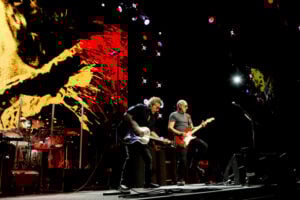
Feature Photo: Dean Bertoncelj / Shutterstock.com
AC/DC has always understood the power of a direct image. From the almost featureless black sleeve of Back in Black to the electrified portrait on Powerage and the bronze cannon of For Those About to Rock We Salute You, the band’s most effective album covers communicate their ideas before the first guitar chord begins.
The visual history is not as uniform as the music might suggest. AC/DC used different logos, photographers, illustrators, designers, and regional covers during its early years. The famous blackletter logo did not appear until the international edition of Let There Be Rock in 1977, although designer Gerard Huerta had created earlier lettering for the international High Voltage sleeve.
The strongest covers share the same qualities as the records: clarity, humor, menace, and an immediate sense of impact. Cannons, television screens, stone, electricity, devil imagery, and Angus Young’s school uniform all became parts of a visual language that has remained recognizable across five decades.
# 10 – Black Ice (2008)

Black Ice arrived in October 2008 with Brian Johnson, Angus Young, Malcolm Young, Cliff Williams, and Phil Rudd together for AC/DC’s first studio album in eight years. “Rock ’n’ Roll Train” led a record whose commercial scale demanded artwork that could function on compact discs, vinyl, tour merchandise, and enormous arena displays.
Joshua Marc Levy handled the art direction, design, and illustration. Rather than placing the band on the cover, he surrounded the AC/DC logo with dense filigree, machinery, symbols, skulls, and ornamental details. The design rewards close inspection without losing its impact from a distance.
Several color variations were issued, turning the packaging into a collectible part of the release. The black version remains the strongest because the embossed-looking detail connects the album with AC/DC’s most famous dark sleeve while still creating a distinct identity.
# 9 – Ballbreaker (1995)

Ballbreaker marked Phil Rudd’s return to the studio lineup and reunited him with Brian Johnson, Angus Young, Malcolm Young, and Cliff Williams. The title invited something exaggerated, physical, and slightly ridiculous, and the finished sleeve embraced all three qualities.
The cover combines a photograph of Angus Young with a painted background illustration by David McMacken. Angus appears to be smashing through a wall of rock, turning the album title into a literal visual event. The image has the oversized energy of a comic-book splash page without losing the guitarist’s recognizable stage persona.
Marvel supplied comic artwork for the album package, but the cover should not be credited to Hugh Syme. The mixture of photography, illustration, and digitally assembled color makes the sleeve unmistakably mid-1990s, which is part of its appeal.
# 8 – Powerage (1978)

Powerage introduced Cliff Williams on bass alongside Bon Scott, Angus Young, Malcolm Young, and Phil Rudd. The record included “Riff Raff,” “Sin City,” “Rock ’n’ Roll Damnation,” and “Gone Shootin’,” capturing AC/DC at one of its rawest and most musically confident points.
Jim Houghton photographed Angus with electrical cables apparently entering his arms and body. His open mouth, school uniform, and frozen expression suggest that the guitarist is being powered, overloaded, or shocked by the same current driving the album.
Bob Defrin directed the artwork. The distressed lettering and harsh contrast reinforce a cover that feels dangerous without becoming complicated. Few images have expressed the literal electricity of AC/DC more effectively.
# 7 – Stiff Upper Lip (2000)

Stiff Upper Lip reunited AC/DC with producer George Young. The album’s blues-heavy sound was more restrained than the production surrounding some of the band’s late-1980s and early-1990s records, but the cover transformed Angus Young into a monument.
A bronze-colored statue of Angus dominates the sleeve. The school uniform, cap, guitar, and slightly demonic expression turn the band’s most familiar figure into something between a public memorial, a gargoyle, and an oversized rock trophy.
The concept grew even larger on tour, where a monumental Angus figure became part of the stage production. The cover succeeds because it recognizes that Angus had become more than a guitarist in the public imagination: he was already AC/DC’s living emblem.
# 6 – High Voltage (1976)

The international High Voltage album assembled material from AC/DC’s first two Australian releases and introduced the Bon Scott-era band to a much wider audience. “It’s a Long Way to the Top,” “T.N.T.,” “The Jack,” “Live Wire,” and “High Voltage” established the group’s humor, danger, and refusal to soften its sound.
Michael Putland’s photograph presents Angus directly to the audience in his school uniform, leaning toward the camera with the expression of a performer already creating his own mythology. The image is simple, but it made the guitarist the visual center of the international campaign.
Gerard Huerta created the cover lettering. It is an important part of AC/DC’s design history, although it is not the famous blackletter lightning-bolt logo he would introduce on Let There Be Rock the following year. Different territories received different sleeves, making High Voltage one of the band’s most visually varied releases.
# 5 – For Those About to Rock We Salute You (1981)

Following the enormous success of Back in Black, AC/DC resisted the temptation to overcrowd its next sleeve. Bob Defrin’s artwork placed a single bronze cannon against a pale background with the album title and logo arranged above it.
The cannon gives the image weight, ceremony, and anticipation. It suggests a salute, a military announcement, and the explosive conclusion of the title song. The object later became one of the defining props in AC/DC’s live production.
The cover works because it does not try to recreate the sound of an arena show through visual clutter. One machine, one title, and one familiar logo are enough to announce exactly what the record intends to deliver.
# 4 – Blow Up Your Video (1988)

Blow Up Your Video brought Harry Vanda and George Young back as producers and featured Brian Johnson, Angus Young, Malcolm Young, Cliff Williams, and Simon Wright. “Heatseeker” and “That’s the Way I Wanna Rock ’n’ Roll” gave the album two of AC/DC’s strongest late-1980s singles.
Photographer Gered Mankowitz built a full-sized television set in his studio and photographed Angus bursting through the screen. The image turns the album title into a staged physical joke while capturing the guitarist at the instant of impact.
Bill Smith Studio handled the design. The glowing screen, exploding frame, saturated color, and diagonal movement make this one of AC/DC’s most unmistakably 1980s covers. It is loud, theatrical, and perfectly suited to an album titled Blow Up Your Video.
# 3 – Let There Be Rock (1977)

The international Let There Be Rock sleeve captured AC/DC in performance at the Kursaal Ballroom in Southend, England, on March 19, 1977. Keith Morris photographed Angus under harsh stage lighting, surrounded by darkness and smoke.
The live image matches the title’s biblical scale without turning the band into something polished or distant. Angus appears less like a posed subject than a force moving through the frame, which gives the sleeve the urgency of the album’s title track and “Whole Lotta Rosie.”
The cover also introduced Gerard Huerta’s blackletter AC/DC logo, created under Bob Defrin’s art direction. Inspired by Gothic lettering and divided by the central lightning bolt, it became the band’s permanent visual signature and one of the most recognizable logos in rock history.
# 2 – Highway to Hell (1979)

Highway to Hell was AC/DC’s final studio album with Bon Scott and the first produced by Robert John “Mutt” Lange. Its international success brought the band to a new level, and the cover needed no elaborate scene to communicate the change.
Jim Houghton photographed Bon Scott, Angus Young, Malcolm Young, Cliff Williams, and Phil Rudd as a single group. Angus’s devil horns and tail supply the joke, while Scott’s expression gives the image a mixture of danger, amusement, and complete confidence.
Bob Defrin directed the artwork. The black background, red logo, and direct band portrait created a cultural marker that remains inseparable from the title. It is one of the last and strongest visual documents of the Bon Scott lineup.
# 1 – Back in Black (1980)

No AC/DC cover communicates more with less than Back in Black. The album introduced Brian Johnson after Bon Scott’s death and placed him alongside Angus Young, Malcolm Young, Cliff Williams, and Phil Rudd for a record built from grief, endurance, and overwhelming volume.
The band wanted an entirely black sleeve as a sign of mourning. Atlantic Records accepted the concept after requesting a visible outline around the logo and title. Bob Defrin’s art direction turned that compromise into the finished design: black typography, restrained gray edging, and almost no decorative imagery.
The cover refuses spectacle. It does not show the new singer, the surviving musicians, a stage prop, or a symbolic illustration. Its darkness functions as memorial, announcement, and challenge. That discipline made the sleeve as timeless as “Hells Bells,” “Back in Black,” and “You Shook Me All Night Long.”
More AC/DC Articles
Check out similar articles on ClassicRockHistory.com.
Start with Top 10 AC/DC Songs, then explore 20 Most Classic AC/DC Songs, 10 Most Rocking AC/DC Songs, and Top 10 AC/DC Deep Tracks and Most Underrated Songs.
Our album features include Top 10 AC/DC Albums and Top 10 AC/DC Album Covers. The broader reference articles include the Complete List of AC/DC Band Members, Complete List of AC/DC Albums and Discography, and Complete List of AC/DC Songs from A to Z.
Additional AC/DC features include 10 Things You Didn’t Know About AC/DC, Top 10 Bon Scott AC/DC Songs, Top 10 Brian Johnson AC/DC Songs, the AC/DC Powerage Album Review, and the AC/DC Power Up Album Review.
Read the story behind AC/DC’s Back in Black Album Cover and AC/DC’s Angus Young Becomes the Last Man Standing.
Read More: Artists’ Interviews Directory At ClassicRockHistory.com
Read More: Classic Rock Bands List And Directory
Updated August 1, 2026.
Top 10 AC/DC Album Covers article published on ClassicRockHistory.com © 2026
ClassicRockHistory.com claims ownership of all its original content and intellectual property under United States copyright laws and those of all other countries. No person, business, or organization is allowed to republish any of our original content on the web or in print without permission. All photos used are either public-domain Creative Commons images or officially licensed from Shutterstock for ClassicRockHistory.com. Photo credits appear in the article. Album-cover images used in affiliate links are the property of their respective owners and are stored on third-party servers. Unauthorized reproduction of this content may result in legal action against the infringing website.