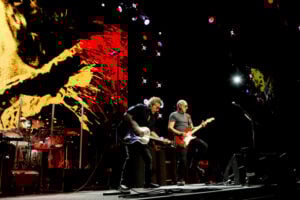
Feature Photo: Avis De Miranda / Shutterstock.com
Since Queen officially began as a rock band in 1970, Brian May was one of the founders who teamed up with Freddie Mercury and Roger Taylor to produce one iconic hit song after another. Born on July 19, 1947, and raised as an only child, Brian May grew up with an aptitude for mathematics and science. He also had a knack for learning musical instruments. He first learned the banjolele, then the piano, before picking up the guitar. When he was eleven, he earned a scholarship to attend Hampton Grammar School.
As a school student, May helped form his first band with Tim Staffell. They called the band 1984. The inspiration came from George Orwell’s novel, 1984, which was published in 1949. At the time, as interested as May was in performing music, he also had his sights set on a career in science. In 1968, he graduated with a BSc degree in physics from Imperial College London, England. Immediately after this, he was offered a position at the Jodrell Bank Observatory. Instead of accepting, May turned it down so he could continue his studies at the college. He also did this so he could keep playing music with Staffell. After 1984 broke up, May and Staffell formed Smile, with Roger Taylor joining on drums.
Smiling Queen
When Tim Staffell left Smile, Brian May and Roger Taylor joined forces with Freddie Mercury to form Queen. John Deacon joined the band in 1971. When the group released its debut album in 1973, it was all smiles as this was their first big step to achieve the superstardom status they rightfully deserved. From the mid-1970s until the 1990s, Queen dominated the world’s rock music scene. This was made evident when Queen stood out in 1985’s Live Aid as that one act that stole the show. As impressive as the roster performed in this multi-band, multi-location concert, Queen became the Jimi Hendrix at Woodstock equivalent when they performed on stage at London’s Wembley Stadium.
Leading up to that iconic 1985 moment, Brian May wrote a series of hits that became some of Queen’s best-selling classics of all time. He was one of the group’s most prolific composers and songwriters throughout their run as a recording artist. In addition to his career with Queen, Brian May also enjoyed a solo career. Not long after Freddie Mercury’s November 24, 1991 death, Brian May and Roger Taylor reunited with their former bandmate, Tim Staffell, for a Smile reunion in 1992. In 2018, the trio reunited again to re-record “Doing All Right” for the Queen-themed movie Bohemian Rhapsody. Staffell, May, and Taylor all contributed vocals to the new version. “Doing All Right” was also one of the songs featured on Queen’s debut album.
Paging Dr. May
In 2007, Brian May earned a Ph.D. degree from Imperial College in astrophysics. This came about thirty-six years after he began his studies while performing as Queen’s lead guitarist. From 2008 until 2013, Dr. Brian May was Chancellor of Liverpool John Moores University. The impact May had in the scientific community was just as profound as the one he made as Queen’s leading guitarist. There was even an asteroid named after him, 52665 Brianmay. He also happens to be the co-founder of Asteroid Day, an awareness campaign, as well as a collaborator with NASA’s New Horizons mission.
Aside from making a name for himself in science, Brian May also has one in the Rock and Roll Hall of Fame as a member of Queen. They were inducted in 2001. Two years later, they were inducted into the Songwriters Hall of Fame. In 2018, they also received the Grammy Lifetime Achievement Award. In 2023, May was knighted for services to music and charity. How many rockin’ scientists do you know of that have these honors? May has also been consistently ranked as one of the greatest guitarists of all time. He cited Eric Clapton, Cliff Richard, Rory Gallagher, Jimi Hendrix, the Beatles, Led Zeppelin, and The Who as key influences in his desire to pick up and learn the guitar. As far as May was concerned, Jimmy Page was a brilliant rock god.
Top 10 Brian May Songs with Queen
# 10 – Keep Yourself Alive
Written by Brian May, “Keep Yourself Alive” was Queen’s debut single released in 1973. It came from their self-titled debut album. At the time of its release, it was mainly ignored by the radio stations so it failed to make a chart appearance. Nowadays, it’s regarded as one of the greatest guitar songs of all time, at least according to music critics. Freddie Mercury was the lead vocalist, with May and Roger Taylor taking lead lines in the middle eight. The first version of “Keep Yourself Alive” was recorded in 1971 as a conversational song that took place between Brian May, Freddie Mercury, and Roger Taylor. “Keep Yourself Alive” became a live performance staple at Queen’s concerts. For the group, it was a great song that told the tale of the band.
# 9 – Too Much Love Will Kill You
Brian May wrote “Too Much Love Will Kill You” with Elizabeth Lamers and Frank Musker. This song was a reflection of the breakdown of May’s first marriage to Christine Mullen and his relationship with Anita Dobson. What started as wedded bliss ended in divorce. Although recorded by Queen in 1988, it wasn’t included in The Miracle‘s album tracklist released in 1989. Unresolved publishing issues kept the song off the album. May later released his solo version after Freddie Mercury died in 1991. As a solo number, “Too Much Love Will Kill You” became a number-five hit on the UK Singles Chart for Brian May. Throughout many European nations, it was at least a top-ten hit.
When this song was performed as a solo act at The Freddie Mercury Tribute Concert on April 20, 1992, many fans assumed this was a song about Mercury as his death came after losing his battle with AIDS. However, this wasn’t the case, as May had clarified this. As for Queen’s recording of “Too Much Love Will Kill You,” this finally made its way on a Queen album. In 1995, it appeared on Made in Heaven before that version was released as a single. Although it didn’t chart quite as high as May’s version did, the song went on to win an Ivor Novello Award for Best Song Musically and Lyrically. It also became certified silver with the British Phonographic Industry. May’s solo version was also able to achieve this, as well as gold in the Netherlands.
# 8 – Save Me
“Save Me” was a power ballad written by Brian May and sung by Freddie Mercury. The song from the 1980 album The Game was released nearly six months before the album came out. On the UK Singles Chart, “Save Me” became a number eleven hit. This was a song May wrote about a friend whose relationship had fallen apart. It was May’s effort to put himself in that person’s situation as someone who had to endure one of the lowest points of life. It peaked as high as number five in the Netherlands and at number seven in Norway.
# 7 – Hammer to Fall
Released as a single in 1984, “Hammer to Fall” came from Queen’s album, The Works. On the UK Singles Chart, it peaked as high as number thirteen. It was also a top ten hit in South Africa, peaking as high as number three. This song about life and death also found a spot in the 1986 movie Highlander. Written by Brian May, “Hammer to Fall” was a power-hitting favorite that also carried Cold War imagery as John Deacon, Brian May, Freddie Mercury, and Roger Taylor grew up while the infamous Cold War was still raging on among some nations.
The raw energy poured into “Hammer to Fall” dealt with the issues of life and death, and only Freddie Mercury could deliver as lead vocalist and Brian May as lead guitarist. Roger Taylor’s drum performance and John Deacon’s bass guitar added that special fuel to “Hammer to Fall” to hammer their story home, along with their views about life and how it should be respected.
# 6 – Fat Bottomed Girls
From Queen’s seventh studio album, Jazz, “Fat Bottomed Girls” was released as a single. Written by Brian May, the song peaked at number twenty-four on the US Billboard Hot 100 and at number eleven on the UK Singles Chart. It was at least a top twenty hit among the nations of Canada, France, Ireland, the Netherlands, New Zealand, and Norway.
It was released on the same record as “Bicycle Race,” which plays off “Fat Bottomed Girls” as much as May’s written single plays off of the song written by Freddie Mercury. The popularity of this appreciative song of shapely women was enough to become certified platinum with the British Phonographic Industry and double platinum with the Recording Industry Association of America.
# 5 – Flash
In 1980, Flash Gordon was a superhero-themed movie that was released in theaters. “Flash” was the theme song played in the film and on the soundtrack. The single featured bits of movie dialogue while Brian May and Freddie Mercury sang “Flash” as a duet. Written by May, “Flash” became a number ten hit on the UK Singles Chart and a number forty-two hit on the US Billboard Hot 100. In Austria, it was a number one hit while it was at least a top twenty favorite among the nations of Australia, Belgium, Germany, Ireland, Italy, the Netherlands, and Sweden. It also became certified silver by the UK’s British Phonographic Industry. If you ever created a hero-based soundtrack, it wouldn’t be complete without Queen’s “Flash.”
# 4 – The Show Must Go On
1991’s “The Show Must Go On” came from the album Innuendo. This song, primarily written by Brian May, was about valiantly continuing despite challenging circumstances. At the time, even though it wasn’t made public yet, Freddie Mercury was dying. Those closest to him knew, which was reflected in May’s songwriting genius that was applied to this song. When this song was recorded in 1990, Mercury’s health was so bad that there were concerns if he’d be able to perform as lead singer. Considering how powerfully he sang “The Show Must Go On,” it’s safe to say he was more than capable.
This was Freddie Mercury’s Swan Song, beautifully written by May, and it is one of Queen’s most inspirational tunes ever released. This song had special meaning among the fan base who looked at Queen as more than just another rock band. It also hit music charts worldwide, peaking as high as number two in France. It was a number forty hit on the US Billboard Mainstream Rock chart.
Even after Mercury’s passing on November 24, 1991, the show went on. April 20, 1992, was the day The Freddie Mercury Tribute Concert was held. The surviving members of Queen—John Deacon, Brian May, and Roger Taylor—were joined by Elton John for the song. He performed as lead vocalist while Black Sabbath’s Tony Iommi played rhythm guitar.
# 3 – Who Wants to Live Forever
Written by Brian May, the first verse of “Who Wants to Live Forever” featured May as lead vocalist. As part of the Highlander movie and soundtrack, “Who Wants to Live Forever” was a beautiful ballad that shared this philosophical question with incredible power. Queen’s 1986 album, A Kind of Magic, also included this. “Who Wants to Live Forever” peaked at twenty-four on the UK Singles Chart.
It also became certified platinum in the UK and gold in Italy. In the movie, the song played while the hero character, Connor MacLeod, was an immortal who painstakingly watched his wife, Heather, grow old before him while he maintained his youthful appearance. May watched Heather’s death scene before putting together the lyrics to this power ballad.
# 2 – I Want It All
Anita Dobson was the inspiration behind the title of Brian May’s “I Want It All.” The two met in 1986, three years before this hit single by Queen was released. She became May’s second wife in November 2000. For May, this song was therapeutic as he was still stinging from the divorce he had from his first wife, Christine Mullen. At the time, he felt like he was a failure as a husband and a father of three children. He also just lost his father. When May met Dobson, it was in 1986 but his separation from his wife didn’t come about until 1988. He was in a state of depression at the time, something Dobson helped pull him out of. It was also during this time he observed Freddie Mercury’s health was deteriorating. Mercury publicly confirmed that he had AIDS on November 23, 1991, one day before his death.
For May, the late 1980s and the early 1990s weren’t a good time for him. “I Want It All” was a song that reflected this reality. Voicing as a man impatiently wanting everything good in life, Freddie Mercury handled the main lead vocal, with Brian May taking co-lead vocals in the middle section, in what became one of Queen’s all-time greatest hits. It became certified gold with the Recording Industry Association of America and Italy’s Federazione Industria Musicale Italiana. It was certified silver by the UK’s British Phonographic Industry. On the US Billboard Hot 100, it became a number fifty hit. It peaked as high as number three on the US Billboard Mainstream Rock chart, as well as the UK Singles Chart. It was at least a top ten hit among the nations of Australia, Belgium, Finland, Ireland, Italy, the Netherlands, New Zealand, and Switzerland.
# 1 – We Will Rock You
The moment the heavy stomping and handclaps begin, fans of Queen instantly know “We Will Rock You” is about to overtake their senses as they get caught up in the moment. As fans, we can thank Brian May for this as this was one of the best songs he ever wrote. For the 1977 album News of the World, this all-time fan favorite classic was often played on radio stations as the first of two songs from this iconic band. “We Are the Champions” was the second. These two were released together and together they became a top ten single worldwide.
At first, the 1977 release saw Belgium chart “We Will Rock You” as high as number eight. It was number one in France in 1978. In the United States, “We Are the Champions,” backed with “We Will Rock You,” reached number four on the Billboard Hot 100. In 1992, the “We Will Rock You/We Are the Champions” pairing returned to the Billboard Hot 100 and climbed as high as number fifty-two. Sporadically, “We Will Rock You” continued appearing on official music charts into 2024. Globally, this song has proven many times over to be a timeless classic that continues to rock the world as a true cult classic champion.
The appeal of “We Will Rock You” is so great that the vast majority of sports venues play this song, along with “We Are the Champions,” whenever there is a game on. It doesn’t matter what the sport is; this song has become a stadium staple. In 2009, it was inducted into the Grammy Hall of Fame. One of the highlights of “We Will Rock You” was May’s guitar solo, along with the clapping and stomping that dictated the beat of one of Queen’s greatest hits ever performed as a group.
Updated August 22, 2026.
Top 10 Brian May Queen Songs article published on ClassicRockHistory.com © 2026