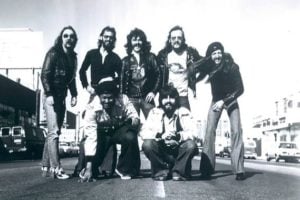
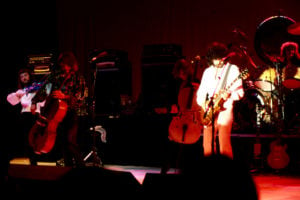
Photo: Tony Morelli, Genesis, November 20, 1974 / CC BY-SA 2.0 (https://creativecommons.org/licenses/by-sa/2.0), via Wikimedia Commons
Our Top 10 Genesis Songs list looks at one of the defining bands of the progressive rock movement. Genesis developed through several distinct eras, moving from the theatrical storytelling of Peter Gabriel to the increasingly direct songwriting and enormous commercial success of the years when Phil Collins sang lead.
The transformation was not as sudden as it is sometimes described. A Trick of the Tail was the band’s first album after Peter Gabriel left in 1975. Following The Lamb Lies Down on Broadway
 , the new album retained the group’s progressive structures, literary character, and instrumental ambition. The difference was that Collins brought a warmer, more rhythmically direct voice to material that Tony Banks, Mike Rutherford, Steve Hackett, and Collins continued writing together.
A Trick of the Tail therefore stands as a bridge rather than a clean break from the albums featuring Peter Gabriel. With Steve Hackett still in the lineup, Genesis remained capable of long-form arrangements, unusual time signatures, and instrumental passages that rewarded close listening.
Genesis released one more studio album with Hackett, Wind & Wuthering , in 1976. After Steve Hackett departed, Banks, Rutherford, and Collins recorded …And Then There Were Three…
 . The album shortened many of the arrangements without immediately abandoning progressive rock.
The 1980s brought Genesis a level of mass popularity the band had never experienced during the years with Peter Gabriel. Phil Collins had also become a major solo artist, but the group’s commercial songs remained carefully written and produced. Genesis was no longer the same progressive rock band that recorded Foxtrot or Selling England by the Pound, yet songs such as “Mama,” “Home by the Sea,” and “Domino” proved that atmosphere and extended storytelling had not disappeared.
This list includes music from the Phil Collins era but places greater emphasis on the years featuring Peter Gabriel and Steve Hackett. Those recordings helped define progressive rock alongside bands such as Pink Floyd, Yes, and Renaissance.
Genesis released fifteen studio albums from From Genesis to Revelation in 1969 through Calling All Stations in 1997. Banks, Collins, and Rutherford later reunited for The Last Domino? tour, which concluded at London’s O2 Arena on March 26, 2022.
# 10 – Your Own Special Way

Opening our Top 10 Genesis Songs list is “Your Own Special Way,” written by Mike Rutherford for Wind & Wuthering. The album was the second Genesis studio release following the departure of Peter Gabriel and the final studio album to feature guitarist Steve Hackett.
The recording shows Genesis experimenting with a gentler and more direct melodic style while retaining the atmosphere of the surrounding album. Phil Collins sings with restraint, Tony Banks adds electric piano and synthesizer colors, and Rutherford supports his acoustic-guitar foundation with bass and twelve-string textures.
“Your Own Special Way” reached number forty-three on the United Kingdom singles chart and became the band’s first charting single in the United States. Its romantic simplicity made it unusual within the Genesis catalog of the period, but that contrast is precisely what gives the track its character.
# 9 – Mama

“Mama” opened the self-titled Genesis album in 1983. By this point, the band consisted of Phil Collins on vocals and drums, Mike Rutherford on guitars and bass, and Tony Banks on keyboards.
The song begins with a skeletal drum-machine pattern and a low keyboard figure before gradually building into one of the darkest performances of the trio era. Collins’ unsettling laugh was influenced by Grandmaster Flash and the Furious Five’s “The Message,” but he transformed it into something theatrical and threatening.
“Mama” reached number four in the United Kingdom, making it Genesis’ highest-charting British single. The track demonstrates that the band could achieve commercial success without abandoning tension, unusual structure, or psychological drama.
# 8 – Squonk

“Squonk” appeared on A Trick of the Tail. The heavy opening and mythical subject gave Phil Collins an ideal opportunity to establish himself as the band’s lead vocalist after Peter Gabriel left.
The quartet featured Collins on vocals and drums, Mike Rutherford on guitars and bass, Steve Hackett on guitar, and Tony Banks on keyboards.
The lyric draws on the North American legend of a miserable creature that dissolves into tears when captured. Banks and Rutherford surround the story with thunderous bass pedals, layered keyboards, and one of Collins’ most forceful early lead vocals. “Squonk” proved that post-Gabriel Genesis could still sound enormous, strange, and unmistakably progressive.
# 7 – The Musical Box

The first three selections on this list represent the Phil Collins-fronted years. “The Musical Box” takes us back to the classic Steve Hackett and Peter Gabriel lineup.
The song appeared on Nursery Cryme , released in 1971. It was the first Genesis album to feature Phil Collins and Steve Hackett.
The lineup on Nursery Cryme consisted of Peter Gabriel on lead vocals, Collins on drums and backing vocals, Hackett on guitar, Mike Rutherford on guitars and bass, and Tony Banks on keyboards.
“The Musical Box” moves from delicate acoustic passages to explosive guitar and organ sections before reaching Gabriel’s increasingly desperate final performance. The song became a cornerstone of the band’s early stage show and one of the clearest examples of Genesis combining narrative, dynamics, theatricality, and instrumental power.
# 6 – I Know What I Like (In Your Wardrobe)

“I Know What I Like (In Your Wardrobe)” was Genesis’ first significant United Kingdom singles-chart success. It appeared on Selling England by the Pound , released in 1973.
The song grew from a Hackett guitar riff and a lyric inspired by Betty Swanwick’s album-cover painting. Gabriel portrays a young groundskeeper resisting the pressure to pursue a more respectable life, while the arrangement mixes pastoral English imagery with psychedelic sound effects and an unusually concise chorus.
Released as a single in 1974, “I Know What I Like” reached number twenty-one in the United Kingdom. It showed that Genesis could condense its eccentric identity into a radio-length song without sounding like anyone else.
# 5 – The Knife

“The Knife” closes the 1970 album Trespass. Its organ-and-guitar opening immediately announces a heavier and more confrontational side of early Genesis.
The recording features Peter Gabriel on lead vocals and flute, Anthony Phillips and Mike Rutherford on guitars, John Mayhew on drums, and Tony Banks on keyboards. Phil Collins and Steve Hackett had not yet joined the band.
Gabriel wrote the lyric from the perspective of a revolutionary leader whose promises of freedom lead to violence and authoritarianism. The song’s shifting rhythms, marching sections, and extended instrumental passages made it one of Genesis’ earliest progressive-rock statements and a long-standing concert finale.
# 4 – Watcher of the Skies
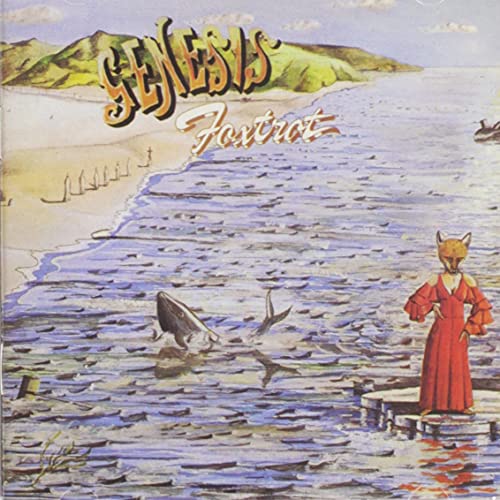
“Watcher of the Skies” opens Foxtrot , released in 1972. Another edition of the album is available here: Foxtrot
 .
.
Peter Gabriel took the title from John Keats’ sonnet “On First Looking into Chapman’s Homer,” which contains the phrase “watcher of the skies.” The science-fiction lyric imagines an alien observer arriving after humanity has vanished.
Tony Banks’ Mellotron introduction is one of the most recognizable openings in progressive rock. The instrument’s unusual chord voicings create an enormous sense of arrival before the band enters with a complex, forceful rhythm. More progressive-rock coverage can be found in our reader poll. Gabriel’s writing and performance demonstrate why his Genesis years remain so influential.
# 3 – Counting Out Time

“Counting Out Time” appeared on the double concept album The Lamb Lies Down on Broadway, released in November 1974.
The album follows Rael, a young New Yorker pulled into a surreal underground world. “Counting Out Time” provides one of the story’s comic moments as Rael prepares for a romantic encounter by studying an illustrated instruction manual, only to discover that theory has not prepared him for reality.
The song was released as the album’s first United Kingdom single, backed by “Riding the Scree.” Another edition of The Lamb Lies Down on Broadway is available through the linked release.
# 2 – Firth of Fifth
“Firth of Fifth” appeared on the 1973 album Selling England by the Pound. Tony Banks composed the central piano material, while the entire band shaped the arrangement into one of the defining works of progressive rock.
The opening piano solo introduces themes that return throughout the piece. Peter Gabriel’s flute carries the melody into the instrumental section before Steve Hackett delivers one of the most celebrated guitar solos in the Genesis catalog. Mike Rutherford and Phil Collins provide a rhythm section that moves through the shifting structure without sacrificing momentum.
The recording balances technical complexity with extraordinary emotional clarity. Every member contributes something essential, from Banks’ keyboards and Gabriel’s vocal to Hackett’s sustained guitar lines.
Read More: Top 10 Peter Gabriel Songs
# 1 – The Lamb Lies Down on Broadway
The title track opens The Lamb Lies Down on Broadway by placing Rael in New York City as the album’s strange journey begins. Tony Banks’ driving piano, Rutherford’s bass, Collins’ drums, Hackett’s guitar, and Gabriel’s urgent vocal immediately establish the album’s urban setting and surreal tension.
The song was issued as a single in the United States, while “Counting Out Time” and “The Carpet Crawlers” were selected as singles in the United Kingdom. None became a major chart hit, but the album and its elaborate stage production became central to the Genesis legend.
The Lamb Lies Down on Broadway was the final Genesis studio album to feature Peter Gabriel. The title track captures the band at an artistic crossroads: still fully committed to progressive rock, but using tighter rhythms, New York imagery, and a more immediate melodic drive.
Read More: Steve Hackett: The ClassicRockHistory.com Interview
Genesis Studio Albums
From Genesis to Revelation (1969)
Trespass (1970)
Nursery Cryme (1971)
Foxtrot (1972)
Selling England by the Pound (1973)
The Lamb Lies Down on Broadway (1974)
A Trick of the Tail (1976)
Wind & Wuthering (1976)
…And Then There Were Three… (1978)
Duke (1980)
Abacab (1981)
Genesis (1983)
Invisible Touch (1986)
We Can’t Dance (1991)
Calling All Stations (1997)
Updated August 3, 2026.
Top 10 Genesis Songs article published on ClassicRockHistory.com © 2026
ClassicRockHistory.com claims ownership of all its original content and intellectual property under United States copyright laws and those of all other countries. No person, business, or organization is allowed to republish any of our original content anywhere on the web or in print without our permission. All photos used are either supplied by the artists, public-domain Creative Commons images, or photographs officially licensed from Shutterstock for ClassicRockHistory.com. Photo credits appear with their respective images. Album-cover images used in affiliate links remain the property of their respective rights holders and are stored on retailer servers.