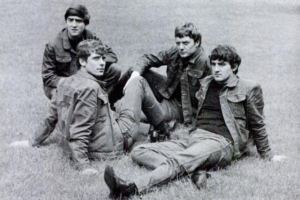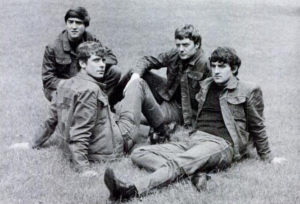
Feature Photo: Imperial Records, Public domain, via Wikimedia Commons
Liverpool’s club circuit in the early 1960s gave The Swinging Blue Jeans their runway, and the group’s sound and look quickly aligned with what became known as Merseybeat. They are identified as a four piece 1960s British Merseybeat band, and they became best known for hit singles released on the His Master’s Voice label, including “Hippy Hippy Shake,” “Good Golly Miss Molly,” and “You’re No Good,” all issued in 1964. The band’s later single activity did not match that early impact, although their 1966 recording of “Don’t Make Me Over” did reach the UK Singles Chart at number thirty one.
Their story begins earlier than the hits. In 1957, Bruce McCaskill formed a jazz influenced skiffle sextet called the Bluegenes, with an early lineup that included Tommy Hughes, Norman Kuhlke, and Spud Ward, followed by rapid personnel movement that brought in Ralph Ellis and Les Braid, then Johnny Carter and Paul Moss. By 1962, the group was working steadily, playing skiffle around Liverpool and at the Star Club in Hamburg, where hostile crowds pushed them to rethink their direction. They shifted into rock and roll, adopted the name The Swinging Blue Jeans as their stage attire became part of the identity, and moved into the classic two guitars, bass, and drums format associated with the era.
That change delivered a record deal and a national breakthrough. As a quintet featuring Ray Ennis, Les Braid, Ralph Ellis, Norman Kuhlke, and Paul Moss, they signed with His Master’s Voice and recorded with producer Walter Ridley. Their first recording, “It’s Too Late Now,” written by Ennis, reached the British Top thirty, and after Moss left, the group continued as a quartet. In December 1963, their cover of “Hippy Hippy Shake” reached number two on the UK chart, establishing them as stars at the height of the Merseybeat wave.
The band’s biggest singles are anchored by those chart peaks. “Hippy Hippy Shake” hit number two in the United Kingdom and also charted internationally, including a Billboard Hot one hundred peak at number twenty four in the United States. In 1964, they followed with “Good Golly Miss Molly,” which reached number eleven in the United Kingdom, and “You’re No Good,” which climbed to number three in the United Kingdom and also reached the Billboard Hot one hundred. Their early run was also tied to live visibility in Liverpool, including appearances at the Mardi Gras Club and the Cavern Club.
Their album output reflects both the British and international marketing patterns of the period, with multiple editions and territory specific releases. Their albums list includes ten titles, including Blue Jeans a-Swinging from 1964 and a 1964 LP titled Hippy Hippy Shake that reached number ninety in the United States, plus other releases such as Tutti Frutti, Live aus dem “Cascade Beat Club” in Köln, Don’t Make Me Over, Brand New and Faded, and Jump ’n’ Jeans. Some entries in the discography are identified as export only, Germany only, Canada only, Sweden only, or as reissues and compilations, underscoring how their catalog was repackaged across markets during and after their peak years.
Lineup changes and stylistic pivots shaped the rest of their career. In early 1966, Terry Sylvester replaced Ralph Ellis, and the band drifted toward a middle of the road approach that did not restore their earlier chart momentum. In 1967, Walter Ridley attempted to position Ray Ennis as a solo star by cutting “Tremblin’” with session musicians, with backing vocals by Madeline Bell and Kiki Dee, although it ultimately came out under the band’s name. That same year, Mike Gregory joined on bass and Les Braid moved to keyboards, and Sylvester departed at the end of 1968 to replace Graham Nash in The Hollies, after which The Swinging Blue Jeans eventually moved into the cabaret circuit.
Their later history became defined by touring continuity, member turnover, and a legal fight over the band name. After Colin Manley’s health declined, Alan Lovell deputised in early 1999, Manley died in April 1999, and Lovell became a permanent member. Ray Ennis retired in May 2010 and announced it publicly, and a dispute followed over the trademark for “The Swinging Blue Jeans,” ending in a court decision that granted Lovell exclusive legal rights, with an appeal later dismissed. The band continues to perform with no original members under Lovell’s leadership, while Ennis made occasional appearances with another group under the name “Ray Ennis’s Blue Jeans.”
# 10 – Sunday Morning Sunshine
This is a strange one to open up this list with, because if there is one songwriter we would not have expected this 1960s band to cover, it would be Harry Chapin. But that is exactly what they did with their 1975 single release, “Sunday Morning Sunshine.” It is interesting how they seem to intentionally echo Harry’s vocal tone on the chorus. This is a really intriguing track, and I thought it would be a fun way to open the list.
# 9 – Crazy ‘Bout My Baby
By October 1, 1965, The Swinging Blue Jeans were still pressing forward with new material, releasing “Crazy ’Bout My Baby” on His Master’s Voice with “Good Lovin’” as the B side, even as their earlier chart momentum had slowed. The song had been written and first recorded by Robert Mosley in 1963, but the Liverpool quartet reshaped it with a noticeably different arrangement that moved it closer to their established Merseybeat drive.
# 8 – Reddy Teddy
In 1964, The Swinging Blue Jeans released their single “Ready Teddy” on His Master’s Voice, backed with “What Have They Done to the Rain.” The record reached number twenty-five on the UK Singles Chart and number fifty on the Billboard Hot one hundred in the United States. The song was originally written by Robert Blackwell and John Marascalco and first recorded by Little Richard in 1956, becoming part of the early rock-and-roll catalog that later British beat groups frequently revisited.
# 7 – Shakin’ All Over
In 1964, at the height of their commercial run, The Swinging Blue Jeans issued their version of “Shakin’ All Over” as a single in Scandinavia, pairing it with “Shake, Rattle and Roll,” while also including the track on their album Blue Jeans a-Swinging, released on His Master’s Voice. Written by Johnny Kidd, whose original 1960 recording had reached number one on the UK Singles Chart, the song fit squarely into the Liverpool quartet’s beat driven approach, built around Ray Ennis on lead vocals and rhythm guitar, Ralph Ellis on lead guitar, Les Braid on bass and keyboards, and Norman Kuhlke on drums, working under producer Walter J. Ridley.
While the record was not a major standalone single in the United Kingdom or the United States, it charted regionally in northern Europe, reaching number seven in Finland and number nine in Sweden in 1964, underscoring the band’s international presence beyond their biggest UK hits such as “Hippy Hippy Shake” and “You’re No Good.” Their interpretation maintained the song’s tense guitar figure and direct rock structure, aligning it with the Merseybeat sound that defined their recording peak.
# 6 – Don’t Go Out into the Rain (You’re Going to Melt
“Don’t Go Out into the Rain (You’re Going to Melt)” became a 1967 single for The Swinging Blue Jeans during the later stage of their chart career, drawing from a song written by Kenny Young. The track had first been recorded by Herman’s Hermits in 1967, and The Swinging Blue Jeans issued their own version that same year, continuing to work within the British pop framework that had defined their mid-1960s output. By this point, the band had undergone lineup changes, including the addition of Terry Sylvester on guitar following Ralph Ellis’s departure, with Ray Ennis remaining on lead vocals and guitar, Les Braid on bass, and Norman Kuhlke on drums.
# 5 – Don’t Make Me Over
In 1966, The Swinging Blue Jeans issued their recording of “Don’t Make Me Over,” a song written by Burt Bacharach and Hal David and first recorded by Dionne Warwick in 1962. Warwick’s original version had reached number five on the Billboard Hot one hundred and number one on the R&B chart in the United States, establishing the song as a significant early Bacharach and David composition.
The Swinging Blue Jeans released their interpretation at a time when their chart momentum had slowed, and the single reached number thirty-one on the UK Singles Chart, becoming one of their last notable chart entries. Their version was recorded during the later phase of the band’s original run, reflecting the group’s transition period in the mid-1960s as lineup changes began to reshape their sound and direction, while still drawing from well-known American material that had previously defined much of their success.
# 4 –Tutti Frutti
By 1964, The Swinging Blue Jeans added “Tutti Frutti” to their catalog of rock and roll covers, recording their version of the song originally written by Little Richard and Dorothy LaBostrie. The track, first recorded by Little Richard in 1955 for Specialty Records and produced by Robert “Bumps” Blackwell, had already become a foundational rock-and-roll hit, reaching number 17 on the Billboard pop chart and number 2 on the R&B chart in the United States. The Swinging Blue Jeans issued their rendition during the Merseybeat era.
# 3 – Good Golly, Miss Molly
By mid 1964, “Good Golly, Miss Molly” had become another major UK hit for The Swinging Blue Jeans, reaching number eleven on the UK Singles Chart. The recording placed the Liverpool quartet firmly in the center of the British Invasion period, following the momentum generated by “Hippy Hippy Shake.” Written by John Marascalco and Robert Blackwell, the song had first been recorded by Little Richard, yet The Swinging Blue Jeans delivered a tight four-piece performance built around Ray Ennis on lead vocals and guitar, Ralph Ellis on guitar, Les Braid on bass, and Norman Kuhlke on drums. The single also charted in North America, peaking at number 43 on the Billboard Hot 100 in the United States.
# 2 – You’re No Good
The Swinging Blue Jeans released their recording of “You’re No Good” in May 1964 on His Master’s Voice, pairing it with the B side “Don’t You Worry About Me.” The single followed their 1964 hit “Good Golly Miss Molly,” then in the United Kingdom it became a major summer record for the band, reaching number three on the UK Singles Chart. The track also charted at number twenty-six in France, reached number ninety-seven on Billboard’s Hot 100 through regional U.S. success, and peaked at number seven on New Zealand’s Lever Hit Parade. A key piece of the song’s path into the band’s hands is tied to Sue Johnston, who at the time worked as a personal assistant to Peter Brown, and she later said she was the one who brought “You’re No Good” to the group’s attention while dating the band’s drummer Norman Kuhlke.
# 1 – Hippy Hippy Shake
The Swinging Blue Jeans recorded their version of “Hippy Hippy Shake” in 1963 and released it as a single on December 6, 1963, with “Now I Must Go” as the B side. The track became the band’s biggest hit in the United Kingdom and North America, reaching number two on the UK Singles Chart, number two on Canada’s CHUM Chart, and number twenty four on the Billboard Hot one hundred in early 1964. The record also placed the group among the earliest British Invasion acts to chart in the United States, following The Beatles, Dusty Springfield, and The Dave Clark Five
Check out similar articles on ClassicRockHistory.com Just click on any of the links below……
Read More: Artists’ Interviews Directory At ClassicRockHistory.com
Read More: Classic Rock Bands List And Directory
Read More: 100 Essential Albums From The 1960s That Everyone Should Own
Top 10 Swinging Blue Jeans Songs article published on ClassicRockHistory.com© 2026
Classicrockhistory.com claims ownership of all its original content and Intellectual property under United States Copyright laws and those of all other foreign countries. No one person, business, or organization is allowed to re-publish any of our original content anywhere on the web or in print without our permission. All photos used are either public domain Creative Commons photos or licensed officially from Shutterstock under license with ClassicRockHistory.com. All photo credits have been placed at the end of the article. Album Cover Photos are affiliate links and the property of Amazon and are stored on the Amazon server. Any theft of our content will be met with swift legal action against the infringing websites.