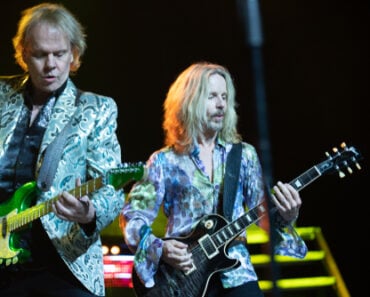
Photo: Ralf Schulze (rs-foto.de) cc-by-sa [CC BY-SA 3.0 (https://creativecommons.org/licenses/by-sa/3.0) or CC BY-SA 3.0 (https://creativecommons.org/licenses/by-sa/3.0)], from Wikimedia Commons
With the addition of Ken Hensley on keyboards, Paul Newton on bass, and Alex Napier on drums, the band set out to create music that blended the power of hard rock with progressive and symphonic influences, a combination that would soon become their signature.
The band’s debut album, …Very ‘Eavy …Very ‘Umble, was released in 1970. From the outset, Uriah Heep’s music stood apart, integrating dynamic organ and guitar interplay with Byron’s soaring vocals. Tracks like “Gypsy” introduced listeners to the band’s signature sound, characterized by dramatic arrangements and an adventurous spirit.
In 1971, Uriah Heep quickly followed with Salisbury, a record that showcased their willingness to experiment on a grand scale. The sixteen-minute title track, featuring brass and woodwind arrangements, revealed a band unafraid to blur the lines between rock and classical influences.
The album also produced “Lady in Black,” which became an enduring classic, especially in Germany. Its 1977 reissue reached No. 5 on the West German singles chart. That same early period also saw drummer Iain Clarke join the band before the recording of Look at Yourself.
The release of Look at Yourself later in 1971 marked another creative leap. The album’s title track remains one of Uriah Heep’s best-known songs, while “July Morning” stands as a staple of their live performances. The band’s early ’70s period was defined by rapid output and musical evolution, as they balanced hard-hitting rock numbers with sweeping, multi-part epics that highlighted their instrumental prowess.
Uriah Heep achieved global recognition with Demons and Wizards (1972) and The Magician’s Birthday (1972), both associated with the arrival of bassist Gary Thain and drummer Lee Kerslake, forming what many fans consider the band’s classic lineup. “Easy Livin’” from Demons and Wizards became their first major hit in the United States, peaking at number 39 on the Billboard Hot 100.
Throughout the 1970s, the band maintained a relentless recording and touring schedule, releasing albums like Sweet Freedom (1973), Wonderworld (1974), and Return to Fantasy (1975). Despite major lineup changes, including the departures of Gary Thain and David Byron, Uriah Heep continued to build a loyal international fan base.
The arrival of John Wetton and later Trevor Bolder on bass, along with John Lawton on vocals, introduced new textures to the group’s sound. Albums including Firefly (1977), Innocent Victim (1977), and Fallen Angel (1978) maintained the band’s strong following, particularly in continental Europe.
The 1980s brought new challenges and changes as the band weathered shifting musical landscapes and more lineup turnover. Even so, they released albums including Conquest (1980), Abominog (1982), and Head First (1983), while “That’s the Way That It Is” helped introduce the band to another generation of listeners. Mick Box remained the constant driving force through each transformation.
Uriah Heep’s reputation for dynamic live performances and their ability to adapt musically have kept them relevant for more than five decades. Their touring schedules took them around the globe, including a historic 1987 run in Moscow after they were invited to become the first Western rock band to perform in the Soviet Union. The band played ten consecutive nights at Moscow’s Olympic Stadium before a combined audience reported at approximately 180,000 people.
As of 2026, Uriah Heep’s catalog comprises 25 studio albums. Their latest studio release remains Chaos & Colour, issued in 2023, following later-period albums such as Sea of Light (1995), Wake the Sleeper (2008), and Living the Dream (2018).
Their music has consistently featured Mick Box’s expressive guitar work, lush vocal harmonies, dramatic keyboards, and a strong sense for melodic songwriting. Their strongest commercial foothold has often been in continental Europe, where the band maintained an unusually devoted audience long after many of their early-’70s contemporaries had slowed down.
The band’s members have also contributed extensively to the wider music world. Ken Hensley developed a substantial solo career after his years with Uriah Heep. Before joining the band, Trevor Bolder had played bass with David Bowie’s Spiders from Mars, and he later became one of Heep’s longest-serving members. Drummer Lee Kerslake also played on Ozzy Osbourne’s landmark early solo albums.
Beyond the stage and studio, Uriah Heep has maintained an unusually active international fan community. Heepvention gatherings have periodically brought together fans from around the world, reinforcing the lasting bonds created by the band’s music.
Uriah Heep’s continued relevance stems from their willingness to evolve while maintaining the spirit of their classic sound. Their legacy is built not only on hit singles and album sales but also on resilience, musical risk-taking, and a deep connection to their audience.
Today, with Mick Box still at the helm, Uriah Heep stands as one of the most enduring acts in rock. Their catalog remains a touchstone for anyone exploring the crossroads of hard rock, progressive rock, and melodic rock.
With such an extensive catalog, any top 10 list will only scratch a small surface of the band’s material.
# 10 – Gypsy
What better way to open our top 10 Uriah Heep songs list than with a song from their debut album? The excellent track “Gypsy” was released in 1970 on …Very ‘Eavy …Very ‘Umble.
The recording features David Byron on lead vocals, Ken Hensley on organ and piano, Mick Box on guitar, Paul Newton on bass, and Alex Napier on drums. The debut album itself was assembled during a period of lineup changes and also included contributions from drummer Nigel Olsson and keyboardist Colin Wood on other tracks.
# 9 – Sweet Lorraine
“Sweet Lorraine” is one of Uriah Heep’s most loved songs by their fans. The song was released on The Magician’s Birthday album in 1972.
The single reached No. 91 on the Billboard Hot 100 in 1973, a feat not easily achieved by many Progressive Rock bands in the United States. Listen to the way this one starts. It hits you hard and heavy instantly and never lets go of your attention; it’s simply a spectacular song, with a sci-fi-sounding guitar lick at the start and a funky riff that kicks in at the beginning of the verse.
# 8 – Lady In Black
“Lady In Black” appears on Uriah Heep’s album Salisbury . This moody song builds in intensity as it moves along.
The record was released in 1971. The song later became a major hit in Germany, with its 1977 reissue reaching No. 5. The band toured as the opening act for Three Dog Night and Steppenwolf during this early period. Now that’s a concert!
# 7 – Easy Livin’
Continuing our list of top 10 Uriah Heep songs, we turn to the great Demons and Wizards album.
With a cover that bleeds Progressive Rock, Uriah Heep released one of the strongest albums of their career in 1972. The album cover was designed by Roger Dean, who was responsible for many of the band Yes’s classic album covers.
“Easy Livin'” was a big hit for Uriah Heep in 1972. The song reached No. 39 on the U.S. Billboard Hot 100 and remains one of the band’s most recognized songs.
# 6 – Bird Of Prey
“Bird of Prey” is the opening track from the band’s 1971 album Salisbury.
The song featured Mick Box on lead guitar, David Byron on lead vocals, Ken Hensley on organ, Paul Newton on bass, and Keith Baker on drums. The opening guitar lick at the song’s start is to die for.
This song sounds like a cross between Queen and Black Sabbath. However, as this came out years before the first Queen album, it’s easy to hear why fans draw comparisons between Uriah Heep’s early sound and some of the theatrical heavy rock that followed. I love that organ riff in the middle of the song.
# 5 – Look At Yourself
The Uriah Heep song “Look At Yourself” was the title track to the band’s third album, also titled Look At Yourself.
The record was released in 1971 and recorded at Lansdowne Studios in London. Produced by Gerry Bron, the studio recording features Ken Hensley on lead vocals and organ, Mick Box on guitar, Paul Newton on bass, Iain Clarke on drums, and David Byron on backing vocals.
Hensley sang the studio lead because Byron was dealing with throat problems at the session, although Byron later sang the song live. “Look At Yourself” was released as a single and remains one of the band’s most popular songs.
# 4 – Rainbow Demon
Our favorite Uriah Heep song from the Demons and Wizards album was the great track “Rainbow Demon.” The song served as the opening cut on side two of the album.
Recorded during the 1972 Demons and Wizards sessions and produced by Gerry Bron, “Rainbow Demon” features David Byron on vocals, Ken Hensley on keyboards and guitar, Mick Box on guitar, Gary Thain on bass, and Lee Kerslake on drums.
The version presented here is the live recording from Spellbinder, the band’s 1996 live album recorded in Cologne, Germany.
# 3 – Wise Man
“Wise Man,” recorded by Uriah Heep in late 1976 and released on the 1977 album Firefly, presents a notable departure from the band’s heavier catalog. Produced by Gerry Bron at Roundhouse Recording Studios in London, the track introduced listeners to vocalist John Lawton in the band’s new lineup.
Alongside Lawton, the recording featured Mick Box on guitars, Ken Hensley on keyboards and guitars, Trevor Bolder on bass, and Lee Kerslake on drums. “Wise Man” was released as a UK single in April 1977.
# 2 – “TIE” Stealin’ / July Morning
Two Progressive Rock masterpieces. We couldn’t leave either of these songs off this list, so we tied it up. Why not?
The song “Stealin'” was released on the album Sweet Freedom in 1973. Written by Ken Hensley, it reached No. 91 on the Billboard Hot 100 and became one of the band’s enduring live favorites.
The song “July Morning” was released on the Look at Yourself album in 1971. We always loved the cover of the Look At Yourself album. It was just so brilliant. The song is killer.
The guitar and organ work at the song’s beginning, and the way the instruments dance with each other, is outstanding. David Byron delivers such a killer vocal on the track, and Manfred Mann contributes the Minimoog part that helps make the closing section so distinctive.
# 1 – Salisbury
Uriah Heep has released a tremendous amount of material over more than five decades, so we apologize if this list is heavy on early 1970s material. We can’t help it. The material the band released early in their career is among the best classic rock of that era.
The track “Salisbury” is all the proof you need. The ambitious centerpiece and title track of Uriah Heep’s second studio album remains one of the band’s most striking achievements.
Recorded in October and November 1970 at Lansdowne Studios in London and produced by Gerry Bron, the sixteen-minute epic features David Byron on lead vocals, Mick Box on guitar, Ken Hensley on organ, Paul Newton on bass, and Keith Baker on drums.
John Fiddy arranged the brass and woodwind parts, lending a distinctive orchestral edge to the track’s multi-movement structure and helping make “Salisbury” one of Uriah Heep’s boldest early progressive-rock statements.
Updated September 30, 2026
Read More:
Check out similar articles on ClassicRockHistory.com Just click on any of the links below……
An Interview With Founding Uriah Heep Bassist, Paul Newton
Complete List Of Uriah Heep Band Members
Read More: Artists’ Interviews Directory At ClassicRockHistory.com
Read More: Classic Rock Bands List And Directory
Top 10 Uriah Heep Songs article published on ClassicRockHistory.com © 2026
Classicrockhistory.com claims ownership of all its original content and Intellectual property under United States Copyright laws and those of all other foreign countries. No one person, business, or organization is allowed to re-publish any of our original content anywhere on the web or in print without our permission. All photos used are either public domain Creative Commons photos or licensed officially from Shutterstock under license with ClassicRockHistory.com. All photo credits have been placed at the end of the article. Album Cover Photos are affiliate links and the property of Amazon and are stored on the Amazon server. Any theft of our content will be met with swift legal action against the infringing websites.