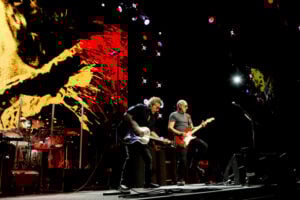
Feature Photo by Paul Garaizar
When I was in high school, there was a girl who would constantly follow me around and talk to me like I was her boyfriend. I had no idea who she was, except that she was following me. It got pretty uncomfortable. That was my first experience with a stalker. Eventually she stopped, but for a while it was pretty annoying. That experience those memories, is what kind of fueled the thought for putting together an article like this.
# 10 – Night Prowler – AC/DC

AC/DC closed their 1979 album Highway to Hell with the slow, menacing “Night Prowler.” Robert John “Mutt” Lange produced the recording, with Bon Scott singing over Angus and Malcolm Young’s guitars, Cliff Williams’ bass, and Phil Rudd’s drums. The lyrics follow a figure moving through the night, giving the song a horror-story atmosphere even before anything happens. Years later, it became unfairly associated with serial killer Richard Ramirez, who was an AC/DC fan, but the band said the song was meant more as the story of a young man sneaking into his girlfriend’s room. That distinction matters because the record’s reputation became much darker than its original intent. Even without the later controversy, the slow riff and Scott’s delivery make “Night Prowler” one of AC/DC’s creepiest recordings.
Read More: Chris Slade Of AC/DC: The ClassicRockHistory.com Interview
# 9 – Maxwell’s Silver Hammer – The Beatles
![Abbey Road Anniversary [Deluxe 2 CD]](https://m.media-amazon.com/images/I/61Co-XI3WGL._SL500_.jpg)
“Maxwell’s Silver Hammer” appeared on the Beatles’ 1969 album Abbey Road. Paul McCartney wrote the song, although it carries the Lennon-McCartney credit, and George Martin produced the recording. The lyric follows Maxwell Edison as he kills one person after another while the music stays almost absurdly cheerful. That makes it less a literal stalker song than a piece about a smiling predator who keeps appearing where nobody expects him. McCartney played piano and Moog synthesizer, while Ringo Starr supplied the famous anvil strike. The contrast between the sing-along arrangement and the murders in the lyric is exactly what makes the song so strange.
Read More: Beatles Albums In Order Of Original UK And US Studio Issues
# 8 – The More You Ignore Me, The Closer I Get – Morrissey
Morrissey released “The More You Ignore Me, the Closer I Get” in 1994 as the first single from Vauxhall and I. Morrissey and Boz Boorer wrote the song, and Steve Lillywhite produced it. The title tells you nearly everything about the narrator, who treats rejection as encouragement and keeps moving closer instead of backing away. Morrissey’s humor keeps the song from turning into a straight horror story, but the persistence underneath the jokes is deliberately uncomfortable. The single reached number eight in the United Kingdom and number forty-six on the Billboard Hot 100, making it Morrissey’s only solo appearance on that chart. It remains one of his clearest examples of turning an unpleasant character into an irresistible pop song.
Read More: Top 10 Morrissey Songs
# 7 – Angie Baby – Helen Reddy
Helen Reddy took “Angie Baby” to number one on the Billboard Hot 100 at the end of 1974. Alan O’Day wrote the song, and Joe Wissert produced Reddy’s recording for the album Free and Easy. The story centers on Angie, an isolated young woman who lives through the music on her radio, and a neighborhood boy who enters her room with bad intentions. From there, the song leaves ordinary reality behind as the boy disappears and Angie seems to take control of the fantasy around her. The record is more a surreal revenge tale than a conventional stalker song, but unwanted pursuit is what sets the story in motion. Reddy’s calm delivery makes the bizarre ending even more effective.
Read More: Top 10 Helen Reddy Songs
# 6 – Moon Over Bourbon Street – Sting

Sting recorded “Moon Over Bourbon Street” for his 1985 debut solo album The Dream of the Blue Turtles. He wrote the song after reading Anne Rice’s Interview with the Vampire, especially the character Louis, a vampire who still has enough conscience to hate what he must do to survive. Sting set that conflict against the French Quarter in New Orleans, giving the song the feel of a late-night jazz standard. The narrator follows his prey while fighting the urge to destroy the very thing that attracts him. That mixture of stalking, hunger, guilt, and restraint makes it one of the more unusual entries on this list. Sting later described the song as being about loneliness, alienation, and being pulled toward something you know you should avoid.
Read More: Top 10 Sting Songs
# 5 – Starstruck – Rainbow

“Starstruck” comes from Rainbow’s 1976 album Rising. Ritchie Blackmore and Ronnie James Dio wrote the song, while Martin Birch produced the record at Musicland Studios in Munich. Dio’s lyric deals with a woman whose fascination with a rock star has crossed into relentless pursuit, giving the song a subject far removed from the fantasy material people usually associate with his writing. Blackmore’s riff, Jimmy Bain’s bass, Tony Carey’s keyboards, and Cozy Powell’s drums turn the situation into a hard-rock charge rather than a frightened confession. The chorus is catchy enough that the uneasiness of the story can slip by on first listen. “Starstruck” is one of Rainbow’s best reminders that Dio could write about ordinary human trouble just as effectively as wizards and kings.
Read More: Top 10 Ritchie Blackmore’s Rainbow Songs
# 4 – Intruder – Peter Gabriel
Peter Gabriel opened his 1980 third solo album with “Intruder,” a song written from the viewpoint of a man who has entered somebody else’s home. Phil Collins’ drum part became nearly as important as the lyric because the track introduced the huge gated drum sound that would spread across 1980s pop and rock. Engineer Hugh Padgham, producer Steve Lillywhite, Gabriel, and Collins developed the effect from the SSL console’s heavily compressed talkback-microphone sound and noise gate. Gabriel then built the arrangement around that frightening, abrupt drum pattern. The narrator takes pleasure in the fear caused by his presence, making this one of the least ambiguous songs on the list. “Intruder” sounds invasive before Gabriel has even finished describing what the character is doing.
Read More: Top 10 Peter Gabriel Songs
# 3 – Possession – Sarah McLachlan

Sarah McLachlan released “Possession” in 1993 as the first single from Fumbling Towards Ecstasy. She wrote the song from the viewpoint of an obsessed man, drawing on disturbing fan correspondence she had received. Pierre Marchand produced the recording, which surrounds McLachlan’s vocal with an arrangement far more beautiful than the narrator’s attitude deserves. One fan later sued McLachlan, claiming he used her letters in the song, although her representatives disputed that the song was based on him alone. That real-world background makes the possessive language in the lyric harder to dismiss as ordinary romantic exaggeration. “Possession” remains powerful because McLachlan sings the stalker’s words without making him sympathetic.
Read More: Top 10 Sarah McLachlan Songs
# 2 – One Way Or Another – Blondie

Blondie’s “One Way or Another” appeared on the 1978 album Parallel Lines and was written by Debbie Harry and Nigel Harrison. Harrison developed the music, while Harry drew the lyrics from a frightening real experience with an ex-boyfriend who stalked her and helped drive her out of New Jersey. She deliberately added humor and swagger to the words to take back some power in the situation. Mike Chapman produced the recording, which keeps the tension high without sacrificing the band’s pop instincts. The single reached number twenty-four on the Billboard Hot 100 in 1979. Knowing where the lyric came from makes Harry’s performance sound less playful than defiant.
Read More: Top 10 Blondie Songs
# 1 – Every Breath You Take – The Police

The Police released “Every Breath You Take” in 1983 on Synchronicity, and it became the biggest hit of their career. Sting wrote the song, while the Police and Hugh Padgham produced the recording. Andy Summers’ clean guitar figure and the restrained rhythm make the track sound calm enough that generations of listeners have mistaken it for a love song. Sting has repeatedly described the lyric in much darker terms, pointing to surveillance, ownership, possession, jealousy, and obsession. The single spent eight weeks at number one on the Billboard Hot 100 and won the Grammy Award for Song of the Year. Few songs have ever hidden such an unhealthy narrator inside music this beautiful.
Read More: Complete List Of The Police Albums And Discography
Check out similar articles on ClassicRockHistory.com. Just click on any of the links below.
Ten 21st Century Rock Bands You Can’t Ignore (U.K. Version)
Suicide Squad Album Blends Classic Rock & New Artists
An Amazing Rock Album Cover Art Exhibit
In A Hip-Hop World, Will The Younger Generation Accept Metal?
Read More: Artists’ Interviews Directory At ClassicRockHistory.com
Read More: Classic Rock Bands List And Directory
Updated September 13, 2026.
10 Best Rock Songs About Stalkers article published on ClassicRockHistory.com © 2026