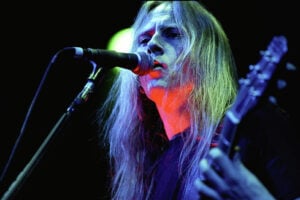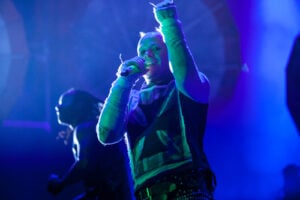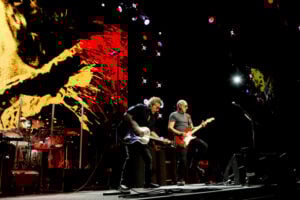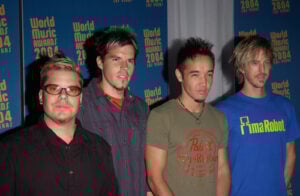
Feature Photo: Featureflash Photo Agency / Shutterstock.com
From the garage-band days of Agoura Hills, California, Hoobastank grew into one of the most recognizable alternative rock acts of the early 2000s. The band was founded in 1994 by vocalist Doug Robb, guitarist Dan Estrin, drummer Chris Hesse, and original bassist Markku Lappalainen. They originally went by the name Hoobustank before settling on the spelling now associated with the band. The group spent its early years building a reputation on the Southern California club circuit, playing alongside other emerging acts at venues like the Cobalt Cafe in Los Angeles. In 1998, they independently released their first full-length album, They Sure Don’t Make Basketball Shorts Like They Used To, which incorporated a saxophone section and was influenced by funk metal and ska punk. After attracting the attention of Island Records, the band signed with the label in 2000 and released six studio albums over the course of their career.
Hoobastank achieved mainstream success with their 2001 self-titled major-label debut, which was certified platinum in the United States and produced the hits “Crawling in the Dark” and “Running Away.” Their second album, The Reason, released in December 2003, peaked at number three on the Billboard 200 and was eventually certified double platinum. The title track reached number two on the Billboard Hot 100 and number one on the Modern Rock Tracks chart, earning the band three Grammy nominations at the 47th Annual Grammy Awards, including Best Rock Album, Song of the Year, and Best Pop Performance by a Duo or Group with Vocal. The band’s third album, Every Man for Himself (2006), debuted at number 12 on the Billboard chart and was certified gold. Subsequent releases include For(N)ever (2009), Fight or Flight (2012), and Push Pull (2018). In total, the band has sold approximately ten million albums worldwide.
Hoobastank’s lineup has seen a number of changes over the years, particularly in the bass position, which has been held by four different players throughout the band’s history. The band parted ways with Island Records in 2012 and signed with Napalm Records in 2017 for the release of Push Pull. While the original three founding members, Robb, Estrin, and Hesse, have remained the band’s core throughout its entire existence, bassist Jesse Charland joined in 2009 and has been a permanent fixture ever since. Over the years, additional members also contributed to the band during the early independent era, including saxophonists Jeremy Wasser and Derek Kwan. The full roster of current and former members is detailed below.
Doug Robb
Doug Robb was born on January 2, 1975, in Agoura Hills, California, and is the lead vocalist and a co-founding member of Hoobastank. He has been with the band since its formation in 1994 and remains its lead singer to this day. Robb began playing guitar around the age of fifteen, and his path to forming Hoobastank began when he competed against guitarist Dan Estrin in a high school battle of the bands. After both of their bands disbanded, the two joined forces and recruited Markku Lappalainen and Chris Hesse to complete the lineup. His mother is of Japanese descent and his father is of English, German, Irish, and Scottish descent. He is a graduate of Agoura High School.
As the principal lyricist and vocal face of the band, Robb contributed to all six studio albums. On the 1998 self-released debut, They Sure Don’t Make Basketball Shorts Like They Used To, the band was still operating within a funk metal and ska punk framework. Upon signing to Island Records, Robb’s vocal style became the centerpiece of the more polished alternative rock sound on the self-titled 2001 album, which featured breakout singles including “Crawling in the Dark,” “Running Away,” and “Remember Me.” The album was certified platinum in the United States. On The Reason (2003), his co-written title track became the band’s signature song, reaching number two on the Billboard Hot 100 and earning two Grammy nominations at the 47th Annual Grammy Awards. Robb continued co-writing on Every Man for Himself (2006), which featured “If I Were You,” a song that addressed a widely publicized tension between Hoobastank and Velvet Revolver during a 2005 co-headlining tour. He remained a co-writer and vocalist on For(N)ever (2009), Fight or Flight (2012), which was the band’s first independent release after leaving Island Records, and Push Pull (2018). The 2017 album cycle included Robb providing vocals for “Fist Bump,” the theme song of the Sonic Forces video game.
Outside of Hoobastank, Robb provided lead vocals for the Finnish cello rock band Apocalyptica on their 2011 single “Not Strong Enough.” The collaboration came about through his working relationship with producer Howard Benson. Robb has also been cited in connection with a missed opportunity involving a collaborative track with Rihanna that was recorded during one of the band’s album sessions but was ultimately not included on the final release. He has cited Faith No More vocalist Mike Patton as one of his primary vocal influences, and has also mentioned Van Halen and Chris Cornell among his inspirations.
Dan Estrin
Dan Estrin is the lead guitarist and co-founding member of Hoobastank, having been with the band since 1994. He grew up in Agoura Hills, California, attending Agoura High School where he first met Doug Robb. According to Estrin, his introduction to serious music came at around age twelve when he purchased Appetite for Destruction by Guns N’ Roses, which prompted him to take up the guitar. By the time he reached high school, he had also learned bass and drums. He has described a freshman-year high school talent show as one of the defining moments that committed him to a life in music.
Estrin has served as the primary musical architect of Hoobastank’s guitar work across all six studio albums. On the self-released 1998 debut, the band’s guitar work was part of a broader funk-influenced sound that also included saxophone. With the 2001 self-titled album, Estrin’s guitar became the defining sonic element, driving singles like “Crawling in the Dark” and “Running Away.” His contributions to The Reason (2003) were particularly significant. He composed the opening instrumental riff that initiated the writing process for the title track, sending a completed demo to Robb, who then added the lyrics. The album peaked at number three on the Billboard 200 and earned three Grammy nominations, including a shared nomination with Estrin for Best Rock Album. Production of the album was briefly disrupted in August 2003 when Estrin was injured in a minibike accident, sidelining the band for approximately one month. He continued contributing to Every Man for Himself (2006), For(N)ever (2009), Fight or Flight (2012), and Push Pull (2018).
Beyond his work in Hoobastank, Estrin has collaborated with other artists, including work with Avril Lavigne and Gavin Rossdale. He spoke about the 20th anniversary of The Reason in a 2023 Billboard interview, noting that the process of writing and recording that album was marked by confidence and creative momentum following the success of the band’s debut. He also noted that Madison Square Garden remained on his professional bucket list, as it was one of the few major venues the band had not yet performed in.
Chris Hesse
Chris Hesse is the drummer and co-founding member of Hoobastank, having been with the band since 1994. He grew up in Humboldt County, California, a relatively small town with a limited music scene, and relocated to the Los Angeles area seeking more musical opportunities. According to interviews, he first took up piano at the age of six, introduced to the instrument by his parents, before transitioning to drums and guitar. He found out about Hoobastank through a classified ad placed in a local music publication known as the Recycler and responded to join the band. He has been a continuous presence in the lineup ever since, outlasting multiple bass players and never missing an album cycle.
Hesse’s drumming appears on all six of the band’s studio albums, beginning with They Sure Don’t Make Basketball Shorts Like They Used To (1998) and continuing through Push Pull (2018). His playing helped define the rhythmic foundation of the band’s harder rock sound on the 2001 self-titled debut and on The Reason (2003). He remained a consistent contributor throughout the band’s Island Records years and into their independent output. On the For(N)ever (2009) release, Hesse noted publicly that he was more satisfied with the album than he had been with any release since the band’s debut. In addition to his work on the studio albums, Hesse was part of the band during their USO Road Tour in Iraq in June 2011, where they performed for U.S. military personnel stationed throughout the country.
Outside of his role as drummer, Hesse has worked as a mixer and mastering engineer. Current Hoobastank bassist Jesse Charland has publicly credited Hesse with mixing and mastering work, recommending him to outside clients through professional music networking platforms. Hesse grew up listening to music in Northern California before relocating to the Los Angeles area approximately three months before he joined Hoobastank, giving him a different regional background from the Agoura Hills roots shared by Robb and Estrin.
Jesse Charland
Jesse Charland is the current bassist, keyboardist, and backing vocalist for Hoobastank, having joined the band in 2009. He replaced the rotating bass position that had seen multiple players cycle through following the 2005 departure of founding bassist Markku Lappalainen. Charland is a graduate of the New England Conservatory of Music, where he earned a degree in Classical Performance. He studied under Lawrence Wolfe of the Boston Symphony Orchestra and Mark McCormick of the Coast Guard Band, giving him a formal musical foundation that set him apart from the self-taught backgrounds common in the rock world. He began his professional career in jazz and classical settings in Connecticut and Massachusetts before relocating to Los Angeles, where he worked in hip hop sessions before connecting with Hoobastank.
Charland’s first studio album with the band was For(N)ever (2009), though his arrival came during the promotional cycle following the completion of that record. He appeared on Fight or Flight (2012), Is This the Day? (the acoustic Japan-only release from 2010), and Push Pull (2018). He has cited Push Pull as a project he is particularly proud of, describing it as an opportunity to incorporate sound design elements he had developed over years of musical experimentation. In addition to bass, Charland contributes keyboards and programming to the band’s recordings, adding a new layer of sonic texture that was not present in earlier lineups.
Outside of Hoobastank, Charland has worked extensively as a session bassist and remote collaborator, offering his services to independent artists and producers through various platforms. He has also been affiliated with other musical projects including Giants of Rome and Something Bot Metro. His formal conservatory training has informed his approach to session work, and he has been noted by collaborators for his ability to bring original musical ideas to projects beyond simply executing what is written.
Markku Lappalainen
Markku Lappalainen is the original bassist of Hoobastank, having been a founding member of the band in 1994. His parents are Finnish, and his early musical background was diverse, beginning with saxophone, then moving to guitar, and eventually settling on bass. His early influences included heavy metal acts such as Iron Maiden and Megadeth, though he also developed an interest in techno music, which he has cited as a lasting influence on his playing. He joined Hoobastank by responding to the same classified ad in the Recycler through which Chris Hesse found the band, though accounts vary on the specific circumstances. At the time he joined, he was reportedly working as a set builder and grip in the film industry.
Lappalainen played bass on the band’s earliest output, including the 1998 independently released debut They Sure Don’t Make Basketball Shorts Like They Used To, as well as the unreleased second album Forward, which was recorded in anticipation of the Island Records deal but ultimately shelved. He was present on the self-titled 2001 major-label debut, which produced “Crawling in the Dark” and “Running Away,” and on The Reason (2003), the band’s most commercially successful album, which was certified double platinum and produced the number-two Billboard Hot 100 hit “The Reason.” He was still with the band during the touring cycle that supported The Reason and the early stages of Every Man for Himself‘s development. Lappalainen departed Hoobastank following the 2005 Summer Tour, with Matt McKenzie from Tsunami Bomb filling in for the remainder of the year’s dates.
No widely documented solo career or major post-Hoobastank projects by Lappalainen have been publicly confirmed, and he has maintained a low public profile since leaving the band. His tenure as original bassist, spanning from the band’s founding through more than a decade of activity, made him a foundational part of the group’s early identity and sound.
Jeremy Wasser
Jeremy Wasser served as the saxophonist for Hoobastank during the band’s early independent era, contributing to the group’s original funk metal and ska punk sound. He was a member in the period leading up to and including the 1998 self-released debut, They Sure Don’t Make Basketball Shorts Like They Used To, for which he also served as executive producer. His involvement with the band extended into the sessions for the follow-up album, Forward, which was completed but never officially released after the band signed with Island Records. The label and the band agreed that the saxophone-based direction no longer suited the sound they were pursuing, and Wasser departed around 2000 as a result.
Before his time with Hoobastank, Wasser had a notable connection to another Agoura Hills-area band, Incubus. He recorded the “Summer Romance” saxophone solo on Incubus’ 1997 album S.C.I.E.N.C.E., which documented his standing as a versatile session contributor within the Southern California scene. In August 2013, Wasser made a one-off appearance at the Sunset Strip Music Festival at the Whisky A Go Go in West Hollywood as part of an event connected to the band’s history. His departure from Hoobastank was not contentious by available accounts, but rather a natural consequence of the band’s evolving musical direction as they prepared for mainstream release.
Derek Kwan
Derek Kwan served as a saxophonist with Hoobastank during the band’s early independent years alongside Jeremy Wasser. Both Kwan and Wasser contributed to the funk metal and ska punk sound that defined the group’s first recordings. Kwan departed from the band in 1999, a year before Wasser’s exit in 2000, as the group began transitioning away from the saxophone-driven sound that had characterized their pre-label output. His contribution was part of the same era that produced They Sure Don’t Make Basketball Shorts Like They Used To and the unreleased Forward sessions. Beyond his time with Hoobastank, there is limited publicly documented information about Kwan’s subsequent musical activity.
Matt McKenzie
Matt McKenzie served as a temporary bassist for Hoobastank following the departure of founding member Markku Lappalainen after the 2005 Summer Tour. McKenzie was already known in the Southern California rock scene from his work with Tsunami Bomb, a Bay Area punk and rock band with which he had spent several years prior to his time with Hoobastank. His role with Hoobastank was a fill-in arrangement covering the remaining 2005 tour dates while the band evaluated long-term options for the bass position. He was subsequently replaced by Josh Moreau, who took over the role around the time of the recording and release of Every Man for Himself in 2006. McKenzie did not record any studio material with Hoobastank during his time with the group.
Josh Moreau
Josh Moreau joined Hoobastank as bassist around 2006, following the brief tenure of Matt McKenzie after the departure of original bassist Markku Lappalainen. Moreau played on and toured in support of Every Man for Himself (2006), the band’s third major-label album, which debuted at number 12 on the Billboard chart and was certified gold in the United States. The album produced three singles: “If I Were You,” “Inside of You,” and “Born to Lead.” Moreau remained with the band through 2008, making him the bassist during one of the group’s transitional periods as they moved away from the commercial peak of The Reason era. He departed prior to the sessions for For(N)ever, which was released in January 2009. There is limited publicly documented information about Moreau’s career outside of his work with Hoobastank.
David Amezcua
David Amezcua served as bassist for Hoobastank in 2008, filling the role briefly between Josh Moreau’s departure and Jesse Charland’s arrival in 2009. His tenure was short and coincided with the period during which the band was completing work on For(N)ever, though he is not credited on that album. The details of his musical background and any subsequent career activity outside of his brief association with Hoobastank are not widely documented in available public sources.
Check out more articles on ClassicRockHistory.com Just click on any of the links below……
Read More: Artists’ Interviews Directory At ClassicRockHistory.com
Read More: Classic Rock Bands List And Directory
Complete List Of Hoobastank Band Members article published on ClassicRockHistory.com© 2026
Classicrockhistory.com claims ownership of all its original content and Intellectual property under United States Copyright laws and those of all other foreign countries. No one person, business, or organization is allowed to re-publish any of our original content anywhere on the web or in print without our permission. All photos used are either public domain Creative Commons photos or licensed officially from Shutterstock under license with ClassicRockHistory.com. All photo credits have been placed at the end of the article. Album Cover Photos are affiliate links and the property of Amazon and are stored on the Amazon server. Any theft of our content will be met with swift legal action against the infringing websites.