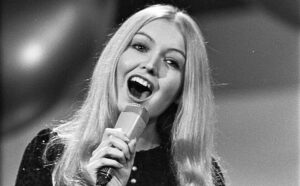
Feature Photo: Eric Koch for Anefo, CC0, via Wikimedia Commons
Mary Hopkin emerged from Pontardawe, Wales, with a background rooted in traditional Welsh music and folk singing. Her first major break came in 1968 after she won the television talent competition Opportunity Knocks, an appearance that brought her to the attention of Paul McCartney. McCartney signed her to the Beatles’ Apple label, marking the formal beginning of her recording career and placing her at the center of one of the most visible label launches of the late 1960s.
Her debut single, “Those Were the Days,” arrived in 1968 and became an immediate international success. The song reached number one in the United Kingdom and topped charts across Europe, while also peaking at number two on the United States Billboard Hot 100. The recording was produced by Paul McCartney and featured a production style that blended orchestral pop with folk influences, establishing the musical framework that would define her early commercial period.
Later in 1968, she released “Goodbye,” another McCartney-produced single that reached number two on the UK Singles Chart. The song reinforced her visibility as one of Apple Records’ most prominent early artists and confirmed her ability to sustain chart success beyond a single breakout hit. During this period, she became closely associated with melodic pop material that balanced contemporary songwriting with traditional sensibilities.
Her debut album, Post Card, was released in 1969 and included both original material and covers arranged to highlight her clear vocal style. The album reached the top five of the UK Albums Chart and marked a shift toward more folk-oriented, acoustic arrangements. That same year, she represented the United Kingdom in the Eurovision Song Contest with “Knock, Knock Who’s There,” finishing second and adding another major international platform to her early career.
In 1970, Hopkin released Earth Song, Ocean Song, an album that marked a deliberate move away from mainstream pop toward folk music and self-selected material. The record reflected her growing interest in artistic independence and traditional influences, even though it did not match the chart performance of her earlier releases. This period signaled a turning point, with Hopkin increasingly prioritizing creative control over commercial expectations.
Across her career, Mary Hopkin released multiple studio albums, including Those Were the Days, Memories, and Valentine, each reflecting different phases of her musical direction. Her work extended beyond English language recordings, with albums and singles recorded in Welsh that contributed to the preservation and promotion of Welsh music. She later operated her own record label, A World of Our Own Recordings, which allowed her to release music independently and manage archival projects.
Outside of her solo recordings, Hopkin participated in collaborative folk projects and remained active in live performance and independent releases. Her career is defined by early chart success, a conscious retreat from pop stardom, and sustained involvement in folk music and self-produced work. She received an OBE in 2009 for services to music, recognizing her contributions to British cultural life.
# 10 – Streets Of London
“Streets of London” was written by Ralph McTell and first released by him in 1969. Mary Hopkin recorded the song for her studio album Earth Song, Ocean Song, which Apple Records released in 1971. Tony Visconti produced the album sessions, which took place in London during 1971. Hopkin’s recording appears alongside material written by Ralph McTell, Cat Stevens, Gallagher and Lyle, and other contemporary songwriters featured on the album. The arrangement on Earth Song, Ocean Song credits Mary Hopkin on vocals with supporting session musicians assembled for the album under Visconti’s production. The album version of “Streets of London” followed McTell’s original composition and lyrics without alteration and remained associated with the Earth Song, Ocean Song release rather than being issued as a standalone single in major markets.
# 9 – The Puppy Song
Paul McCartney asked Harry Nilsson to write “The Puppy Song” for Mary Hopkin during sessions for her debut album Post Card, recorded between early October and early December of 1968 at EMI Studios (now Abbey Road Studios) in London with McCartney producing and contributing bass guitar, and Richard Hewson arranging the orchestral parts. Hopkin’s version appears as track six on Post Card, which was released on February 21, 1969, in the United Kingdom and in March of 1969 in the United States on Apple Records. The song was never released as a major single in key markets, although it served as the B-side to “Temma Harbour” in Italy in 1970, and Nilsson later recorded his own version for his album Harry in August of 1969. Nilsson wrote the song at McCartney’s request and worked out the composition on piano before sending it to McCartney for Hopkin’s recording. David Cassidy later released “The Puppy Song” as a double A-side with “Daydreamer,” which reached number 1 on the United Kingdom singles chart in 1973.
# 8 – Water, Paper And Clay
“Water, Paper And Clay” appears as the B side of the single “Earth Song” released by Mary Hopkin in 1971. Michael Julien and Peter Yarrow wrote the song. Tony Visconti produced the recording. The single was issued in the United Kingdom in 1971. “Earth Song” reached number 37 on the UK Singles Chart, with “Water, Paper And Clay” included on the release as the accompanying track. The recording period for the single took place during sessions in 1971.
# 7 -Aderyn Llwyd
Sometimes, certain songs don’t translate as well into English as they do in their native language. This is an example of that.“Aderyn Llwyd” was released in 1969 as a seven-inch 45 RPM single in the United Kingdom on the Cambrian label. The record carried “Aderyn Llwyd” on the A side and “Y Blodyn Gwyn” on the B side.
# 6 – Temma Harbour
“Temma Harbour” was released on January 16, 1970 on Apple Records with “Lontano Dagli Occhi” as its B side. Written by Robert Anson under the pseudonym Philamore Lincoln, the track was produced by Mickie Most. It became the first single Mary Hopkin recorded for Apple that was not produced by Paul McCartney. The recording was issued as a single in early 1970 and entered the UK Singles Chart, where it reached number 6 and remained on the chart for eleven weeks. In the United States, “Temma Harbour” peaked at number 39 on the Billboard Hot 100 and reached number 4 on the Billboard Easy Listening chart. The song refers to an inlet of the same name on the island of Tasmania.
# 5 – Que Sera, Sera (Whatever Will Be, Will Be)
Mary Hopkin recorded “Que Sera, Sera (Whatever Will Be, Will Be)” in 1969 at EMI Studios, Studio Two, Abbey Road in London with Paul McCartney producing the sessions and Ringo Starr on drums while Hopkin provided vocals and acoustic guitar; the single was first issued in North America on June 15, 1970 on Apple Records with “Fields of St Etienne” as its B side and later appeared on UK and international releases, and it reached number 77 on the Billboard Hot 100 and number 7 on the Billboard Adult Contemporary chart in the United States.
# 4 – Knock, Knock Who’s There?
“Knock, Knock Who’s There?” was written by John Carter and Geoff Stephens and released in March 1970 as a single backed with “I’m Going to Fall in Love Again.” Mickie Most produced the recording, which appeared on the Apple label. The song was selected on March 7, 1970, through the UK television program A Song for Europe to represent the United Kingdom at the Eurovision Song Contest held in Amsterdam. It was performed seventh in the running order and finished in second place with 26 points. The single reached number 2 on the UK Singles Chart and remained on the chart for 14 weeks.
# 3 – If You Love Me (I Won’t Care)
Mary Hopkin recorded “If You Love Me (I Won’t Care)” in 1969 as an English-language version of “Hymne à l’amour,” which Édith Piaf wrote with Marguerite Monnot in 1949. Phil Everly translated the lyrics into English under the title “If You Love Me (Really Love Me).” The recording took place at EMI Studios, Abbey Road, London. Paul McCartney produced the session for Apple Records. Hopkin provided the lead vocal. The single was released in 1969 on Apple Records. The song charted in several countries, reaching number 8 on the UK Singles Chart. The recording later appeared on Hopkin’s album Post Card.
# 2 – Goodbye
“Goodbye” was released as a single in 1969 on the Apple label and appeared on Post Card, with songwriting and production credited to Paul McCartney. Paul McCartney wrote the song and produced the recording, which was recorded at EMI Studios in London in February 1969. The recording features Mary Hopkin on lead vocals, with Paul McCartney contributing acoustic guitar and backing vocals, and orchestral arrangements credited to Richard Hewson. The single was issued with “Sparrow” as the B side and reached number two on the UK Singles Chart, number thirteen on the US Billboard Hot 100, and number five on the US Adult Contemporary chart. The release followed the commercial success of “Those Were the Days” and continued Hopkins’ association with Apple Records during the label’s initial period of activity.
# 1 – Those Were the Days
Mary Hopkin released “Those Were the Days” as her debut single in 1968 after Paul McCartney discovered her on the television talent show Opportunity Knocks and signed her to Apple Records. Gene Raskin wrote the song, adapting the melody from the Russian romance “Dorogoi dlinnoyu” by Boris Fomin, with English lyrics credited to Raskin. The recording took place at Abbey Road Studios in London, with Paul McCartney serving as producer and arranger. The session featured session musicians, including Big Jim Sullivan on guitar, John Paul Jones on bass, Barry Morgan on drums, and Richard Hewson handling orchestration. Apple Records issued the single in August 1968, and it reached number one on the UK Singles Chart for six consecutive weeks beginning in September 1968. The song also reached number one on the Billboard Hot 100 in the United States, holding the top position for two weeks, and topped charts in multiple countries including Canada, Australia, and Ireland. The single appeared on Hopkin’s debut album Post Card, released in 1969, and marked her first major international success.
Check out similar articles on ClassicRockHistory.com Just click on any of the links below……
Read More: Artists’ Interviews Directory At ClassicRockHistory.com
Read More: Classic Rock Bands List And Directory
Read More: Top 200 Songs About Food
Read More: 25 Best Classic Rock Live Albums Of All Time
Top 10 Mary Hopkin Songs article published on ClassicRockHistory.com© 2025
Classicrockhistory.com claims ownership of all its original content and Intellectual property under United States Copyright laws and those of all other foreign countries. No one person, business, or organization is allowed to republish any of our original content anywhere on the web or in print without our permission. All photos used are either public domain Creative Commons photos or licensed officially from Shutterstock under license with ClassicRockHistory.com. All photo credits have been placed at the end of the article. Album Cover Photos are affiliate links and the property of Amazon and are stored on the Amazon server. Any theft of our content will be met with swift legal action against the infringing websites.