Feature Photo: Photography Stock Ruiz / Shutterstock.com
Kiss demands chaos, Free exudes confidence, and Bruce Springsteen fights for something real. Elton John tells a story of love and loss, The Beatles preach unity, and Jimi Hendrix sets the world on fire. Mott the Hoople takes the misfits and gives them an anthem. The artists on this list couldn’t be more different, some chase excess, some chase meaning, and some don’t know what they’re chasing at all. But they all use “all” as something absolute, something that refuses to be ignored.
# 10 – You Shook Me All Night Long – AC/DC
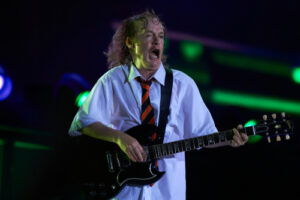
AC/DC’s “You Shook Me All Night Long” was released in 1980 on Back in Black, the song marked Brian Johnson’s debut as AC/DC’s lead vocalist following the tragic death of Bon Scott. Built on a foundation of Angus Young’s razor-sharp guitar riffs and a rhythm section that drives with relentless power, the track became one of the most enduring rock songs of all time.
Read More: Chris Slade: The ClassicRockHistory.com Interview
# 9 – Where Have All The Good Times Gone – The Kinks
Nostalgia and disillusionment collide in Where Have All the Good Times Gone, a song that captures a sense of longing for the past with biting wit and social observation. The song was released in 1965 as part of The Kink Kontroversy. Recorded at Pye Studios in London, Where Have All the Good Times Gone features the classic Kinks lineup: Ray Davies on lead vocals and rhythm guitar, Dave Davies on lead guitar and backing vocals, Pete Quaife on bass, and Mick Avory on drums.
Read More: Dave Davies of The Kinks: The ClassicRockHistory.com Interview
# 8 – All Dead, All Dead – Queen
Queen’s News of the World is often remembered for its bombastic rock anthems, but “All Dead, All Dead” offers a contrasting, deeply personal moment. Written and primarily sung by Brian May, this poignant ballad reflects on loss and memory, with lyrics that carry a somber yet beautifully poetic tone. Lines like “Her ways are always with me” and “I wander all the while” evoke a sense of lingering sorrow, while “But please, you must forgive me” hints at an unresolved emotional weight.
Read More: Brian May of Queen: The ClassicRockHistory.com Interview
# 7 – Rock And Roll All Night – Kiss
Kiss delivered one of the most recognizable rock anthems of all time with “Rock and Roll All Nite,” a track that perfectly encapsulates the band’s commitment to spectacle, excess, and the unrelenting power of music. Released on Dressed to Kill in 1975, the song became the defining statement of Kiss’s identity, reinforcing their party-hard philosophy with an electrifying chorus that refuses to let up. The track was recorded in February 1975 at Electric Lady Studios in New York City, with Casablanca Records founder Neil Bogart serving as producer alongside the band. The lineup consisted of Paul Stanley on vocals and rhythm guitar, Gene Simmons on vocals and bass, the late Ace Frehley on lead guitar, and Peter Criss on drums, all contributing to the song’s larger-than-life energy. While the studio version initially peaked at No. 68 on the Billboard Hot 100, it was the live rendition from Alive! that cemented the song’s legacy, climbing to No. 12 in 1976 and becoming Kiss’s breakthrough hit.
Read More: Tommy Thayer of Kiss: The ClassicRockHistory.com Interview
# 6 – All Right Now – Free
Free’s “All Right Now” is a song that captures the raw spirit of blues-infused rock while embodying the thrill of reckless abandon. Released in 1970 on Fire and Water, the track became the defining anthem of the British band’s brief but influential career. The song was recorded in early 1970 at Trident and Island Studios in London, produced by Free alongside engineer Roy Thomas Baker. The lineup consisted of Paul Rodgers on lead vocals, Paul Kossoff on guitar, Andy Fraser on bass and keyboards, and Simon Kirke on drums, each member contributing to the track’s unmistakable groove. Commercially, “All Right Now” was a breakthrough, reaching No. 2 on the UK Singles Chart and No. 4 on the Billboard Hot 100 in the United States.
Read More: Simon Kirke Of Bad Company: 10 Albums That Changed My Life
# 5 – Prove It All Night – Bruce Springsteen
With Darkness on the Edge of Town, Bruce Springsteen traded in the youthful exuberance of his earlier work for something grittier, more desperate, and driven by an unshakable sense of determination. Nowhere is that more apparent than in “Prove It All Night,” a song that pulses with the urgency of a man who refuses to let love slip through his fingers. Recorded on September 16, 1977, at The Record Plant in New York City, the song was produced by Springsteen and Jon Landau, with the E Street Band delivering one of their most electrifying performances. Roy Bittan’s cascading piano intro builds into a storm of guitars, while Clarence Clemons’ saxophone, Garry Tallent’s bass, and Max Weinberg’s thunderous drumming create a relentless momentum that mirrors the song’s central theme: love isn’t just about words—it’s about action.
Read More: Why Springsteen’s Darkness On The Edge Of Town Was His Best Album
# 4 – All The Young Girls Love Alice – Elton John
Elton John’s “All the Girls Love Alice,” featured on his 1973 album Goodbye Yellow Brick Road, delves into the tragic life of a young girl grappling with her identity and societal rejection. The song was recorded in May 1973 at the Château d’Hérouville in France, with production by Gus Dudgeon. The lineup included Elton John on vocals and piano, Davey Johnstone on guitar, Dee Murray on bass, and Nigel Olsson on drums.
Read More: Complete List Of Elton John Songs From A to Z
# 3 – All You Need Is Love – The Beatles
At the height of 1967’s Summer of Love, The Beatles delivered one of their most enduring anthems with “All You Need Is Love,” a song that distilled the era’s utopian ideals into a simple yet profound message. Written primarily by John Lennon and credited to the Lennon-McCartney partnership, the track was commissioned for Our World, the first-ever live, global television broadcast. On June 25, 1967, the band performed the song at EMI Studios in London as part of a historic event watched by an estimated 400 million people across 25 countries. The recording itself began on June 14, 1967, at Olympic Sound Studios in London before moving to EMI Studios for additional overdubs. Produced by George Martin, the track featured an orchestral arrangement that intertwined with The Beatles’ unconventional instrumentation, including Lennon on harpsichord, Paul McCartney on double bass, George Harrison on violin, and Ringo Starr on drums.
Upon its release on July 7, 1967, the single topped the charts in the UK and the US, cementing its place as one of The Beatles’ most significant cultural statements. The song’s orchestral coda, incorporating musical references such as “La Marseillaise” and Glenn Miller’s “In the Mood,” reinforces its theme of unity. Critics praised the track for its innovation and optimism, and it remains an enduring symbol of peace and love. Among the songs on this list, “All You Need Is Love” stands alone in its grand ambition—it’s not just about love in a personal sense but love as a unifying force that extends across the world.
Read More: Complete List Of The Beatles Songs From A to Z
# 2 – All Along The Watchtower – Jimi Hendrix
Jimi Hendrix’s reinvention of “All Along the Watchtower” took Bob Dylan’s folk song and transformed it into a searing, electrified masterpiece that remains one of the most celebrated covers in rock history. Recorded at Olympic Studios in London, the track took shape over multiple sessions beginning on January 21, 1968. Hendrix, who produced the recording himself, played the majority of the instruments, including bass in later overdubs. Mitch Mitchell provided the song’s dynamic drumming, while Dave Mason contributed 12-string guitar, and Brian Jones of The Rolling Stones added percussion. The production process was meticulous, with Hendrix layering multiple guitar tracks and experimenting with sonic textures that would redefine the song’s impact.
Released in September 1968 as part of Electric Ladyland, Hendrix’s version of “All Along the Watchtower” outperformed Dylan’s original in commercial success, reaching No. 5 on the UK Singles Chart and No. 20 on the Billboard Hot 100. Bob Dylan himself acknowledged Hendrix’s reinvention, later adapting Hendrix’s arrangement into his own live performances. The song’s apocalyptic energy and groundbreaking production solidified it as one of Hendrix’s defining works.
Read More: Complete List Of Jimi Hendrix Songs From A to Z
# 1 – All The Young Dudes – Mott The Hoople
Mott the Hoople’s “All the Young Dudes” is a song that not only saved the band from breaking up but also became an anthem for the glam rock era. Written and produced by David Bowie, the track was recorded on May 14, 1972, at Olympic Studios in London. The lineup featured Ian Hunter on lead vocals and piano, Mick Ralphs on guitar, Pete Overend Watts on bass, Dale Griffin on drums, and Verden Allen on organ. Bowie himself contributed backing vocals, solidifying his influence on the track. Originally, Bowie had offered them “Suffragette City,” but the band declined, leading him to present “All the Young Dudes,” which they immediately recognized as a song that could change their fortunes.
Released on July 28, 1972, “All the Young Dudes” reached No. 3 on the UK Singles Chart and No. 37 on the US Billboard Hot 100, giving Mott the Hoople their biggest hit. The song not only revitalized the band’s career but also helped define the glam rock movement alongside artists like Bowie, T. Rex, and Roxy Music.
Read More: Top 10 Mott The Hoople Songs
Check out more similar articles on ClassicRockHistory.com Just click on any of the links below……
Updated December 17, 2025
Read More: Artists’ Interviews Directory At ClassicRockHistory.com
Read More: Classic Rock Bands List And Directory
10 Best Songs With The Word ‘All’ In The Title article published on Classic RockHistory.com© 2025
Classicrockhistory.com claims ownership of all its original content and Intellectual property under United States Copyright laws and those of all other foreign countries. No one person, business, or organization is allowed to re-publish any of our original content anywhere on the web or in print without our permission. All photos used are either public domain Creative Commons photos or licensed officially from Shutterstock under license with ClassicRockHistory.com. All photo credits have been placed at the end of the article. Album Cover Photos are affiliate links and the property of Amazon and are stored on the Amazon server. Any theft of our content will be met with swift legal action against the infringing websites.