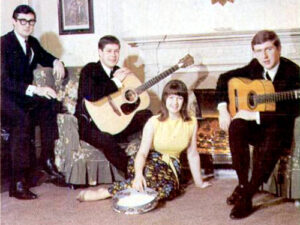
Featured Photo: Capitol Records, Public domain, via Wikimedia Commons
Formed in Melbourne, Australia, in 1962, The Seekers began as a harmony-driven folk group built around the distinct lead voice of Judith Durham, with Athol Guy, Bruce Woodley, and Keith Potger shaping a sound that quickly stood apart from other early sixties vocal groups. The members initially came together through Melbourne’s folk scene, recording homemade tapes and performing locally before traveling to the United Kingdom in late 1963, a move that proved decisive for their international breakthrough. Their early reputation was built on precise vocal arrangements and a repertoire that blended traditional folk material with contemporary songwriting.
The group’s commercial rise accelerated after signing with EMI in Britain, where producer Tom Springfield played a central role in shaping their recordings. Their first major success came with “I’ll Never Find Another You,” released in 1964, which reached number one in the United Kingdom and established the band as a global act almost overnight. The song’s success was followed by a rapid run of international hits that solidified their place in the mid-1960s pop landscape while maintaining strong ties to folk traditions.
Throughout this period, The Seekers released a steady run of albums, including Introducing The Seekers, A World of Our Own, Hide and Seekers, and Come the Day, each expanding their audience across Europe, Australia, and North America. Their recordings were defined by clean production, prominent acoustic instrumentation, and carefully balanced harmonies, with Judith Durham’s vocal performances serving as the emotional center of the group’s sound. The albums consistently charted well in multiple countries, reinforcing the band’s reputation for both commercial appeal and musical discipline.
Their singles run during this era remains the core of their legacy, with songs such as “A World of Our Own,” “The Carnival Is Over,” “Morningtown Ride,” and “Georgy Girl” achieving major chart success. “The Carnival Is Over” became a number one hit in the United Kingdom in 1965, while “Georgy Girl,” written by Tom Springfield and Jim Dale for the film of the same name, reached number one in Australia and the United States in 1967. That single also earned an Academy Award nomination for Best Original Song, marking a rare crossover between pop chart success and major film recognition.
At the height of their popularity, The Seekers were recognized with numerous industry honors, including multiple gold records and widespread international awards tied directly to sales and chart performance. In 1967, they became the first Australian pop group to sell more than one million singles in the United Kingdom. Their ability to maintain chart dominance across different territories distinguished them from many contemporaries whose success remained regionally limited.
Beyond recording and touring, the individual members pursued notable paths outside the group framework. Judith Durham later received national recognition in Australia, including an appointment as an Officer of the Order of Australia and honorary doctorates, acknowledging her cultural contribution beyond commercial music. The group’s influence also extended into education and media through archival releases, documentaries, and formal recognition of their role in shaping Australia’s international music identity.
# 10 – Children Go Where I Send You
Released as a non-album single in 1969, the composition is a traditional African-American spiritual characterized by its cumulative structure in which each numbered verse carries a biblical reference, typically progressing through twelve levels. The song’s origins are uncertain, though its nearest known relative is the English folk song “The Twelve Apostles” (also listed in the Roud Folk Song Index as #133), with possible earlier origins traced to the traditional Yiddish Passover song “Echad Mi Yodea,” first documented in the 16th century. The earliest known North American recording of the tune was captured in 1934 by folklorists John Avery Lomax and Alan Lomax at Bellwood Labor Camp in Atlanta, Georgia, performed by an unidentified group of African-American convicts. The Golden Gate Quartet’s 1937 commercial recording for RCA Victor’s Bluebird label further popularized the song and established its form as a distinctly American folk tune, with the quartet having learned it from the Heavenly Gospel Singers. The spiritual has been recorded by numerous artists across multiple genres, and today many Americans know it as a Christmas carol. The Seekers’ 1969 single release did not chart but became a fan favorite.
# 9 – Cotton Fields
Based on a composition by blues musician Lead Belly that was first recorded in 1940, Cotton Fields entered the folk music canon through Odetta & Larry’s 1954 album recorded at the Tin Angel nightclub in San Francisco. The track appeared on the Seekers’ 1964 self-titled album as a 2:52 piece on Side 1, with the arrangement credited to the group. The song became a standard cover for numerous folk and country-rock acts throughout the 1960s, with versions recorded by artists including Harry Belafonte, the Highwaymen, and later the Beach Boys and Creedence Clearwater Revival.
# 8 – Kumbaya
An African-American spiritual of disputed origin known from the Gullah culture of the Sea Islands off South Carolina and Georgia, Kumbaya was originally an appeal to God to come to the aid of those in need. The song experienced renewed popularity during the American folk music revival of the early to mid-1960s, largely due to Joan Baez’s 1962 recording, and became associated with the civil rights movement, with marchers singing it as “Come By Here” during the 1965 Selma-to-Montgomery march for voting rights. The Seekers recorded the composition for their 1967 double LP compilation album Introducing the Seekers Big Hits, which appeared on Side 3 and peaked at number 5 in Australia in 1967.
# 7 – Emerald City
Recorded in 1967 and released as a single around Christmas that year, the composition drew its melody from Ludwig van Beethoven’s “Ode to Joy” from his Ninth Symphony and told the story of a visit to L. Frank Baum’s fictional Emerald City from the Oz books. Writing credit was initially listed to Kim Fowley and John Martin, though during a 1993 reunion tour, the band disclosed that John Martin was a pen name used by band member Keith Potger. The single reached number 50 on the UK Charts in 1967.
# 6 – Waltzing Matilda
The classic folk song “Waltzing Matilda” developed from lyrics composed in 1895 by Australian poet Banjo Paterson to a tune played by Christina MacPherson, which was based on Thomas Bulch’s march “Craigielee.” Harry Nathan published the first setting on December 20, 1902, with his own arrangement and modified lyrics. Tea merchant James Inglis purchased the rights in early 1903 and commissioned Marie Cowan to rework the piece for use as a Billy Tea advertising jingle. Cowan made changes to both words and melody, giving the song a simple, brisk accompaniment that made it highly catchy, and her version, published in 1903, became the best-known arrangement.
The Seekers recorded the composition for their 1964 self-titled album, where it appeared as a 2:54 track and was initially released in November 1963, reaching number 74 on the Australian music report. The group re-recorded and released it as a single in 1966 on Columbia DB 8060, produced by Tom Springfield. The single spent 15 weeks on the UK Singles Chart, reaching number 2 on December 28, 1966, and spent seven weeks on the American Billboard Hot 100, peaking at number 44, while also reaching number 13 on Billboard’s Easy Listening chart.
# 5 – Morningtown Ride
Malvina Reynolds’ lullaby tells the story of children traveling through the night on a train with the Sandman as guard. The composition was first recorded by the group in 1964 on Hide & Seekers (W&G Records WG-B-2362) with Bobby Richards and his Orchestra before being re-recorded and released as a single in 1966 on Columbia DB 8060, produced by Tom Springfield. The single spent 15 weeks on the UK Singles Chart, reaching No. 2 on December 28, 1966. In the United States, the single spent seven weeks on the Billboard Hot 100, peaking at No. 44, and reached No. 13 on Billboard’s Easy Listening chart. The Irish Rovers recorded versions for their 1972 album The Irish Rovers Live and 1976 album Children of the Unicorn, with their 1973 recording reaching No. 83 on Canada’s RPM 100 and No. 39 on RPM’s Adult Contemporary Playlist. Brendan Grace released a version that reached No. 25 on the Irish Singles Chart on January 6, 1985.
# 4 – A World of Our Own
First off, I love the colors of this video. It really does look like the band is living in a world of their own. “A World of Our Own” was written by Tom Springfield and released by the Australian pop group in April 1965 in the UK, followed by a May 1965 US release. The single achieved significant chart positions internationally, reaching number 3 in the UK, number 2 in Australia, number 19 on the American Hot 100, and number 2 on the Easy Listening charts. The song’s appeal extended beyond pop audiences three years later when country artist Sonny James recorded a cover version in 1968 that became his sixth consecutive number one hit and his 26th overall chart entry on the US country music chart, spending three weeks at the top position with a total run of 17 weeks on the chart. A 1994 UK reissue brought the track back into circulation as a four-track CD single that paired the original recording with a newly recorded version alongside two B-sides: “When the Stars Begin to Fall” and “Keep a Dream in Your Pocket.”
# 3 – The Carnival Is Over
Released in November 1965, “The Carnival Is Over” was issued as a single and recorded at Abbey Road Studios in London, with production handled by Tom Springfield, who also adapted the lyrics from the nineteenth-century Russian folk song “Stenka Razin.” The recording featured the group’s standard lineup at the time, Judith Durham on lead vocals, Athol Guy on double bass, Keith Potger on twelve-string guitar, and Bruce Woodley on acoustic guitar. The single reached number one on the UK Singles Chart, where it remained for three weeks, and also topped the charts in Australia, New Zealand, and several European countries, while reaching the Top Forty on the US Billboard Hot 100. The song was later included on the album The Seekers Sing Their Big Hits and became one of the group’s most commercially successful releases, with sales exceeding one million copies worldwide.
# 2 – I’ll Never Find Another You
“I’ll Never Find Another You” was released in December 1964 with the B side “Open Up Them Pearly Gates” and was recorded on November 4, 1964, at Abbey Road Studios in London, running 2 minutes and 40 seconds. The song was written and produced by Tom Springfield and issued on EMI Columbia in the United Kingdom and on Capitol in the United States. It reached number one on the UK Singles Chart in February 1965, ranking as the second most popular single in the United Kingdom that year, and also achieved major international success, peaking at number one on the Australian Kent Music Report, number six on Canada’s CHUM Chart, number three in Malaysia, number six on Norway’s VG lista, number two in Ireland, number four on the US Billboard Hot 100, and number two on the US Billboard Easy Listening chart. The recording later experienced a resurgence in the United States when Sonny James recorded his own version, released in May 1967, which reached number one on the US Billboard Hot Country Singles chart. The song was added to the National Film and Sound Archive of Australia’s Sounds of Australia registry in 2011.
# 1 – Georgy Girl
If you grew up in the ’60s, you definitely remember this one, no matter where you lived on this planet, well, maybe there were a few places you didn’t hear it. Released in 1966 as the theme song for the British film of the same name, “Georgy Girl” was written by Jim Dale and Tom Springfield and recorded in London during sessions that same year, with production handled by Tom Springfield. The recording was issued in late 1966 and quickly achieved major international success, reaching number one on the Billboard Hot 100 in the United States, number three on the UK Singles Chart, and topping charts in several other countries including Australia and Canada.
The song was also nominated for an Academy Award for Best Original Song, tying it directly to the film’s cultural impact beyond the pop charts. It later appeared on the album Georgy Girl, released in 1967. The recording features the group’s standard lineup at the time, with Judith Durham on lead vocals, supported by the group’s established vocal blend and instrumental backing overseen by the producer. Its chart performance marked the group’s most successful single in the United States
Check out similar articles on ClassicRockHistory.com Just click on any of the links below……
Read More: Artists’ Interviews Directory At ClassicRockHistory.com
Read More: Classic Rock Bands List And Directory
Read More: Top 200 Songs About Food
Read More: 25 Best Classic Rock Live Albums Of All Time
Top 10 Songs By The Seekers article published on ClassicRockHistory.com© 2025
Classicrockhistory.com claims ownership of all its original content and Intellectual property under United States Copyright laws and those of all other foreign countries. No one person, business, or organization is allowed to republish any of our original content anywhere on the web or in print without our permission. All photos used are either public domain Creative Commons photos or licensed officially from Shutterstock under license with ClassicRockHistory.com. All photo credits have been placed at the end of the article. Album Cover Photos are affiliate links and the property of Amazon and are stored on the Amazon server. Any theft of our content will be met with swift legal action against the infringing websites.