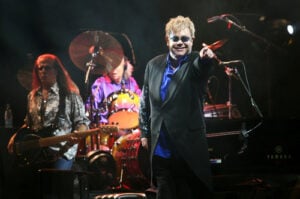
Feature Photo: Mazur Travel / Shutterstock.com
For those of us who grew up in the 1970s, whether you were in middle school, high school, or even college, most of us were huge Elton John fans. Of course, I can only speak for myself, but just about all my friends and everyone I knew loved Elton John. There really was no bigger artist in the 1970s than Elton John, with maybe the exception of Paul McCartney. I only say this because those of us who lived through that time know Elton John’s music inside and out. We lived that music; we bought every album that came out, listened to those records hundreds of times, and we continue to listen to it for the rest of our lives. I am still spinning Captain Fantastic and the Brown Dirt Cowboy on my turntable.
So the idea behind this article was to come up with 10 songs that would serve as a great introduction to Elton John’s music for younger listeners or for people who may not know his catalog very well. That is not an easy task, because Elton has, as we all know, written so much great music with Bernie Taupin. His style has also changed over the years, sometimes very quickly, even within a short span of time. This is not a list of the top ten Elton John songs. This is a list designed to showcase the range of his work and highlight many of the great things he has done, with the goal of getting people to dig deeper into his catalog and discover the music of one of the greatest songwriting partnerships of all time. I thought it would be more fun to put this list in chronological order, starting with his earlier work.
Another important part of this list is that we are intentionally avoiding the most well-known hits. There is a good chance that younger listeners have already heard many of those songs in passing, on the radio, in commercials, or somewhere in the background. That kind of familiarity can lessen their impact when you are introducing someone to an artist in a meaningful way. Instead, the goal here is to dig a little deeper into the catalog and bring forward songs that may not get that same level of exposure but are just as strong, if not stronger, in showing what makes Elton John and Bernie Taupin such a remarkable songwriting team. These are the songs that often get overlooked over time, and they are the ones that can really open the door for someone to discover the depth and quality of the music.
# 10 – Skyline Pigeon

If you’re trying to show a career perspective, it’s best to start out with something from the first album. This is definitely one of the most beautiful songs on Empty Sky. The live version that was later released on Here and There is also breathtaking. It was so good that they opened the live album with it.
“Skyline Pigeon” dates to the earliest days of Elton John and Bernie Taupin’s partnership. Written in 1968 and released on the 1969 album Empty Sky, the original recording has Elton singing and playing harpsichord and organ without a backing band. That sparse setting makes Bernie’s imagery of a bird longing for freedom feel especially personal. Elton has described it as one of the first songs the two of them wrote that truly excited them.
Elton revisited the song in 1972 with a piano-led arrangement, giving it an entirely different character. The performance that opens Here and There, released in 1976, was recorded at London’s Royal Festival Hall in 1974. Hearing the delicate early version and the later concert performance side by side is a great way to appreciate how his singing and piano playing developed during just a few years.
# 9 – Take Me to the Pilot

One of the points we want to establish early on is that Elton John was not just a brilliant songwriter but also a very underrated rock-and-roll pianist. Proof of that can be found very easily on the fantastic live album 11/17/70. This was a bit of a hit, but the piano playing is just so good that we wanted to showcase it.
“Take Me to the Pilot” appeared on Elton’s self-titled second album in 1970. Bernie Taupin wrote the lyrics, and Elton supplied the driving piano part that makes the song jump out of the speakers. The studio recording also features Caleb Quaye on electric guitar, a rhythm section, backing singers, and an unusual combination of guitar and arranged cellos. It shows how quickly Elton was moving beyond the stripped-down recordings of Empty Sky.
The version on 11/17/70, known as 17-11-70 in Britain, is an entirely different experience. Recorded during a November 17, 1970 radio performance at A&R Recording Studios in New York, it features only Elton on piano, Dee Murray on bass, and Nigel Olsson on drums. Without the studio orchestration, his piano becomes a lead instrument as much as an accompaniment. That three-piece sound is exactly why this song belongs on a list designed to introduce people to the full range of his talent.
# 8 – Come Down in Time

This is probably one of the most underrated Elton John songs of all time, and I don’t really know how it’s flown under the radar for so many years. But the real Elton John fans knew about it. The man had so many hits and was releasing music so quickly that stuff like this just kind of got lost. It’s from the brilliant album Tumbleweed Connection.
“Come Down in Time” was released on Tumbleweed Connection in 1970, an album that drew heavily on Bernie Taupin’s fascination with American imagery and storytelling. The song was produced by Gus Dudgeon, with a remarkable arrangement by Paul Buckmaster that includes harp and oboe. Skaila Kanga played the harp and Karl Jenkins played the oboe, giving the recording a delicate, almost chamber-music quality. It is one of the rare Elton John studio tracks on which his singing, rather than his piano, is the centerpiece.
The lyrics follow someone waiting for a romantic meeting that may never happen, and Buckmaster’s restrained arrangement seems to hold its breath along with the narrator. It was never one of the album’s big radio songs, but it offers a different side of Elton and Bernie than the energetic piano rockers that made them famous. There is a piano-demo version as well as an alternate jazz arrangement, making it fascinating to hear how this beautiful composition could have taken several different directions.
# 7 – Indian Sunset

With “Levon” and “Tiny Dancer,” and to some extent even the title track “Madman Across the Water,” becoming part of popular culture, I always thought the real gem on this album was the opener on side two, “Indian Sunset.” This one was pretty dramatic, especially with the line about Geronimo.
“Indian Sunset” appeared on Madman Across the Water in 1971. Written by Elton and Bernie Taupin, it uses the voice of a Native American narrator to tell a tragic, theatrical story about dispossession, war, and the destruction of a way of life. Paul Buckmaster’s dramatic orchestration and choral passages give the performance an almost cinematic scale, while Elton shifts from quiet reflection to explosive vocal passages. It is one of the most ambitious compositions in his early catalog.
The recording also includes a choir and an arrangement that moves through several contrasting musical sections rather than settling into a simple verse-and-chorus formula. The song reflects a fictionalized, early-1970s telling of history, rather than a literal historical account, but its emotional power is unmistakable. Elton continued performing it in concert over the decades, and a sample of his vocal later appeared in Tupac Shakur’s “Ghetto Gospel,” introducing a piece of this extraordinary recording to another generation.
# 6 – Mona Lisas and Mad Hatters
From an album that gave us “Rocket Man” and “Honky Cat,” as well as songs like “Hercules,” “Mellow,” “Slave,” and so many others, this was a transitional record for Elton John. It marked a shift from the country-Americana style he explored on Tumbleweed Connection and Madman Across the Water toward the pop sound that would soon make him one of the most successful artists of the decade. In between that Americana foundation and the pop breakthrough sits a song like this one. Just wonderful.
“Mona Lisas and Mad Hatters” was released on Honky Château in 1972, an album recorded at the Château d’Hérouville outside Paris. Bernie Taupin’s lyrics draw on his impressions of New York City and reference Ben E. King’s “Spanish Harlem,” giving the song a sense of wonder mixed with disappointment. Elton responds with one of his most restrained and moving melodies, allowing the story to develop without overwhelming it with a big rock arrangement.
The recording was not originally released as a commercial single, which helps explain why it can be overshadowed by the album’s hits. Yet it became a favorite with longtime fans, and Elton continued returning to it onstage. The song is proof that the partnership could be just as compelling when dealing with the loneliness and contradictions of city life as when delivering a chart-topping pop chorus.
# 5 – Blues for Baby And Me
This is one of the most hidden gems in Elton John’s catalog. At the time, Elton had so many hits that songs like this were just swept away from the radio or even the concert stage. Yet the hook and the chorus are just an epic story of beauty in love and the open road of hope.
“Blues for Baby and Me” appeared on the 1973 album Don’t Shoot Me I’m Only the Piano Player. It was written by Elton and Bernie Taupin and produced by Gus Dudgeon, with a string arrangement by Paul Buckmaster. Davey Johnstone contributed guitars and sitar, while Dee Murray and Nigel Olsson provided the bass and drums. The combination gives the song a warm, sweeping sound that matches its story of a couple hoping to escape together.
Bernie’s lyrics imagine a Greyhound bus waiting to carry the lovers away, one of many American images that turned up in his writing during this period. The melody keeps building toward that gorgeous chorus, and the string arrangement makes the hope in the story feel almost tangible. It may not have been one of the album’s radio singles, but for anyone interested in Elton’s gift for melodies, it is just as essential as many of the hits.
# 4 – Grey Seal
It’s hard to find a greater studio double album than this one. Hit after hit, opening with the epic “Funeral for a Friend/Love Lies Bleeding.” But I do remember that when I first bought this album, this was my favorite song. This was a deep track that was loved by many.
“Grey Seal” appeared on Goodbye Yellow Brick Road in 1973, the double album that also gave us “Candle in the Wind,” “Bennie and the Jets,” and its famous title track. The song is propelled by Elton’s bright, insistent piano, while Nigel Olsson’s drums, Dee Murray’s bass, and Davey Johnstone’s guitar give it an enormous amount of energy. It is one of those album tracks that sounds like it could have been a single without losing any of its personality.
What is especially interesting is that Elton had already recorded an earlier version in 1970, released as the B-side of “Rock and Roll Madonna.” The 1973 remake feels bigger, sharper, and much more like the sound of his classic touring band. Listening to both recordings is another great way to hear the development of the Elton John sound, and it explains why this song made such a strong impression on those of us who bought Goodbye Yellow Brick Road when it first came out.
# 3 – Ticking
I’m not sure that in this world, where younger people scroll through TikTok after watching a video for two seconds and then move on, they will have the patience to listen to a song like this. But if they do, they will hear one of the saddest works of art ever written. This is one that really blew away Elton John fans who know his records inside and out. I think Caribou is one of his greatest albums. It had some big hits on it, but I always loved the deep tracks, songs like “I’ve Seen the Saucers,” “Grimsby,” and “You’re So Static.” What a great record this was.
“Ticking” closes Caribou, Elton’s 1974 album recorded at Caribou Ranch in Colorado. Written by Elton and Bernie, the song tells the disturbing story of a young man whose life ends in violence. Rather than filling the track with a big rock arrangement, Elton sings and plays piano with an almost frightening sense of restraint. The recording also features synthesizer textures, but it is largely carried by the piano and the story.
One of the most remarkable details about the session is that Elton recorded his lead vocal live with the piano, something he rarely did on his studio albums. The performance unfolds over more than seven minutes, slowly building tension as the details of the tragedy emerge. “Ticking” is not an easy song to hear, and it certainly was not designed for casual radio listening. That is precisely why it makes such a powerful introduction to the darker, more challenging side of Elton and Bernie’s work.
# 2 – Tower of Babel
If there’s one Elton John album from the 1970s that stands out as not being driven by hits, even though it did have a big one with “Someone Saved My Life Tonight,” it’s the sensational Captain Fantastic and the Brown Dirt Cowboy. This is the Elton John album that I have put on my turntable more than any other, and I’m not alone. It’s probably the best-sounding studio record I’ve ever heard, especially the drum sound that Nigel Olsson delivers on this album. There’s a moment in this track, right at the start of the chorus, when Nigel breaks through that will make your jaw drop, and anyone hearing it for the first time will feel the same way. There’s a big reason why this is the second track on side one.
“Tower of Babel” is the second track on Captain Fantastic and the Brown Dirt Cowboy, released in 1975. The album was a concept record looking back at the early struggles of Elton John and Bernie Taupin before they became stars. Recorded at Caribou Ranch and produced by Gus Dudgeon, it features the classic band with Nigel Olsson on drums, Dee Murray on bass, and Davey Johnstone on guitar. The hard-driving arrangement and those tremendous drum fills make it one of the album’s most exciting tracks.
The song’s lyrics use images of excess and corruption, while the music pushes forward with the kind of confidence that came from a band playing at its peak. Captain Fantastic became the first album to debut at number one on the American Billboard album chart, but “Tower of Babel” was never one of its familiar radio hits. The entire album was performed at Wembley Stadium in 1975, and a live recording of the song has since been issued. For someone discovering this record for the first time, it is a perfect example of how much great material was hiding beyond the singles.
# 1 – Tonight
I would argue that Blue Moves is Elton John’s most underrated album. It’s also the last great Elton John album of the 1970s and the last great Elton John album until he released Songs from the West Coast in 2001. But it’s this song, this epic, heartbreaking, sensationally orchestrated piece, that hits you the hardest. This is probably as dramatic as he has ever gotten, and it stands as one of the most beautifully orchestrated pieces of pop music ever written. You have the London Symphony Orchestra performing on this track, and the fact that it wasn’t written about more, played more on the radio, or more widely known just baffles me. It’s sheer beauty and sadness all at the same time. That’s what life is about, captured perfectly in this stunning recording.
“Tonight” appeared on Blue Moves in 1976, the second double studio album of Elton’s career. The track runs close to eight minutes and features Elton on piano and vocals with the London Symphony Orchestra conducted by James Newton Howard, who also arranged the strings. Produced by Gus Dudgeon, the recording begins with a long orchestral passage before Elton enters, almost as though the song were a movement from a larger classical work rather than a pop ballad.
Bernie Taupin’s lyrics describe a couple trapped in another painful argument, and the orchestration gives that intimate conflict an enormous emotional weight. The piano and strings rise and fall around Elton’s vocal, never rushing the listener toward an easy resolution. Blue Moves also contained the hit “Sorry Seems to Be the Hardest Word,” but this is the recording I would play for someone who thinks they already understand everything Elton John could do. It is a magnificent way to end a journey through the less familiar side of his 1970s catalog.
Check out more Elton John articles on ClassicRockHistory.com Just click on any of the links below……
Top 10 Most Underrated Elton John Songs
A Look At Elton John’s Christmas Songs
Top 10 Elton John Album Covers
10 Best Non-Album Track Elton John B Sides
Top 10 Elton John Non-Album Singles
Elton John Discography and Retrospective
Why Elton John’s Captain Fantastic Album Was So Great
Why Elton John’s Honky Château Was A Turning Point
Elton John’s Beautiful “Cage The Songbird,” Featured Crosby & Nash
Elton John’s “White Lady White Powder,” Featured The Eagles (Classic Rock Gems Series)
Elton John’s Retirement Seems Genuine This Time
Why Elton John’s Looking Up is His Best Single in Years
Elton John’s mesmerizing performance of Tiny Dancer in 1971
Elton John Releases New Documentary On Lockdown Sessions
Elton John & Ed Sheeran Hit # 1 with ‘Merry Christmas’ Single
Why Elton John’s Don’t Shoot Me I’m Only the Piano Player Was One Of His Most Melodic LPs
Elton John’s Honky Château Album Gets Deluxe 50th Anniversary Reissue
Why There Were Many Overlooked Gems On Elton John’s Caribou LP
Read More: Artists’ Interviews Directory At ClassicRockHistory.com
Read More: Classic Rock Bands List And Directory
Updated November 8, 2026
10 Songs That Introduce Elton John Beyond The Hits article published on ClassicRockHistory.com © 2026